
Defense continues to be the name of the game in the draft for the forever-ith year in a row for the Bengals.
The Bengals have selected defensive players with 10 picks against just three offensive players in the first three rounds of the last four drafts.
That trend comes into focus again, as nobody would be surprised by a clean sweep for defensive coordinator Al Golden in the first two days.
A free agency period that left positional boxes unchecked means the Bengals aren’t just in need of playmakers to fill out depth, but defenders counted on to arrive and contribute — if not start — immediately.
Free agency moved cornerback to the top of the positional needs chart. The group is thin in both the short and long term, with nothing guaranteed beyond DJ Turner and Dax Hill forming an outstanding tandem for 2026 while negotiating extensions this summer in the last year of their rookie deals.
The Bengals will still be seeking pass rushers after signing Boye Mafe and Jonathan Allen in free agency, but the addition of a combo linebacker capable of bringing aggressiveness off the edge also sits near the top of the needs list.
The rest would be classified as more luxury and depth picks, with the other major starting roles accounted for in 2026.
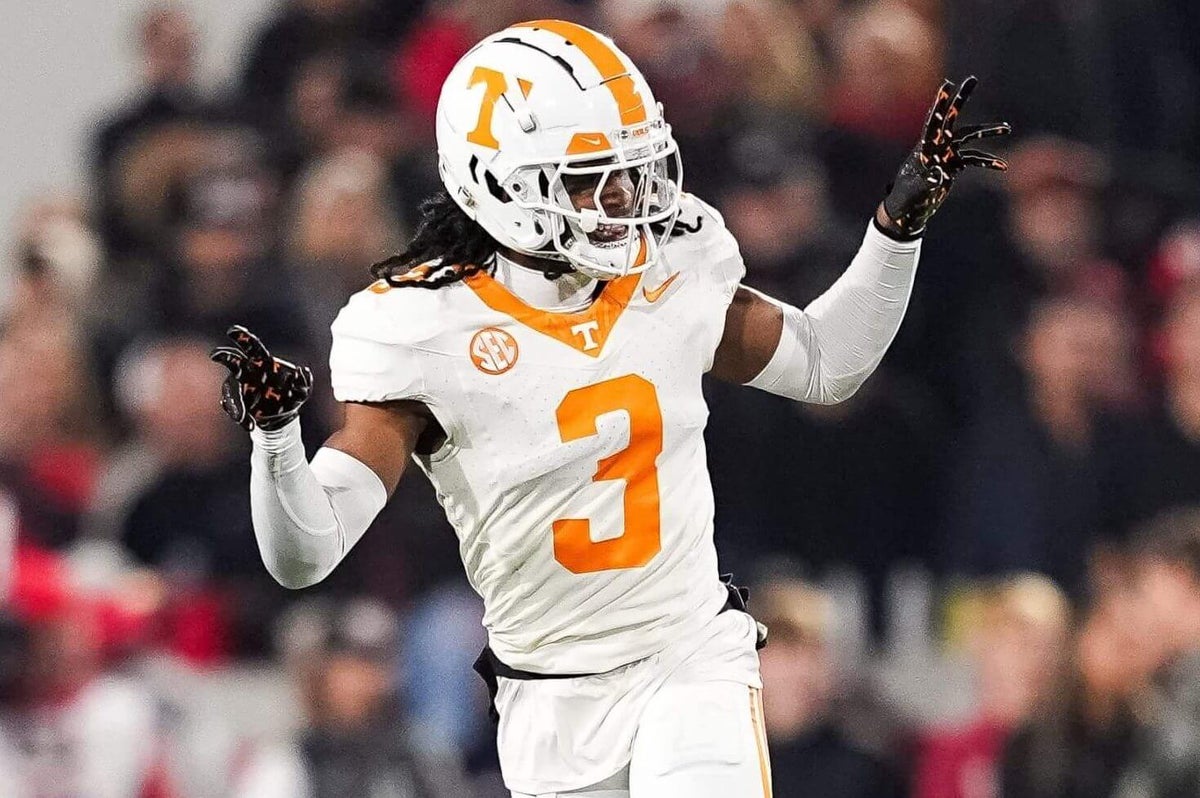
First round (No. 10): Jermod McCoy, CB, Tennessee
This might come as a surprise to see this name at No. 10, but he ended up the best player available for the Bengals in The Athletic beat writer mock draft (which comes out in full on Thursday). Many of the big names typically associated with the Bengals were gone, leaving the top two cornerbacks in this draft atop the big board: McCoy and LSU’s Mansoor Delane.
The McCoy pick comes under the assumption that he tests well at his pro day on March 31 and looks fully recovered from the ACL tear suffered in January 2025. That will be an important moment in assessing options at No. 10 because cornerback might be the most likely position at this point, unless one of the big names (Rueben Bain Jr., Caleb Downs, Sonny Styles) slips down the board.
As for McCoy, going off his 2024 tape, he shows the foundation of a top-tier corner all day. Delane would be an understandable pick here, but the ballhawking trait displayed by McCoy breaks the tie for me. The Bengals’ defensive staff has always prioritized that specific skill in cornerback evaluation. He posted six interceptions and 16 passes defensed in 25 games between Oregon State and Tennessee and was originally recruited as a wide receiver. That skill is not as notable in Delane’s profile despite being more consistent across the board as an overall prospect.
There’s undeniably a projection and medical consideration here, but if McCoy’s ultimate upside is considered higher than Delane’s, I could absolutely see the Bengals going that route. Three times in a six-year period last decade, they took a cornerback with multiple starters established (2012 Dre Kirkpatrick, 2014 Darqueze Dennard, 2016 William Jackson III) and there is essentially no depth at outside corner right now. Having Turner and Hill would reduce the pressure for McCoy to learn from existing starters and ease into the rotation with the possibility of being a No. 1 corner before long. Also, Hill could bump back inside to get the best three on the field. This would be a pick with an eye on winning in December and January as well as becoming a turnover-producing No. 1 corner into the foreseeable future.
Second round (No. 41): Anthony Hill Jr., LB, Texas
Are the Bengals really about to do the rookie linebacker thing again? Maybe. Barrett Carter and Demetrius Knight need support and the entire group requires a talent upgrade that never came in free agency. Cincinnati loves top players from blueblood programs, and Hill made plays as a centerpiece of the Longhorns defense since the moment he stepped on campus. He racked up 31.5 TFLs, 17 sacks and eight forced fumbles in three seasons. His 9.83 Relative Athletic Score was second at the position group, only to Sonny Styles (9.99).
Also, Hill brings excitement as a blitzer, an element the Bengals didn’t possess with Knight and Carter last year. As concerning as playing a rookie linebacker again would be and as much as it could add instability to an already unstable room, Hill also brings the chops to fix the position for good in ways Knight and Carter did not last year.
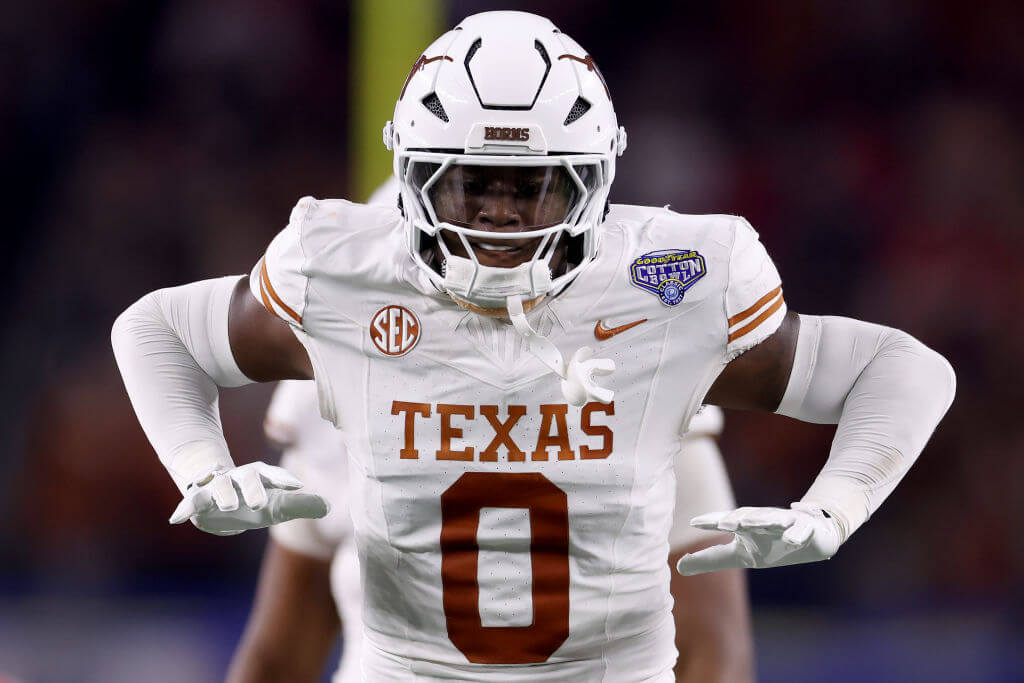
Anthony Hill Jr. would add to a young linebacker corps for the Bengals. (Sam Hodde / Getty Images)
Third round (No. 72): Caleb Tiernan, OT, Northwestern
This marks the second time I’ve mocked Tiernan to the Bengals. Despite the extension for Orlando Brown Jr., the lack of a true swing tackle beyond whatever Cody Ford offers at this point stands out. Tiernan will need time to develop, but at 6-8, 324 pounds, he would fit right in with the Bengals tackles, who could help him learn how to use his size.
He’s a team captain who played both spots for Northwestern and could offer positional flexibility to work inside as a useful player as well. He reminds me of Ozzy Trapilo, a 6-foot-8 rookie who began the year as a backup, but started six games for the Bears last year after being selected at No. 56.
There are many different directions the Bengals could go here, but the lack of depth behind the starting tackles feels like such a significant need. It’s hard to imagine they would pass on an addition barring a veteran signing in free agency.
Fourth round (No. 110): Landon Robinson, DT, Navy
De facto GM Duke Tobin likes to mention his reluctance to give away fourth-round picks because they could be Geno Atkins. That stood out when considering the powerful, but undersized, defensive tackle Robinson. He’s 5-11, 293 pounds, but he tested at an elite level (9.41 RAS) after a productive career for the Midshipmen. He was the American Athletic Conference Defensive Player of the Year and racked up 14.5 sacks with 18.5 tackles for loss in his three seasons.
Sixth round (No. 189): Jeff Caldwell, WR, Cincinnati
One of the stars of the combine, Caldwell tested at an absurd level, posting a 4.31 40, 42-inch vertical and 11-foot-2 broad jump. Caldwell caught six touchdown passes out of his 32 receptions for the Bearcats and served as an explosive deep-play threat. It would be easy to envision a future weapon for Joe Burrow to attack in one-on-one situations, trying to find explosives.
He’s raw and will need work to reach desired levels as a route runner and in contested catch situations, which is why he’d be available in this round, but wide receivers coach Troy Walters could have fun over the next year trying to develop one of the best athletes in the class just as he did with Andrei Iosivas in the sixth round three years ago.
Sixth round (No. 199): Matthew Hibner, TE, SMU
The Bengals would be foolish not to take advantage of the extreme depth at tight end in this draft. They need to consider the future with Drew Sample entering the final year of his contract, Erick All’s health uncertain and Mike Gesicki over 30. Pick any tight end you’d like here, where there is an abundance of useful players like Hibner, who brings tenacity as a blocker and vertical-threat athleticism.
Seventh round (No. 221): Jaeden Roberts, G, Alabama
Roberts graded as one of the better pass-protecting guards in this class. That usually projects to be worth a shot even if the rest of the tape isn’t fantastic. The type of skill you bet on and develop the rest at this level of the draft.
Seventh round (No. 226): Athan Kaliakmanis, QB, Rutgers
The Bengals have been poking around Kaliakmanis and even plan on bringing him in for a visit. That typically suggests building a relationship to land a player as an undrafted free agent, but they could use one of their seventh-round picks to ensure they get him. He threw for 3,124 yards with 20 touchdowns and seven interceptions last season for the Scarlet Knights and started 42 games over the course of his career. They’ll be looking for the next quarterback they hope could develop into a long-term backup.