
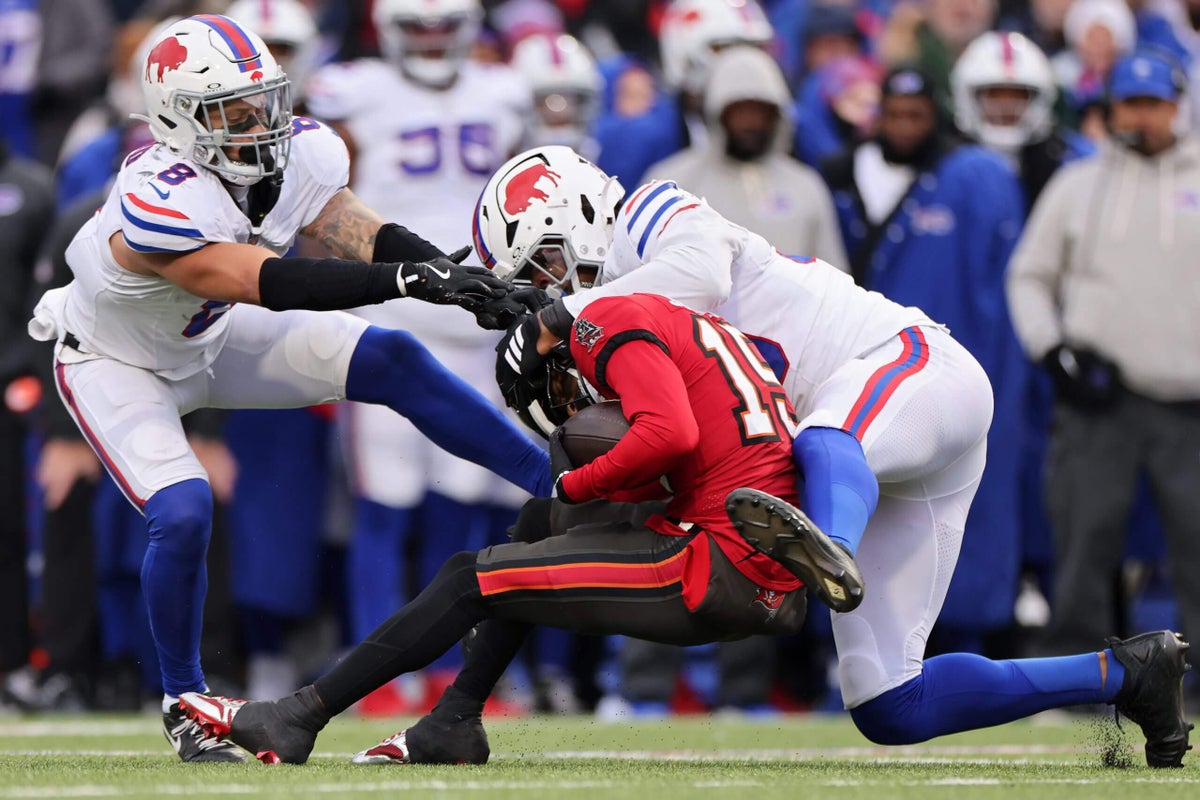
The Buffalo Bills might not have made a massive move this offseason, but they added several key players to address roster flaws. As always, free agency, and in this year’s case, the pre-free-agency trade market, is always just the first half of the roster-building process in an offseason.
With free agency now in the past, it’s time to recalibrate for the 2026 NFL Draft. How have the Bills’ potential priorities shifted for the 2026 NFL Draft after adding all the pieces they have over the last two weeks?
After reviewing their roster and how they’ve operated in the past, here are how their needs potentially stack up for the remainder of the offseason.
BEAT OUR EXPERTS
Predict how you think the tournament will
play out. Can you beat one of our experts?
Edge rusher/outside linebacker
Though yes, the Bills signed an edge rusher better suited to the scheme coming with new defensive coordinator Jim Leonhard, the room still feels one player short. Bradley Chubb will be a starter for them in 2026 under a contract that is effectively a two-year commitment, and he’ll be an important piece given his years of experience as an outside linebacker. Michael Hoecht is coming off a torn Achilles tendon, and it remains to be seen how effective he’ll be in his first year after the injury. They can use Greg Rousseau as an edge rusher in some situations, too.
Brandon Beane said Rousseau’s role on defense will ultimately be determined by who they add during the offseason. Rousseau could wind up having a bevy of roles that align with his skills, whether it be as an outside linebacker, an odd-man front defensive end, or, when the Bills use an even-man front on some snaps, an edge rusher. The Bills are better stocked along the defensive line for the present and future, with Rousseau, Ed Oliver, Deone Walker and T.J. Sanders, which brings us back to the importance of finding another edge-rushing outside linebacker.
If there’s one thing the Bills’ defense lacks, it’s an explosive edge rusher who can win with speed and natural bend around the edge. Taking someone at that position with those skills allows them to have an extremely versatile defensive front and sets them up to have a long-term starter, as Chubb (turns 30 in June) might only be a short-term solution. That, along with all the talent and depth at edge rusher in this year’s draft class, makes for an ideal scenario for the Bills to add one, potentially with their top pick.
Inside linebacker
The Bills, somewhat surprisingly, have yet to make a single move at inside linebacker this offseason. The two projected starters each have a question mark attached to them. Terrel Bernard, whom they signed to a long-term deal last offseason, had some injuries and struggled in 2025. There is also some wonder whether he is a precise fit for this scheme, considering he’s undersized and has shown some difficulties getting off blocks. Dorian Williams is the other projected starter, though he is going into the final year of his rookie deal and has never been given the keys as a full-time starter before in his career. The Bills’ depth at inside linebacker is also lacking. They have Joe Andreessen, who has mostly been a special teams player, and past him, a pair of practice squad players from 2025 in Keonta Jenkins and Jimmy Ciarlo.
At the very least, depth is needed at inside linebacker. However, with those key questions about both starters and their long-term outlook in Buffalo, it’s worth wondering whether the Bills might want to bring someone who can develop into a starter, either immediately in 2026 or beyond. A first-round pick on an inside linebacker could be a little rich, but it’s not out of the question. A mid-round pick on one could be a likelier outcome.
Wide receiver
The Bills added DJ Moore via trade, but given how the last two years have gone at wide receiver in Buffalo, you can never rule out another addition of consequence. Right now, the top four are Moore, Khalil Shakir, Keon Coleman and Joshua Palmer. Tyrell Shavers suffered a torn ACL in January, casting doubt on his 2026 availability. The team also has Mecole Hardman, Stephen Gosnell and Jalen Virgil, though none of them will prevent the Bills from making another move. The Bills are likely hopeful that Coleman or Palmer can become a trustworthy No. 3 wide receiver this season and are leaving the light on for both.
The most likely outcome is the Bills add another veteran receiver to round out the group as their No. 5 wide receiver — at least before the season begins. With the Bills using a second-round pick to add Moore and this year’s wide receivers class not being strong, they could be pushed to use their first- and third-round picks at other positions. A Day 3 selection at receiver could be a more likely scenario. However, if the right player gets to them at No. 26, never say never.
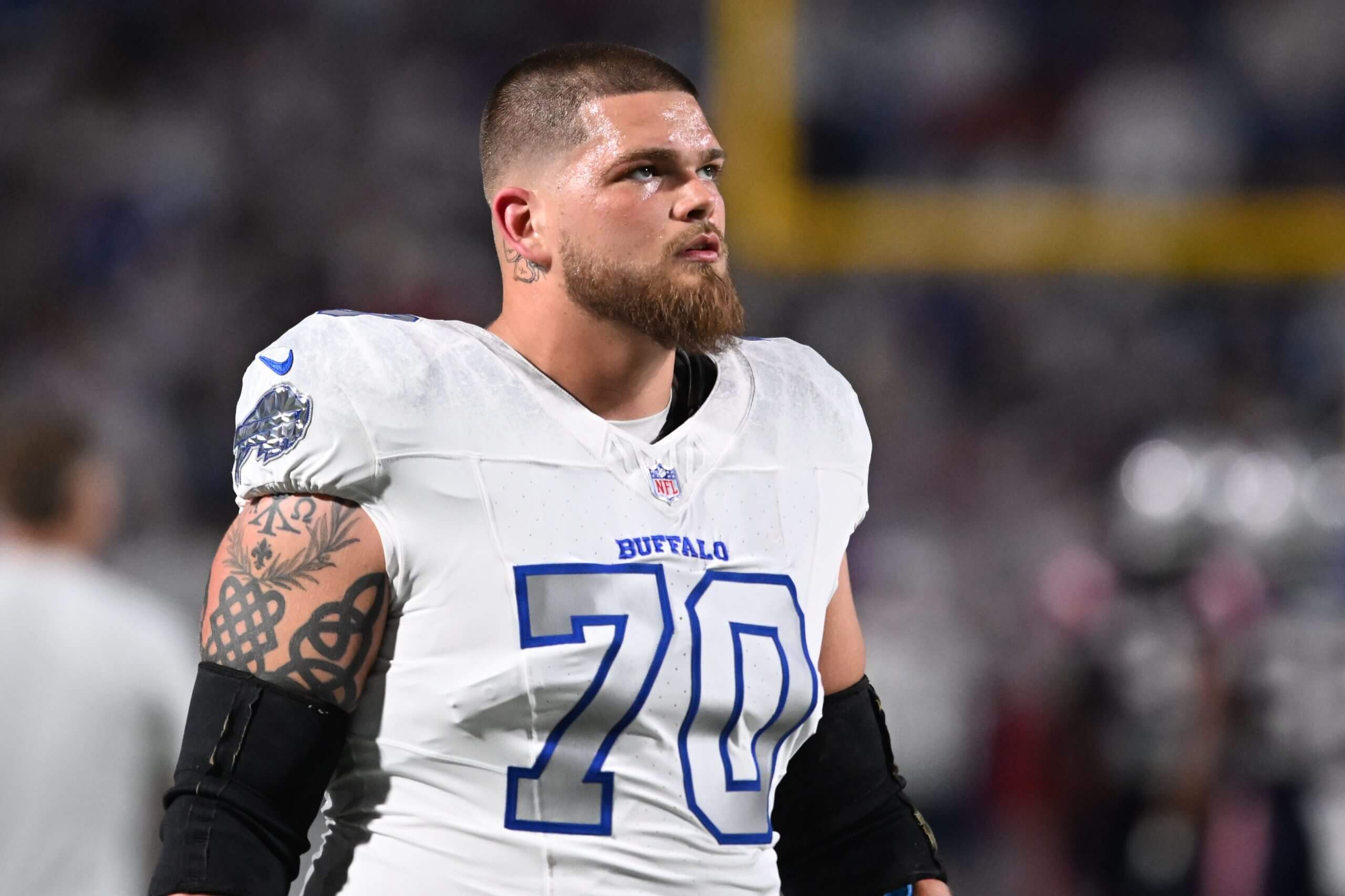
Alec Anderson could be the next full-time starter at left guard. (Mark Konezny / Imagn Images)
Left guard
The Bills prioritized wide receiver, edge rusher and center ahead of left guard this offseason as they watched left guard David Edwards head to the New Orleans Saints in free agency. That leaves them with a potential hole at left guard and, as of now, they have only in-house options from 2025 to consider for the job, though all of them have never had extended playing time other than a spot start or some garbage-time duty. Alec Anderson is the leader in the clubhouse as of now, with the most experience at guard of all the names. Anderson, however, is on only a one-year deal. Sedrick Van Pran-Granger has drawn some praise, though they really used him only at center throughout the 2025 season, leading to some concern about whether he can be the answer at guard. Tylan Grable is a tackle first who has cross-trained at guard before, though he missed most of last season on injured reserve.
The Bills have kept 10 offensive linemen on the roster in the past, so adding a guard is definitely doable. The team might prefer to go for a player with more starting experience for 2026. This could be one of those spots they address right after the draft with a free agent. However, guard is one of those positions at which teams can find an immediate starter with a mid-round pick, so if the right player is on the board, the Bills could go for it.
Defensive line depth
The Bills could go in a couple of directions here. They’ve got a good base of potential starters in Rousseau, Oliver, Walker and Sanders. They also have another layer of usable players in DeWayne Carter and Phidarian Mathis, depending on what they do the rest of the offseason. Adding another rotational odd-man front defensive end is certainly a possibility, given Carter might not be a good fit for the new defensive scheme on top of sitting out all last year with a torn Achilles. Carter could be a late summer trade candidate. Another route they could take is to add another nose tackle, allowing Walker to move around the defensive line a bit more to take advantage of his varied skills. Both spots will be definite draft considerations, most likely on Day 3.
Boundary cornerback
The Bills have yet to add a third cornerback to serve as the primary backup to Christian Benford and Maxwell Hairston. They’ll need to do that, either with an experienced veteran or with a draft pick — but they might just add to the position with both of those options. They have high hopes for Hairston as the team’s 2025 first-round pick, but he’s far from a guarantee after an up-and-down rookie season. Some veteran insurance would be good. On top of that, there is still no word on the playing status of 2025 sixth-round pick Dorian Strong after he suffered a season-ending neck injury last year. That could facilitate a late-round pick to round out the group. Even with Strong, the Bills need to add one.
Quarterback
The team added 2023 backup Kyle Allen to the roster, but the door remains wide open for it to use a Day 3 selection on a quarterback for the first time since Jake Fromm (fifth round, 2020). If the Bills can find a long-term, cost-controlled backup on a rookie deal over the next four years, that would give them additional flexibility and a potential trade chip if the quarterback is good enough. Even when they have a star quarterback, it is never a bad idea to take a shot on one later in the draft in the event they find some gold.
Safety
The Bills seem to have filled out their safeties group with the additions of C.J. Gardner-Johnson and Geno Stone, along with starter Cole Bishop and backup Jordan Hancock. The only thing it lacks is a defined long-term plan at starter next to Bishop if they don’t see Hancock in that light. It also depends on whether the Bills see Hancock as a nickel or a safety in Leonhard’s scheme. If they think he’s a nickel, it could justify a pick at safety at some point, canceling out the potential draft need at nickel.
Nickel
The Bills signed Dee Alford in what is likely a two-year commitment, but their depth at the position needs a boost. Some of it depends on their vision for Hancock in the defense. If he’s a safety in their eyes, a Day 3 selection on a nickel could easily be a consideration to help their depth and special teams operations.