
The boy who had “I will go pro” scrawled in blue marker on a piece of paper taped to his bedroom wall his entire childhood was waking up, seatbelt still secure, feeling a pain in his right side. His Audi Q5 had rolled over, off the side of a highway in rural Oregon, near the small town of Lakeview. When the SUV had skidded to a stop on its side, he unbuckled his seatbelt and climbed out through the sunroof, which he’d opened to keep himself awake.
Ernest Hausmann then saw bright headlights aimed at him. The local sheriff’s department and EMTs were on the scene, responding to the car’s automatic emergency system.
 Add us as a preferred source on GoogleFollow
The 22-year-old linebacker, already well below his playing weight, was four weeks removed from the last football game he thought he’d ever play—a 24–22 win over Northwestern at Wrigley Field. He was on his way to enlisting in the Air National Guard, less than 100 miles from the base he was planning to report to in Klamath Falls. He had no driver’s license or credit cards on him. His cell phone was thrown out the window 2,000 miles ago.
He was, in the estimation of most people around him, lost. His disappearance from the Michigan football program at the end of the season was a curiosity for the rest of the Wolverine-watching public, never fully explained after he missed a win over Maryland and a loss to Ohio State to finish the regular season. But in his mind, he was on his way to do bigger things than anyone could imagine—he just had to figure out how to get there.
Little did he know that day, he was on a winding path that would eventually lead him back to the football field.
This Friday, a little more than three months after the crash, Hausmann will return to Schembechler Hall, to resume his pursuit of the dream that 8-year-old in Nebraska posted on his bedroom wall. He’ll be on the field in Ann Arbor for Michigan’s pro day with teammates he hasn’t spoken to since leaving the team in November.
Most importantly, he’ll do it now healthy in mind and body. Hausmann’s tumultuous, chaotic few months ended with a specific conclusion: He suffers from, and has always carried with him, bipolar disorder. He’s one of an estimated 5.7 million adults in the United States, according to the Cleveland Clinic’s website, with the condition. So, yes, Friday is about starting his NFL journey and telling his story to NFL teams. But it’s more than just that. It’s also where he intends to start helping others.
“Too many to count. Too many to count,” Hausmann said, when asked how many people he thinks are out there who need the help he ultimately found. “I believe that there are so many things that people struggle to talk about. Like when I was in high school—you didn’t even know you’re manic. I didn’t know anything about depression. But if this even helps one person, I’ll be happy with this all.”
He’d hoped that night, before the crash, the road he was traveling would bring him closer to finding his way to do that. That hope, in the aftermath, may be more alive than ever before, albeit in a very different way.

The note Ernest Hausmann hung in his bedroom at age 8. | Courtesy: Hausmann family
Bipolar disorder can sit dormant in people for years before it’s diagnosed, often manifesting in manic bouts in a person’s teens or 20s.
“People with bipolar disorder will frequently experience depression first,” says Dr. Andrew Nierenberg, a professor at Harvard Medical School and the director of the Dauten Family Center for Bipolar Treatment Innovation. “And then can have their first manic episode in their 20s.”
Indeed, Hausmann did. But the diagnosis he’d wind up getting this past December was hardly the first major challenge he’d faced in his 22 years—those started for the native Ugandan at birth.
Born to parents diagnosed with AIDS, and one of 23 children, the parts of Ernest’s life from before he can remember were spent in real poverty. When he was 2, the Hausmann family, an American couple located some 7,500 miles away in middle America, was embarking on an admirable quest. Bob and Teresa Hausmann had met Ernest’s biological uncle, who had immigrated to the States on a religious visa and was a minister in their town of Columbus, Neb. The uncle explained the situation to them. Bob and Teresa Hausmann looked at each other: Are you thinking what I’m thinking?
They’d talked about adding more children to their family and this seemed like the perfect way to do it.
Ernest was the youngest of the 23 siblings. What the Hausmanns didn’t know at the time was how hard the adoption would be to complete. Bob was told they would be just the second American family to adopt a child from Uganda, largely because the adoption laws of the countries don’t mesh. They saw that firsthand over the two years it took to get Ernest—at one point involving members of Congress in their effort—before finally bringing him home to Nebraska when he was 5.
Football became a bonding experience for Ernest and Bob. Because of a faulty penicillin shot he got to the hip before leaving Uganda, when his birth mother thought he had a cold, Ernest barely had use of one of his legs when he arrived in the United States. So he couldn’t play right away—but he could watch. “The first question I asked [Bob],” Ernest says, “was, How do I get on TV?”
As the leg improved, Bob threw his adopted son, about a decade younger than the Hausmanns’ biological daughters, into everything. Ernest’s determination immediately stuck out. His first year of soccer, playing on the hobbled leg, he scored six goals in a game. By the time he was 7, he was asked to play on a travel soccer team, then started for the team right away. He played club baseball at 8. That’s when the “I will go pro” sign went up in his bedroom.
“He had the drive,” says Bob, who played quarterback at Division II Kearney State [now the University of Nebraska Kearney], and coached high school football for 11 years. “Once he healed up, there was no doubt he’d be good at something. And probably everything.”
That premonition was prescient. He picked up football at 9, in fourth grade. By middle school, he asked his dad which sport he’d go Division I in. By high school, he was a star in both football and basketball, and driven to make it in something.
That’s also, as Ernest sees it, when the depressive side of his bipolar disorder started to surface.
When he was in eighth grade, wanting a bigger bedroom, he moved from the main floor of the Hausmann house to the second floor. Growing into a creature of routine, Ernest would work out in the morning, go to school, go to practice and then sequester himself in his room.
“I didn’t realize that isolation really was depression,” he says. “I didn’t really know that that was really the word for it until I didn’t want to be with people. I just didn’t want to talk to people at all.”

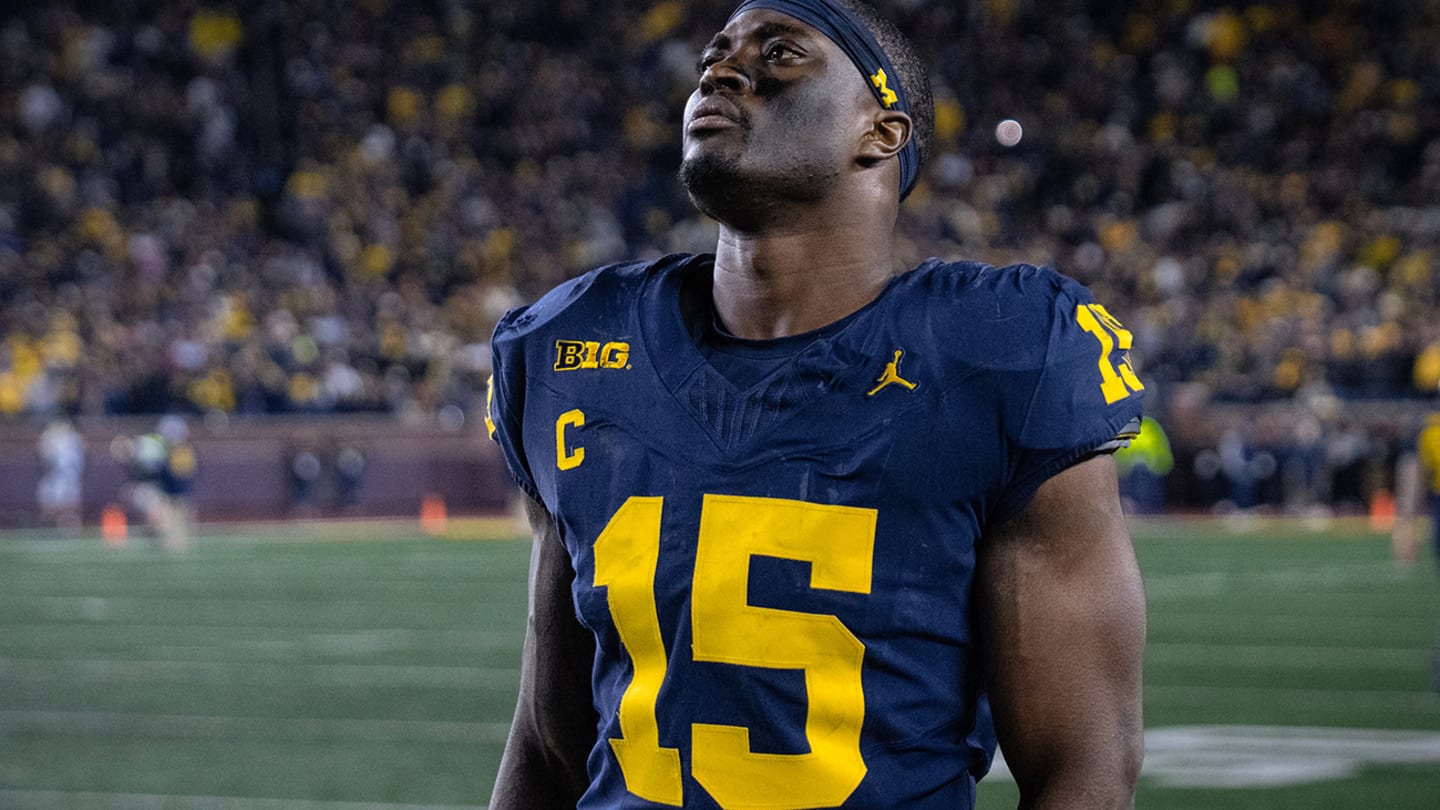
As a team captain, Hausmann represented Michigan at Big Ten Football Media Day. | Courtesy: University of Michigan Athletics
Hausmann didn’t just make it to Division I football—he was a star almost right away, becoming the fifth true freshman to start a game at linebacker at Nebraska in 30 years, and finishing 2022 with 54 tackles in seven starts. While in Lincoln, he also started to get a handle on his mental health, going to the team psychologist after he’d noticed how much more outgoing his teammates were than the kid who’d spent so much time in that upstairs bedroom.
Nebraska fired head coach Scott Frost after three games that year, and Hausmann entered the transfer portal after the season, looking for a place that would help him, in his words, “maximize my potential.” Michigan, on the precipice of its first national title in 26 years, was that fit.
Hausmann proved himself worthy on the field quickly—building a bond with linebackers coach Chris Partridge, who rotated him in at both inside linebacker positions, behind veterans Junior Colson and Mike Barrett, comfortable that he was smart enough to man multiple spots. Off the field, there weren’t outward signs of trouble, but he’d withdrawn a bit on getting the help he needed, working with a counselor whom he started to use more as a sport psychology resource than for mental health reasons.
“He was a worker. A great teammate. He put the time in and he was always going to help the guys around him—he had a natural ability to coach those around him,” says Partridge, who’s now in the NFL with the Seahawks. “He just sees things the right way. Understanding what everyone around him is doing is a real strength of his. He could run the defense.”
The Wolverines won it all, head coach Jim Harbaugh left for the Chargers—as did most of the defensive staff—and in 2024, Hausmann settled in as a starter, leading the team with 89 tackles and making All–Big Ten honorable mention, setting him up for a big final season and the realization of his NFL dream.
But the real turning point came in early November of that year.
Local philanthropist Mike Owens first got in touch with Bob and Teresa Hausmann as they were navigating the arduous adoption process, hearing they were working to take in a Ugandan boy. Owens knew how difficult that would be and asked if he could meet with them, intrigued and touched by what the Hausmanns were doing. They grew close, and Owens wound up becoming Ernest’s godfather—and now sits on the board of the One Million Wells charity, which works to provide clean water for some of the most impoverished communities in the world.
Owens accompanied them to the Oregon-Michigan game on Nov. 2, and on that trip told Bob and Teresa that he was planning a trip to Uganda for March 2025. He suggested they come, and that it could be Ernest’s first trip back to his native land.
Ernest had warmed to the idea over the years, but it took time. When he was 8, Teresa wanted to celebrate Ernest’s third “Gotcha Day” (the anniversary of a family taking in an adopted kid) by showing him a video of their first meeting in Uganda. Ernest burst into tears, unprepared to deal with the visual. By high school, though, he’d started to grow curious about going back. The opportunity Owens presented was appealing.
Teresa approached Ernest about the idea days later. He balked, saying he wasn’t ready. His older sister, Molly, the older of the two Hausmann girls, pushed him to go. “This is really something you should do,” she said. Hausmann then started talking to Owens about going, with Owens having his trip planned for the week that Michigan was on spring break.

Returning to Uganada has become an important part of Ernest Hausmann’s life. Here, he and his grandma pump clean water after the completion of a well. | Courtesy: Ernest Hausmann
Part of the reason for Hausmann’s arrival in America in the first place was the belief that his birth parents, in the throes of AIDS, wouldn’t make it, leaving their youngest kids in the most dire straits. But as Hausmann became a star at Columbus High, Bob and Teresa got updates from Africa that his father and mother, Paul and Olive, were still alive, and had taken the AIDS vaccine.
It made Ernest ask a million obvious questions of himself, and them, before he could talk to or meet them—and added complexity to the idea of traveling back to Uganda.
Part of the trip would be to dig wells with Owens’s nonprofit. Another part would be to, finally, meet his family. And then, there were things he’d see that almost immediately he knew he’d never be able to unsee, poverty simply on a different level than what anyone experiences in the United States. Guilt set in.
Why was he the one who got to escape all this, as his mother, father and siblings suffered?
“You hear about the guilt aspect, but to feel it, it’s two different things,” Hausmann says. “And, unfortunately, when I felt it, I didn’t understand what it was going to do to me.”
During his first week there, last March, he built a well 20 feet away from his parents’ home. It wasn’t easy. When one method for digging didn’t work, because of the terrain, they had to adjust. He had to personally make sure the crew they hired did what they were paid to do, with terms changing as they went—giving Hausmann insight into corruption in Uganda.
He was shaken. He was also consumed by what he was experiencing. He kept asking himself, Why is it so difficult for a simple resource to be created? And so it began.
“The obsession with helping people back home,” he says. “And I’m not saying that it’s a bad thing—but it’s what got me into trouble with my mental health.”
The next chance he got, after Michigan wrapped spring practice, he was on a plane back.
The result of the second trip was a heightened urgency to do more to help. He started his own foundation, which Owens helped him launch. He planned construction on a new home for his birth parents and siblings with his NIL money. Meanwhile, an escalating perception of his ability to effect change in his homeland grew. He no longer wanted to fix one problem. He wanted to fix everything.
He didn’t know it at the time, but his bipolar disorder was beginning to manifest.
Last summer, he was preparing for his final season at Michigan, training with teammates, going to classes to inch closer to graduation, starting his foundation and overseeing the build of the new family home in Uganda. By his own admission now, “I forgot that I still have to take care of myself.” Which was easy, because on the surface, things seemed incredible.
ESPN and CBS were coming to tell his story. He was elected a captain at the end of fall camp, “an unbelievable honor,” he says. “One of the greatest things I’ve ever accomplished.”
The leadership Partridge had seen in him two years earlier, when Harbaugh had him address the team before playing against Nebraska, was coming to life. That night, Hausmann used his favorite superhero, Batman, as an example, as the crusader who only came out at night when he was needed most, to explain how guys play for each other—and he felt like the group responded by playing for him against his former team. “It was special,” he says.
But there was another Batman reference more poignant for the time. On his shin, Hausmann has a tattoo of Bane, the villain from The Dark Knight Rises, with the quote, “No one cared who I was until I put on the mask.”
Football had become his mask, his ability to suppress everything in his head and just go, giving everyone the impression he was O.K.
Then, what Hausmann hoped would be his dream season arrived, and everything came undone. In Week 2, the Wolverines lost to Oklahoma and Hausmann got banged up, to the point that it started to affect his sleep. He played through it. He was trying to lead the team. He was still trying to manage things in Uganda.
Experts on bipolar disorder maintain that those who suffer from it make things worse when they fall out of structure—with their sleep, with their diet, with their life. Conversely, someone who is incredibly disciplined can keep it at bay, which, unknowingly, may have been what covered up Hausmann’s affliction well into his 20s.
But, as fall wore on, the injury, his obsession with helping in Uganda and the responsibility he felt as a captain to his teammates only mounted—and his behavior changed.
After a loss at USC on Oct. 11, he says, “I dug a bigger hole.” Known for being a stoic, strong, quiet leader, he was increasingly struggling to contain his emotions. After the game, he punched a hole through a whiteboard in the locker room, splitting open his pinkie finger. When the team returned to Ann Arbor, the Wolverines held a meeting, with Hausmann standing up and going into fight-or-flight mode with his teammates. He was blunt. He was honest. He was sharing what others wouldn’t.
The worst part: He didn’t think his teammates heard him.
Michigan started winning again, but things stayed bumpy. Five weeks after losing to USC, the team was in a rockfight with Northwestern at Wrigley Field. In the fourth quarter, Hausmann took on a block from Wildcat guard Evan Beerntsen, trying to get to running back Caleb Komolafe, and fractured his thumb. Komolafe scored, Hausmann came off the field for the two-point conversion, then returned later after being taped up.
That wound up being the end of his college career.

Ernest Hausmann and the rest of Michigan’s captains before a game against Purdue. | Courtesy: University of Michigan Athletics
By then, Hausmann was communicating his delusions of grandeur—a symptom of bipolar disorder—more frequently. A young man of deep faith, he told people he thought he had a greater calling, and that he was a sort of Second Coming.
And the thumb injury became another piece of the puzzle. He refused treatment coming out of the Northwestern game, believing he had a “gift” to heal his body any way he wanted. He even asked a teammate to come to his apartment, trying to prove it by squeezing on a forearm gripper and saying, “If I really broke my thumb, do you think I could do this?”
Concern was raised with the athletic department, and the decision was made to conduct a wellness check on Hausmann on the night of Nov. 18, three days after the game at Wrigley and four days before a game at Maryland. A police officer and two social workers came to his apartment, and left, determining there was no acute safety issue. But, Hausmann says now, his paranoia was mounting.
Later that night, he received a text saying he still needed to be cleared because of the thumb injury, something he thought was strange because the team doctor had already told him he could play with a cast. He went in the next morning anyway. A staffer led him down a hallway at Schembechler Hall and took a left where Hausmann knew the X-ray room was to the right. Waiting for him was Dr. Victor Hong, a psychiatrist at the University of Michigan and on the athletic department’s mental health team.
As they talked, Hausmann reiterated that he was capable of healing the thumb on his own. He said he planned not just to dig wells, but to fix the clean water issue across Africa, eradicate poverty in Uganda and even unite nations across the world. He added that he could see the gift he had in others, and couldn’t trust nonbelievers. He was irritable, which he’d never been before.
And, Hausmann says now, “That’s where my brain blocks off.” He’d texted head coach Sherrone Moore that his thumb was fine, and told him to show up to see if he believed him. Moore didn’t show up, saying he had a meeting. Hausmann asked a team doctor for another X-ray and for his closest friend on the team, TJ Guy, to come and see it. He then told Guy he felt betrayed by his coaches, and was planning to take a break from football.
He wasn’t cleared, and didn’t make the trip to Maryland. Broken up over it, he sent the coaches a 30-second voice message to play for the team from him, as a captain, the night before the game. He tried to watch that Saturday, but couldn’t. He caught the highlights afterward, with the 45–20 win setting up a showdown with archrival Ohio State for Nov. 29.
Hausmann returned to the facility the Monday after the Maryland game, got X-rays and informed linebackers coach Brian Jean-Mary and defensive coordinator Wink Martindale that the game against the No. 1-ranked Buckeyes would be his last as a Wolverine.
“As a captain, I had never lost to Ohio State,” he says. “And being a leader for a game like this would be very crucial. So I said I’d come back for this one last game, just for my team.”
But at practice, it was clear that his reps were cut and that other linebackers were being prepared to start. “Now,” he continues, “I thought I had been betrayed again.” Dr. Hong, who spoke for this story with Hausmann’s permission, had already commenced meetings with Moore, assistant coach Biff Poggi (one of the few who’d maintained Hausmann’s trust), Jean-Mary and team doctors on whether they’d clear him for the game.
By Wednesday, they’d decided not to clear him. But that night, Hausmann decided to leave the team on his own.

After he left the team, Hausmann struggled to watch the games he didn’t participate in. | Courtesy: Ernest Hausmann
Bob and Teresa Hausmann rented a Vrbo in Ann Arbor for Thanksgiving weekend and, by then, they knew something was wrong. Ernest was only communicating through text. In telling them he wasn’t coming over for Thanksgiving dinner, just down the street from his apartment, he asked his mom to respect his space and trust him.
Dr. Hong, by law, couldn’t yet talk to them. The football program hadn’t told them anything.
Ernest had told them that while he might not play, he spent the week helping the linebackers prepare. Since the Hausmanns received their tickets, Teresa assumed he was still with the team. But she had an intuition to go by his apartment before the game and, sure enough, just before kickoff, they saw his Audi parked there. Teresa threw an elbow into a glass door to break into the apartment and found Ernest inside.
By then, he was overcome with his plans for Africa. He was talking a mile a minute.
What Bob and Teresa didn’t know was that Ernest tried to leave the day before for Uganda, to avoid the pain of being in town for The Game. He couldn’t because he didn’t have a visa, but was working on a way by getting his birth father to write a letter that he’d use to get through the airports and customs. Teresa and Bob tried, for what Teresa estimated was two hours, to get him to reconsider. But he wouldn’t.
“It was the worst feeling in the world,” she says, “giving him a hug goodbye.”
Ernest had booked himself through Dulles and Ethiopia to get back to Uganda, putting only a laptop in his backpack—a laptop he hoped to use to create a national database for his native land that would help curb all the corruption that he’d witnessed. He Ubered to Detroit as the Buckeyes and Wolverines kicked off. He actively avoided finding out what happened in the game, to no avail.
An ESPN alert came across his phone while he was on his first layover that said Ohio State had won, 27–9. Seeing that, he says now, “was one of the worst pains I’ve felt. It was unbearable. Like, it wasn’t until I came back to America that I even watched some of the highlights. I’ve yet to watch the whole game from start to finish.”
He arrived in Uganda on Monday and got picked up at the airport by a man he’d met on one of the previous trips, who’d take him the six hours to a refugee camp in the village of Sembabule to start his work. He arrived there the next day, where the man showed him around and brought him to meet with the camp’s prime minister. He couldn’t understand the language, but says, “I can read body language.” He then saw a woman in a shirt with a sentence printed across the front: Do you see us?
“It was everything I needed to know,” he says. “It said that I can’t stay here in Uganda forever if I want to do what I want to.”
After just three days in Africa, he headed back to the U.S.
Upon his return to Ann Arbor, with nearly everyone in his life now cut out, the burden on Hausmann was only growing.
“It’s like a million pounds in my head,” he says. “I thought my whole process was just going crazy in my head in terms of the national database. Now it’s to the point where I have a computer here, another computer. It’s now tenfold. Now it’s do you want to build the currency? Do you want to build the security system? All these thoughts were going through my head. Because I’d quit the game.”
Just two minutes down the road, his teammates were preparing for their bowl game against Texas. And he was researching trying to create a currency, when he hit a roadblock that caused him to reconsider all of it—and start looking into the military.
Now deeper into his manic episode, impulsivity was kicking in. He saw a plane overhead and thought, “It’d be very cool to fly.” The quote from his Bane tattoo also happened to be derived from a scene where the villain threw his arrestors out of a military jet. So he went online and filled out an application for the Air National Guard. The response came asking if he wanted to start the process of enlisting. He said he did.
He was to report to Klamath Falls, Ore., more than 2,000 miles from Ann Arbor. To prepare, he did something he’d never done, sleeping through the day, waking up at 6 p.m. to start his drive at 7 p.m., with a plan to go straight through. He took only his bible and that laptop in his backpack. He left his license and credit cards behind. Twenty minutes into the drive, he threw his cell phone out the window, to be sure no one could reach him.
During the drive, on Dec. 11 and into the 12th, he had only the radio, which is how he first heard the news that Moore was fired by Michigan. He was pulled over in Wyoming, as the sun was coming up over the mountains, going well over 100 miles per hour, the first time he’d ever been pulled over in his life. He told the officer where he was going and gave him his name, without his license on him, and the officer ticketed him and let him go.
Fatigue was setting in as he followed his car’s GPS. He chewed sunflower seeds, downed energy drinks and put his windows all the way down as tactics to keep himself awake.
Then, it all went dark, he felt the pain in his side, he climbed out of the sunroof around 8:30 PT on Dec. 12 and saw a man. Hausmann asked if he’d hit someone, with the headlights of the police and EMTs showing. “There’s no one out here,” the man responded. The first responders approached the car. An EMT checked his vitals, and the sheriff offered him a ride to the Best Western after completing the report. Hausmann got there, and didn’t have enough cash to check in—he’d brought enough only for gas and food. He went to a hotel next door. They wouldn’t give him a room because he didn’t have an ID.
Finally, at a third hotel, Hausmann pleaded with the manager, explaining that he was in an accident and was going to enlist, and the manager let him in. Soon after checking in, there was a knock on his door. It was the sheriff.
“Hey, I just looked you up, you had a great career,” he said. “Are you willing to voluntarily go to the hospital?”
Hausmann agreed, with the hospital in walking distance. Bob and Teresa, meanwhile, had been notified of the accident by the deputy sheriff, and were already headed to Omaha, where they could take a flight to San Francisco, and then Medford, Ore., and then drive three hours to reach their son, whom they hadn’t talked to since the day of the Ohio State game two weeks before.

Trips back to Uganda will continue to be an important part of Ernest Hausmann’s future. | Courtesy: Ernest Hausmann
Hausmann didn’t ask for, or want, his parents to come to the hospital. But they were there, and spent the night after Ernest was discharged in Oregon. Before he left the doctors, one asked if he wanted them to arrange a ride for him to get to Klamath Falls to follow through on enlisting. “I don’t know what it was,” he says, “but all of a sudden, I just said no.”
His plan was then to return to Ann Arbor, and finish his degree—he was 18 credits short of graduation—as a regular student, not an athlete. So his parents saw him off to the airport, before they returned to Nebraska, frightened for what was next. The next day, Teresa bared her soul in a heartfelt email to her son, telling him that he had her unconditional love.
“It kind of broke me a little bit,” Ernest says, “I felt like nobody was on my side.”
His response was a very cold thank you to Teresa and Bob for bringing him to America, and to his sisters, Molly and Emie, for being good siblings. Then, more or less, a goodbye to all of them. “It was horrible,” Teresa says.
On Dec. 16, Dr. Hong was tipped off that Hausmann was spotted at a grocery store in Ann Arbor. Hong got on the phone with the Hausmanns, who told him of the accident, that he ended up in the emergency room and had been treated for injuries—and that, fortunately, he was not seriously hurt in any way. But it was time, as Hong saw it, to go further. “God bless Dr. Hong,” Teresa continues. “He saved my son’s life.”
The next day, Dr. Hong went to the Washtenaw County Courthouse in Ann Arbor to petition the court to initiate the process of running an involuntary mental health check, making the case to the judge that Hausmann was a danger to himself or others. The judge agreed, and a team of police and mental health professionals were on the scene at Hausmann’s apartment, again, that afternoon.
This time, they took him in as the first step of the involuntary mental health check. The second step, as prescribed by the state of Michigan, was to have a doctor assess and see if they agreed with the petitioner. In this case, the doctor did. At that point, Hong was concerned that Hausmann would continue on the path of thinking he was O.K., not accept treatment and wind up stuck in the hospital for an extended period of time.
“Surprisingly, within two days, he realized he needed help,” Hong says.
Hausmann went on a mood stabilizer. He quickly started to realize the error of his ways and the relationships he severed. He apologized to Hong, then to his parents. Teresa remembers one conversation in particular.
“Mom, can we talk?” Ernest asked.
“I’d love to talk,” she responded. “But can we agree that you’ll be an adult about this?”
He agreed.
“Do you remember the email I sent you?” she asked. “You said you don’t want contact with me. Is that still true?”
Ernest said yes. Teresa then, through tears, responded, “Ernest Hausmann, I will not be bitter …” He stopped her, and added, “I don’t mean forever.”
That was on Hausmann’s seventh day in the hospital. He was released a week later.

A moment Ernest Hausmann had with teammates in Wrigley Field stands out as memorable. | Courtesy: University of Michigan Athletics
Hausmann got out on New Year’s Eve, and was in an Uber to the Detroit airport later that day to fly home to Nebraska. He was watching the Wolverines’ bowl game against Texas on his phone and the emotion became too much. Those were his teammates. That was the group he was supposed to captain. This was his year. He shut it off.
Four days later, he announced on Facebook that he was medically retiring from football and would stay in school to complete his degree.
The spring semester started and he was enrolled in upper-level writing classes that required a lot of reading. He was staying on top of it, and sticking to his schedule, and then one day at the Fishbowl, a computer lab on campus, it hit him that he had to see his NFL dream through. He missed football badly. He sent a couple of texts. Then, he called his parents and asked, “Is my wanting to go back to football all of a sudden part of being bipolar?”
The first person to support his newfound desire to play was, indeed, Teresa. She said she knew him, and the sacrifices he’d made for football, and that, going with what was in his heart, he’d make the right decision.
“That meant so much to me because at the time I had guard up,” he says. “I wasn’t really sure about myself.”
Ernest then texted his Ann Arbor–based financial advisor, Jared Kohlenberg, to get a number for Mike McCartney, the agent he’d fired on Thanksgiving Day. McCartney jumped right in on mapping things out—and Hausmann was on a plane to San Diego that Friday to start his training for the draft.
In the process, McCartney advised Hausmann to turn down an invitation to the NFL combine, because teams would ask the obvious questions in the interviews, and this was far too complex a story to pack into 15-minute sessions, with the risk that word of his condition would leak out.
Meanwhile, the number of people who knew was kept to a small circle. Partridge, his linebackers coach, and Guy, his closest teammate, were among the few connected to Michigan who knew. His linebackers coach from Nebraska, Barrett Ruud, did, too. His training group of fewer than 10 prospects—including three guys on the other side of the rivalry with Ohio State: Sonny Styles, Lorenzo Styles Jr. and Davison Igbinosun—was looped in. But otherwise, information was intentionally sparse on his whereabouts as he worked toward Friday’s pro day.
As for where this all goes now, his intention is to do a whole lot more than just make the pros, with the story of his broken-road journey to a dream he’s had since he was 8.

Ernest Hausmann has stayed on track while training for the NFL draft. | Spot1ight Visuals
Maybe most remarkable about where Hausmann is now is that he’s made it back to this point without so much as a hiccup since January.
This is where football comes in. Again, sticking to a schedule—and being diligent about sleep, diet and routine—is vital for those dealing with bipolar disorder. And Hausmann has been as good at keeping his schedule as he is at playing linebacker, now fully trusting those around him to help.
He wakes up at 7 every morning and takes his medication. Since high school, he’s been strict about nutrition, so adapting back to that was never going to be a problem. “He’s always put that on himself,” Teresa says. “We’d say to him, Don’t you want some Skittles? Nope.” He takes his melatonin at 9 p.m. and is asleep by 10. He’s back, in many ways, in his element, before the dueling obsessions of football and fixing Uganda conspired to derail him.
And that doesn’t mean he’s given up on his nonfootball aspirations. He still wants to help in Uganda. The house for his family is nearing completion. He also has a new mission to do all he can for people who are battling mental health issues and don’t know where to go—which reveals something about him that actually never changed, as bad as things got.
“When people have their first manic episode, they are often occupied with picking up the pieces afterwards. That’s not Ernest,” Dr. Hong says. “He almost immediately started thinking about how he could use his platform to inspire others to seek care.”
The other rare thing, Hong adds, “is his capability to own that he has this illness. A lot of people fight it for years. It took him two or three days in the hospital.”
The plan is to continue work through his foundation to create wells that bring clean water to Ugandan villages like the ones he visited, and help where he can in making people aware of what he went through, in hopes that others who have bipolar disorder can flag it earlier.
For now, though, Hausmann is back to dreaming about playing pro football, closer than ever to the NFL, and ready to answer anything teams have to ask him. He’ll have dinner with the Eagles on Thursday night in Ann Arbor, and be in on a whiteboard session with the Patriots and fellow Michigan linebacker prospect Jimmy Rolder after that.
But what he really can’t wait for is what’ll come after he finds his next team. Especially since there’s no one way he could’ve seen what was coming after the last time he strapped on his pads, four months ago at Wrigley.
“I would never imagine,” he says, with a smile. “I remember I have a picture, still have it, from that day and it’s just me talking with the DBs in pregame warmups. It’s just me smiling. And just knowing how much the team means to me, that’s one thing about Michigan I love—it’s the team, the team, the team. That’s everything to me, the players, the whole organization. Because that’s what it takes to win football games.
“It’s not about one individual person, it’s everybody in the organization. That’s who an NFL team is gonna be getting, someone that cares about the whole organization. Because it’s more than just a game. It’s always been more than just a game.”
After the last year, Hausmann can truly say the game was his salvation. And he hopes that, through it, he can help others find that faint light at the end of the tunnel that he saw from those police cars in Oregon, and deliver them the same kind of salvation that he found.
If you are suffering from a mood disorder and need help, contact the Crisis Text Line 24/7 by texting TALK to 741741. To find treatment, you can reach out to a primary care or mental health provider, or call the National Alliance on Mental Illness Helpline at 1-800-950-6264 or by texting 62640.
More NFL From Sports Illustrated