
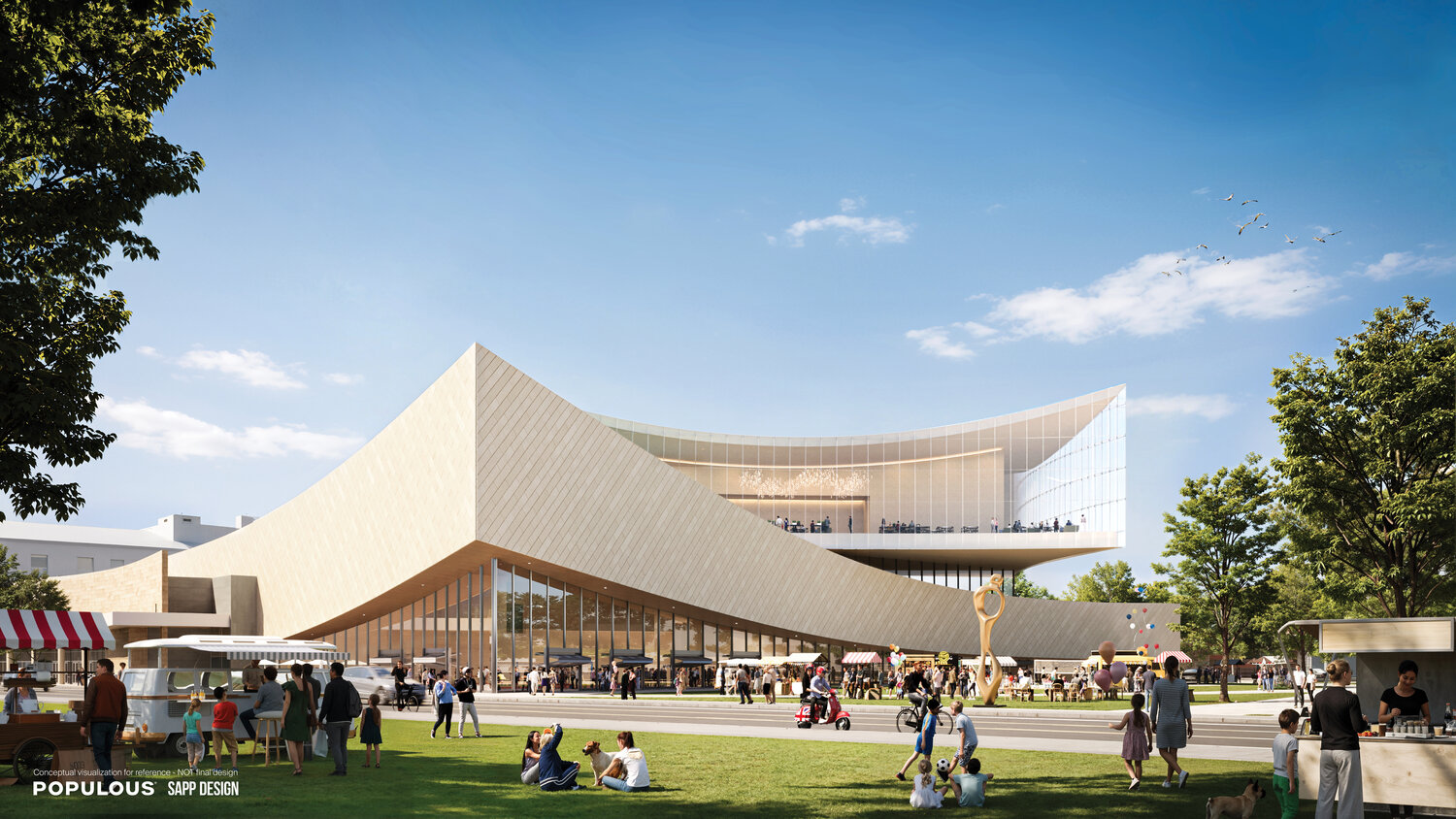
Intersecting walls of white stone and glass curtain jut upward like the prows of passing ships in a design workup for a proposed downtown Springfield convention and events center by architectural firm Populous Inc.
The Kansas City-based firm showed concepts for the center gleaned from a series of community visioning sessions in a design reveal today at 4 p.m. at the Discovery Center. The release was originally scheduled for March 13, but it was delayed at the request of the design team.
The renderings are not the finished designs, but rather offer a sense of what participants desire, based on broad feedback about favorite local places, attitudes and pastimes provided in interactive poster displays and tabletop exercises.
“Springfield voters are who will ultimately decide the fate of this project on April 7,” said City Manager David Cameron in a news release provided prior to the reveal event.
Cameron said the city learned a lot from the November 2025 defeat of a 3% lodging tax measure to fund a proposed center. That ballot issue failed by fewer than 400 votes on only a 7% voter turnout, he noted.
“Through public listening sessions and a community survey, Springfield made it clear they wanted more information about the project, greater transparency and stronger safeguards,” Cameron said during the presentation.
He thanked people present for their feedback and their holistic approach to moving forward as a community.
Cameron said the facility is designed to have no dark days but to be open year-round and to position the community for growth.
“We are now asking our community to reconsider, with more information than we previously provided – because it’s an important next step in our strategic growth plan,” Cameron said.
Mayor Jeff Schrag called the reveal a turning point for the city, with a facility that is designed to serve a robust, growing metro and is paid for largely by visitors who come to the city to use the convention center for their own events.
Tim Rosenbury, the city’s director of quality of place initiatives, said he is excited about reimagining the Springfield Expo Center as a true civic center to serve the city now and in the future.
Rosenbury revealed slides of the design prepared by Populous with local architectural firm Sapp Design Associates Architects Inc.
He said the form of the addition follows the sweep of the Expo Center’s facade, but in a way that is “more exuberant, more iconic and more memorable.”
Open space between the Jordan Valley Car Park and the current Expo Center would remain largely open, though some space would be taken by an elevated ballroom, and views into many public spaces within the building are transparent.
The ground floor on the east end includes glass garage-style doors that open completely to extend the lobby space into the open lawn beside the car park.
Rosenbury said the idea is to convert a portion of the roof of the existing exposition hall into a fifth facade with a green roof and solar collectors for sustainability. Networks of open spaces connect Jordan Valley Park to the north alongside the convention center and toward the area of Kentwood Hall on the south side.
“For me, and I hope for you all, it’s not hard to look at this image and see how this investment just in this area could catalyze the development of other sites in the immediate area for greater community and economic benefit,” Rosenbury said.
On April 7, voters will consider another proposal for a 3% lodging tax, this one with a 35-year sunset, to fund the $175 million facility. The news release notes that the city is seeking private-sector interest in a complementary hotel development to be privately funded.
According to the release, the design includes the following:
• A 65,000-square-foot modernized exhibit hall, expanded from the existing footprint
• A 30,000-square-foot grand ballroom for banquets, ceremonies and general sessions
• A 14,000-square-foot junior ballroom for midsized events
• 16,000 square feet of breakout and meeting rooms
• A full-service kitchen and food service infrastructure
• Improved loading, rigging, lighting and production systems
• Multicourt indoor sports configurations
• Modern circulation with escalators, elevators and guest amenities
The facility is designed to be flexible to accommodate events like expos, trade shows, conventions, sports tournaments, graduations, weddings, meetings and concerts, the release states.
The goal is to make Springfield more competitive in attracting large events, according to city officials, while positioning the city for long-term economic growth.
Some features stand out in the renderings provided, like a portion of diamond-shaped roof covered in grass at the east end of the structure, with grass and solar panels topping the large main section of the building.
Outside, there is an area for food trucks around what appears to be a pickleball court on the east end, and families are depicted playing and picnicking on the lawn.
The facility has 125,000 square feet of program space, Rosenbury said, and another 125,000 square feet will be needed for support spaces, like restrooms, kitchens and storage. He noted the 250,000-square-foot building would be the largest project built by the city since the 275,000-square-foot main terminal at the Springfield-Branson National Airport was constructed in 2009.