

In advance of its annual shareholders meeting on April 23, HCA Healthcare’s board of directors once again is urging voters to reject a proposal by state Sen. Julie Mayfield, D-Buncombe, that would require HCA to report on the health consequences of its acquisitions over the past 10 years, including the purchase of Asheville’s Mission Hospital in 2019.
Mayfield’s proposal would require HCA to disclose information including the number of physician departures post-acquisition; a comparison of pre- and post-acquisition patient satisfaction ratings; a comparison of the number of staff per occupied beds pre- and post-acquisition; and an overview of the community’s perception of the acquisition.
Although the supporting material provided by Mayfield uses Mission as an example — citing “patient safety failures, regulatory censure, multiple lawsuits, clinician attrition, inability to expand, and community backlash” — the proposal would cover all HCA acquisitions over the past 10 years.
“Without transparent, comparative data across other HCA hospitals, shareholders cannot determine if these issues [at Mission Hospital] are an anomaly or a systemic problem,” Mayfield wrote in a letter asking support from other shareholders.
Nashville-based HCA operates 190 hospitals in the United States, including six in the Mission Health system in western North Carolina. In 2016 it operated 170 hospitals, so the proposal — if accepted by shareholders — would require examinations of approximately 20 acquisitions.
Mayfield noted that she was filing the proposal not as an elected official, but as an HCA shareholder. She purchased 105 shares of HCA common stock in November 2023, according to a letter she filed with her proposal. In a message to Asheville Watchdog, she explained: “Only as many as I needed to meet the investment threshold — $25,000 — to submit a shareholder resolution after one year. I bought them for the express purpose of submitting a shareholder resolution starting in 2025.”
The value of those 105 shares has more than doubled since Mayfield bought them.
HCA tried to exclude Mayfield’s 2025 proposal from a shareholder vote, arguing to the Securities and Exchange Commission (SEC) in unusually personal terms that Mayfield was “using public opposition to the Company and her Mission Health related activism in an attempt to bolster her political career, an interest not shared by other shareholders at large.”
HCA’s lawyers also asserted to the SEC that Mayfield “is in a personal relationship and shares a residential address with a doctor who formerly practiced medicine at Mission Health who has sued the Company…”
Mayfield is campaigning for reelection to represent North Carolina Senate District 49. Her campaign website states, “Currently, I am leading a community coalition [Reclaim Healthcare WNC] to stop the decline in the quality of our healthcare in WNC due to HCA’s ownership of Mission Health.”
 HCA Healthcare purchased the Mission Health system, including Asheville’s Mission Hospital, for $1.5 billion in 2019. // Watchdog file photo Katie Linsky Shaw
Responding to HCA’s attempts to disparage her motives, Mayfield wrote to the SEC: “I acknowledge that my campaign website mentions my commitment to stand against “greedy hospital profiteers” and that I talk about the quality, availability, and accessibility of healthcare in my community at campaign and other events. However, I do so not because these issues poll well or because I think they will help me win elections, but because they are important issues that impact both my constituents and many other Americans.”
“Furthermore,” Mayfield continued, “I won my first senate election in 2020 with 62% of the vote and my 2022 election with 65% of the vote. Both of these elections occurred before my efforts related to [HCA] were widely known. In short, I do not need to criticize [HCA] or submit this shareholder proposal as part of my re-election strategy.”
Mayfield and Allen W. Lalor, who was an emergency room physician at Mission and other hospitals for 27 years, attended and spoke at last year’s virtual annual meeting as shareholders. Lalor called for an amendment to the charter of HCA’s Board of Directors’ Patient Safety and Quality of Care Committee requiring a review of staffing levels and their impact on patient safety, quality of patient care, and patient satisfaction ratings.
The SEC rejected HCA’s attempt to block Mayfield’s 2025 proposal, and it appeared on the ballot last year along with the board’s recommendation that shareholders vote against it. A majority did, defeating Mayfield’s proposal, along with Lalor’s and another proposal that sought to tie executive bonuses and compensation more closely to patient health and safety.
Last month the company reaffirmed in its report to the SEC that executive bonuses will continue to be awarded on a formula weighted 80 percent for hitting or exceeding profit targets, and 20 percent on quality of care.
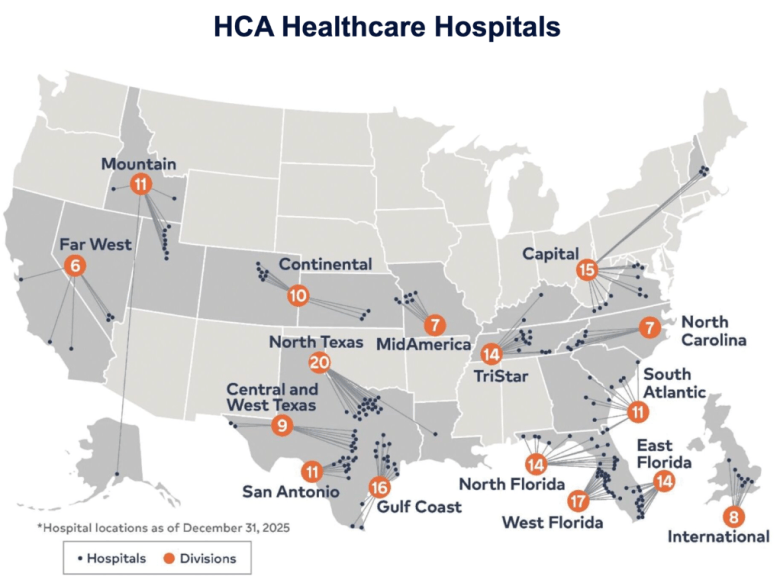 This map shows HCA Healthcare’s footprint across the country and in England. The Frist family, the founders and major shareholders of HCA, leveraged private equity to take HCA private in 2006, and then became the ultimate controlling shareholders when the company returned to the public market in 2011. // Credit: Securities and Exchange Commission
Immediate Jeopardy citations
In supporting material for her 2026 proposal, Mayfield argues that “HCA’s acquisition of Mission Health (“Mission”) in 2019 illustrates the potentially harmful impact such acquisitions can have on impacted communities.”
“Since 2019, well over 200 physicians have left Mission,” Mayfield wrote. “In addition, almost immediately, HCA allegedly raised prices by 10%, started charging patients surprise fees and reduced the number of staff per occupied bed at the flagship Mission Hospital from 6 full time equivalents pre-sale to 3.7 (average across North Carolina is 5.1). Patient satisfaction ratings declined precipitously from 4’s and 5’s pre-sale to 1 in 2025, and there were significant staff reductions and/or departures in nursing staff and services such as chaplaincy, pharmacy, rehabilitation, sterile processing, laboratory, and environmental services.”
Citing Asheville Watchdog reporting, Mayfield continued: “Since 2019, Mission has been cited five times for Immediate Jeopardy (IJ) due to multiple patient deaths and two Emergency Medical Treatment and Labor Act (EMTALA) violations and referred for a third EMTALA violation. Nursing shortages correlate with at least one IJ citation.”
“Prior to HCA’s acquisition, Mission was the only health system designated as one of the nation’s Top 15 Health Systems in six of seven years by IBM/Watson Health (2012-2015; 2017-2018). Since 2019, Mission has experienced a steep decline in the quality of care and patient experience, repeated regulatory censure, a lawsuit from the North Carolina Attorney General, and community opposition.”
“There is robust evidence that hospital acquisitions can cause an array of problems, including higher prices, worse health outcomes, shutdowns and reduced access,” Mayfield wrote.
“Shareholders should know the healthcare, legal, reputational, and employee impacts of HCA’s acquisitions, both to understand whether HCA contributes to our country’s healthcare crisis and to assess how HCA manages risks associated with its acquisitions. For these reasons,” Mayfield wrote, “I urge you to vote FOR this proposal.”
Mayfield told The Watchdog that she is actively soliciting support for her new proposal. “Last year, this resolution got 12 percent of the total vote and 18 percent of the independent vote,” she said. “It needs to get 15 percent of the total vote to remain alive for future years.”
An analysis by the financial information company MarketBeat found that only about one-third of HCA’s voting shares are independently controlled. The rest are held by institutional investors and hedge funds, who tend to vote at the direction of the board.
‘Squarely aligned with shareholder value’
Unlike the 2025 proposal, Mayfield’s 2026 proposal appeals more directly to shareholders’ financial interests. HCA’s alleged mismanagement of Mission threatens HCA’s institutional value, corporate revenue, and potential legal liability, Mayfield wrote in a separate letter to other HCA shareholders arguing that her proposal is “squarely aligned with long-term shareholder value and fiduciary responsibility. [The proposal] asks the HCA Board to provide investors with material insight into how acquisition-driven growth has affected patient care, workforce stability, and community trust.”
In this year’s proxy statement, the HCA board also unanimously recommended against another proposal that would give shareholders a greater voice in bringing their concerns to the board. The proposal cited Mission’s Immediate Jeopardy sanctions, among other concerns about HCA hospitals and facilities.
HCA’s meeting this year again will be virtual, held in a live webcast.
HCA board’s response
In its 2026 definitive proxy statement to shareholders, the HCA board responded: “We have carefully reviewed Proposal 4 and, for the following reasons, have determined that adopting the proposal is not in the best interests of HCA Healthcare or our stockholders. The Board unanimously recommends a vote “Against” the proposal.
“We believe the report called for in this proposal is neither practicable nor a good use of Company resources given its broad scope. If adopted as proposed, the proposal would result in unnecessary expense and burdens with limited benefit to our stockholders.”
“Mission Hospital in North Carolina, specifically mentioned in the proposal, was one of three HCA Healthcare hospitals to receive the 2026 Healthgrades America’s 50 Best Hospitals Award for being within the top 1% in the nation for consistent clinical excellence. This is Mission Hospital’s 11th consecutive year to receive this recognition from Healthgrades.”
The Watchdog has previously reported that such ratings provide an incomplete picture of a hospital’s performance. Companies such as Healthgrades charge a hospital a fee to participate in the rankings system and ratings are limited in their scope.
Multiple studies raise concerns
The issue of healthcare consequences of hospital mergers and acquisitions has been a hot topic in this decade. Several national studies of the health consequences of for-profit hospital ownership in recent years have found that quality of care, patient safety, and cost and availability of care often worsen after an acquisition by a profit-oriented company.
 A study last year by Mark A. Hall, a professor of law and public health at Wake Forest University, found that “HCA’s ownership and operation of the Mission Hospital system has proven … to be much more controversial and contentious than anyone imagined. // Photo credit: Wake Forest University
A study last year by Mark A. Hall, a professor of law and public health at Wake Forest University, found that “HCA’s ownership and operation of the Mission Hospital system has proven … to be much more controversial and contentious than anyone imagined. Concerns related to Mission’s quality of care, scope of services, patient access to services, corporate profits, inadequate staffing, excessive physician turnover, and questionable charitable care policies have produced an avalanche of negative publicity, both locally and nationally, as well as several high-profile lawsuits and a major federal enforcement action.”
At the time, Nancy Lindell, chief spokesperson for HCA’s North Carolina Division and Mission Hospital, rejected the study’s findings because it was funded in part by the nonprofit Arnold Foundation, a Houston-based philanthropic organization that also provides general funds to a law firm that does social impact work. One of the firm’s projects is litigation against healthcare organizations including Mission Health. As a result, Lindell said, “It is not an impartial ‘study’ and it does not justify comment or response.”
A Harvard Medical School study in 2023 found that “Patients are more likely to fall, get new infections, or experience other forms of harm during their stay in a hospital after it is acquired by a private equity firm.”
The Frist family, the founders and major shareholders of HCA, leveraged private equity to take HCA private in 2006, and then became the ultimate controlling shareholders when the company returned to the public market in 2011.
[CLARIFICATION: This article was updated at 6:45 p.m. to clarify the Arnold Foundation’s role in a lawsuit against Mission Health. The foundation provides general support to a law firm involved in multiple legal actions against healthcare organizations, including Mission and Charlotte-based Advocate Health. It does not specifically fund the Mission lawsuit. Also, the story was updated to provide the current value of Mayfield’s HCA shares.]
Asheville Watchdog welcomes thoughtful reader comments on this story, which has been republished on our Facebook page. Please submit your comments there.
Asheville Watchdog is a nonprofit news team producing stories that matter to Asheville and Buncombe County. Peter H. Lewis is executive editor and a former New York Times senior writer, editor and columnist. Email plewis@avlwatchdog.org. The Watchdog’s local reporting is made possible by donations from the community. To show your support for this vital public service go to avlwatchdog.org/support-our-publication/.
Related