
Like most North American viperids, copperheads prefer to avoid humans and, when given the opportunity, will leave an area of humans without incident, according to the National Park Service.
Picasa
National Park Service
It felt like something of a reprieve not having to worry about copperheads in the yard or along trails, but that time is coming to an end.
In a few weeks, South Carolina’s most populous venomous snakes will be coming out of their hidey-holes where they’ve spent the winter.
The South Carolina Department of Natural Resources said they especially love your rhododendrons, woodlots, gardens and the state’s wildlands. They fare pretty well, though on an acre or two with some shade and a lot of white-footed mice.
DNR puts it plainly: “This animal, with its highly camouflaged coloration and venomous bite, has been a concern to people over the centuries. It will likely remain so into the future.”
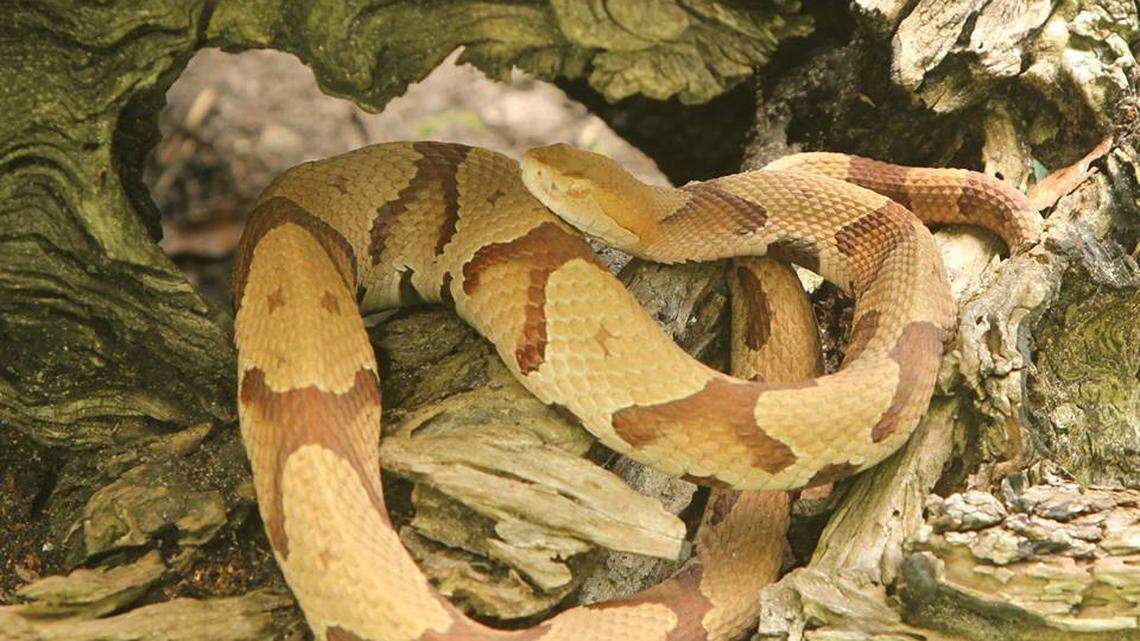
You can tell a copperhead by its light to rich brown colored with darker brown hourglass shaped markings across their backs.
They are often mistaken for non-venomous corn snakes, juvenile rat snakes, and the northern water snake. The difference is corn snakes don’t have fangs ( they are constrictors). Water snakes’ pattern is wider on the sides and narrower towards the backbone.
If you should come upon a copperhead, DNR says remain motionless and chances are it will slither away. If you step on it all bets are off and that snake is going to bite you if it can.
Adults are 24 to 30 inches long but can grow to 4 feet.
During winter, copperheads and other snakes enter brumation, when they crawl into holes and under rocks, sometimes even leaves and go into something similar to hibernation like mammals.
They become lethargic, but aren’t totally asleep. They don’t eat, although they do need water. Generally, this occurs when the temperature drops below 60 degrees (that’s also the temperature that rouses them to come out).
Mallory Maher, Natural Resources Extension Associate at Clemson University, says on the university’s Home and Garden website, the best thing to do to keep snakes away is not make it easy on them. Don’t pile up brush. Snakes like firewood stacks. Keep them away from your house. Rodents like that stuff, too, and guess who eats rodents?
“You cannot blame a snake for moving into a perfect habitat where all its needs are met,” she said.
Remember you probably walk by snakes more often than you see them. And herpetologists resoundingly say leave them alone. They want to see you less than you want to see them.
Copperhead are responsible for more bites in the U.S. than any other snake species, but bites are rarely fatal.
Maher said most people are bitten while harassing or approaching a venomous snake.
“In the unlikely case you are bitten by a venomous snake, it’s best not to try and treat the bite yourself,” she said. “The victim must stay calm and seek medical attention as soon as possible.”
There have been no fatalities due to a copperhead bite in South Carolina since 1937, and that’s not for sure. It also could have been a rattlesnake or cottonmouth bite that killed a Clio farmer picking blackberries.
Herpetologist Jeff Beane at North Carolina State Museum of Natural Sciences advocates not only for live and let live philosophy about snakes, but also thinks it’s to your benefit to let them live in your back yard.
“They eat a lot of species that we don’t like, like mice and rats, that can cause diseases and problems,” he told Blue Ridge Public Radio. “And [by] eating a lot of rodents, snakes are swallowing a lot of ticks. And ticks cause things like Rocky Mountain spotted fever and Lyme disease.”