
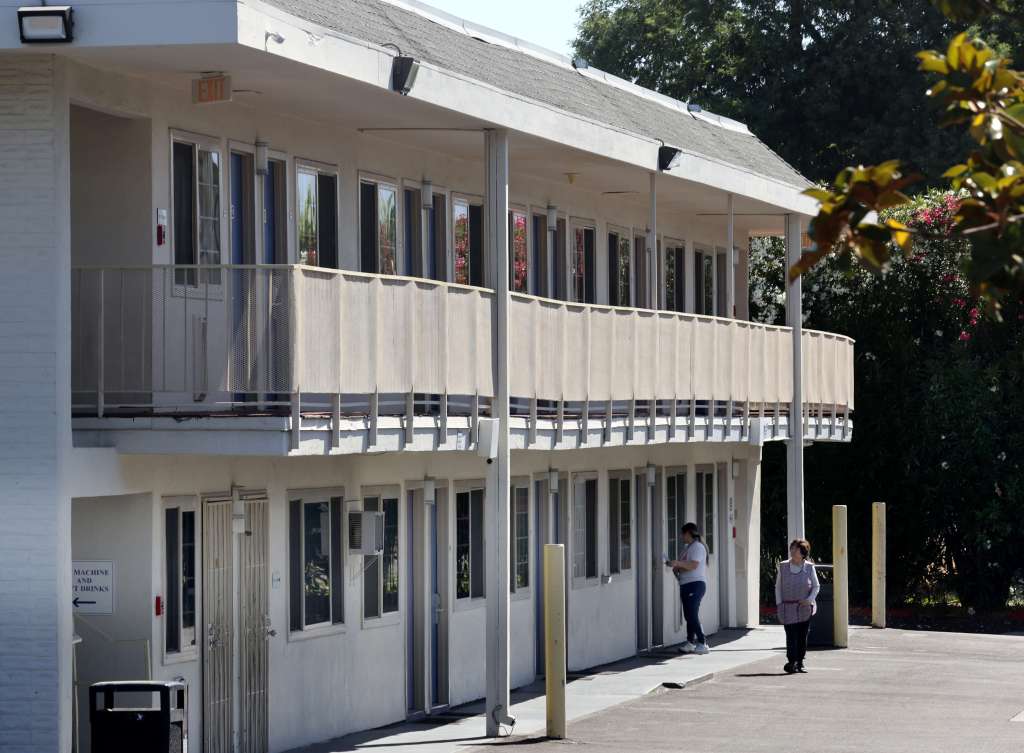
The North Napa Center, a former Motel 6 on Solano Avenue that’s served as transitional housing for homeless residents since August 2023, will be closing at the end of June, and the city of Napa is working to secure housing for the center’s roughly 40 remaining residents.
The city’s almost three-year lease of the property was funded with a $15 million California Encampment Resolution Funding Program grant. That lease is set to end June 30.
Napa Community Resources and Development Director Molly Rattigan told the Napa City Council on Tuesday, March 17, the city was previously unsuccessful in applying to the state for more funding for the project that could have extended it, and the state this year has yet to put out another notice of funding availability for such projects.
But the city expects to have between $500,000 and $1 million left over from the original grant by June 30, and will use those funds on “making sure that those who remain have the opportunity to be housed” by providing rental assistance, housing navigation and tenancy care services before the funding expires in June 2027, Rattigan said.
“It’s probably impossible at this point that we will be able to continue operations of our North Napa Center,” Rattigan said. “So we are now making contingency plans.”
She also said there may be an option to continue renting some rooms for a small number of residents at the Motel 6, if the city can’t find places to transition people right away.
Originally the center was intended to bring in 120 homeless residents from encampments — the center has capacity for up to 65 people at a time — and transition at least 80 of them into permanent housing. It’s been operated by Abode Services, Napa County’s nonprofit homeless services provider, throughout the nearly three years.
But in January, with the lease expiration coming up, the center stopped taking in new people and refocused on housing those currently living there.
Rattigan said that, as of Monday, March 16, the center had provided services for 180 people; 56 of them had been housed, and eight people were actively in the leasing process.
Of the others served, Rattigan said, three people went to live with family, five were removed from the center and later housed, five more were removed for long-term incarcerations and one person died.
By Monday, Rattigan said, 43 people remained at the center, though she noted a family of three living there was set to transition to the Catholic Charities Rainbow House during the week.
That left 24 people identified as having income or pending income as of Monday, Rattigan said, and 16 people who either don’t have income or face other challenges toward getting housed.
Though those with income can likely find housing with assistance from Napa’s homelessness support system, the others are unlikely to be successfully housed before the North Napa Center lease ends, Rattigan said. So the plan is to transition them to the South Napa Shelter — Napa County’s main shelter, which since 2006 has provided overnight and day services to homeless residents and is funded directly by the county — over the next few months.
Rattigan said current North Napa Center residents at a March 9 meeting of program participants expressed thanks to the council for having the courage to open up the center in 2023, despite resistance from some area neighbors. The opportunity had changed their lives, the residents said, according to Rattigan.
“The motivation for housing and to stay housed and never have to return to homelessness is so great,” she added. “There are people who’ve gotten sober while in that program, people who have jobs, some with relatively good incomes, that are changing the trajectory of their lives.”
The North Napa Center — along with a growing number of permanent supportive housing units and shelter beds — coincided with a 26% decline of the local homeless population from 2023 to 2025 recorded in the annual one-day homelessness count. Data from the most recent 2026 count, held in January, isn’t yet available.
The reduction has been particularly pronounced for unsheltered people living in encampments, in vehicles or on the streets: from 2024 to 2025, Napa saw a 42% reduction in unsheltered homelessness.
Scott Wagner, who oversees Abode’s Napa County operations, said at the meeting he hoped the project could serve as a model in the future when additional funding becomes available. Despite the upcoming closure, he said, the project helps to prove that something similar could be successful in the future at making major differences in the lives of homeless residents.
“If we think about it, these are all individuals who came out of encampments, so some of the most disengaged individuals that we had in this community were selected to go into this project,” Wagner said.
The Napa council members said they were sad to see the program end, noting they would support a similar effort if funding for it becomes available in the future.
Council member Mary Luros said it is disappointing other cities don’t get the same opportunity for such a project “because clearly it’s a solution for a problem that we’re all facing.”
Council member Bernie Narvaez said the project, which faced early resistance, helped build confidence between the Napa community and the city.
“I’m really glad that we’ve had this opportunity in our community to showcase something that works,” Narvaez said.
You can reach Staff Writer Edward Booth at 707-521-5281 or edward.booth@pressdemocrat.com.