
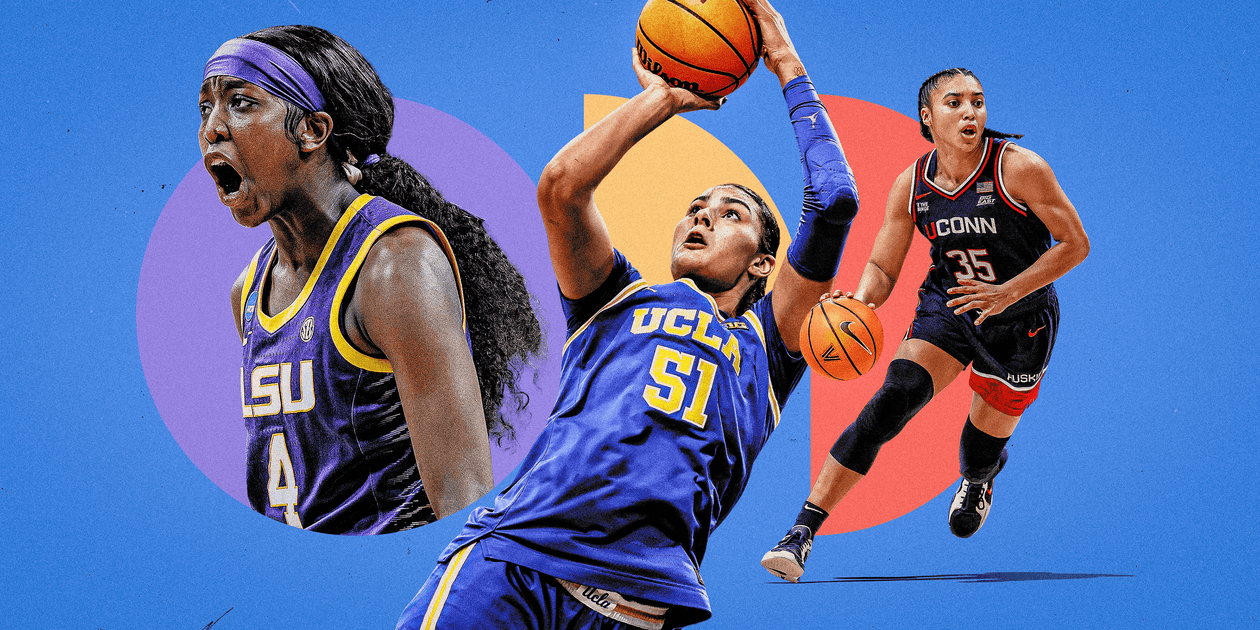
Despite concerns about a delayed season due to the lengthy collective bargaining agreement negotiations, the WNBA season will indeed start on time on May 8.
A historic deal was met on Wednesday morning, and that means the rest of the offseason can finally take shape, including the WNBA Draft on April 13 in New York. As of now, the draft order remains fixed, as it has since the lottery in November, but the possibility of change due to transactions still exists.
The book on most of these prospects is almost closed, with at most six NCAA Tournament games left in their seasons. Nevertheless, a good tournament run can still affect draft stock. Think of Villanova’s Maddy Siegrist rocketing up to No. 3 in the 2023 draft after reaching the Sweet 16, or Alabama’s Sarah Ashlee Barker cementing herself in the first round after a 45-point performance against Maryland in the 2025 tournament.
Here is one last mock draft before we run the risk of getting swayed by a few good games and all hell breaks loose in the 2026 offseason.
1. Dallas WingsAwa Fam | 6-4 center | Valencia (Spain)
Look no further than Fam’s performance in Spain’s World Cup qualifier game against the U.S. for proof that she can hang with the world’s best players. As a 19-year-old, Fam had 10 points and five rebounds, excelling as a center and power forward, even when Team USA played smaller lineups. Her mobility popped on defense, and she looked taller than her listed height of 6-foot-4. She reads the floor well and can guard on the perimeter and in the paint. Her touch around the rim isn’t perfect, but she still made 5 of 7 2-pointers. Fam even flashed a step-back midrange jumper. The only knock against her is that she isn’t as seasoned as some of the college players in this draft, but she is already just as good at a younger age.
2. Minnesota Lynx (from Chicago Sky)Azzi Fudd | 5-11 guard | UConn
Fudd is a plug-and-play prospect who will add value as a shooter and defender. Even as she has added more volume as a scorer in her final season, Fudd’s efficiency has remained sparkling: She is making 53.2 percent of her 2s and 44.6 percent of her 3s. Fudd has become a ballhawk with 2.5 steals per game, and she has the best on-off impact on UConn’s defense.
Minnesota wouldn’t be drafting Fudd to turn into a primary on-ball creator. There is little evidence that she can be the engine of an offense, and her free-throw attempt rate is pretty low. Still, her gravity as a shooter — both at a standstill and in movement — makes her an ideal secondary option, not unlike the role Kayla McBride currently plays with the Lynx. Considering that McBride will turn 34 this season, it’s not a bad time for a succession plan.
3. Seattle Storm (from Los Angeles Sparks)Olivia Miles | 5-10 guard | TCU
Miles’ disinterest in defense has raised some alarm bells. And it isn’t just a function of her offensive responsibility at TCU, because Notre Dame also benched Miles during some fourth quarters in the 2024-25 season before she transferred. That prevents Miles from being considered for a top-two pick because her offensive talent and production remain exquisite.
Setting aside the spectacular passing — she’s seventh in the nation with 6.4 assists per game despite TCU not playing with much pace — consider the improvement in Miles’ jump shot. Before she tore her ACL, she made 24.6 percent of her 3-pointers and was even worse off the dribble, making 22.8 percent of those attempts. Post-ACL, her 3s are going in 37.8 percent of the time. The high percentage isn’t a result of playing off the ball, because her pull-up 3-point percentage has gone up to 37.2 percent.
4. Washington MysticsLauren Betts | 6-7 center | UCLA
The box scores aren’t always gaudy — Lauren Betts has recorded one double-double in her last six games — but UCLA keeps winning, and she is the main reason why. She sucks in the defense when she rolls hard into the paint, and makes good decisions out of double teams. When she has space to work, Betts can take one hard dribble and finish over her right shoulder.
The allure with Betts is on defense. The Bruins have challenged her to be more versatile, rather than just hanging back in the paint, which she has already proven she can handle with aplomb. UCLA switches more frequently, and it’s been fun to watch Betts on an island against a guard, mirroring the movements of her opponent as they slowly realize that they won’t be able to generate an advantage. Look at Betts defending All-American Jaloni Cambridge on a switch and swallowing up all of the little guard’s driving angles; Cambridge is forced to take an off-balance jumper that gets blocked.
Given the rumblings about Shakira Austin potentially seeking a new home, the Mystics could use a center to anchor their young foundation, and Betts is that piece.
5. Chicago Sky (from Connecticut Sun)Kiki Rice | 5-11 guard | UCLA
Perhaps my focus on what Kiki Rice isn’t (a pure point guard) has obscured much of what she does well. The Big Ten tournament was laid bare exactly why Rice is so valuable: she puts pressure on the rim, she’s a willing playmaker and she is genuinely disruptive to opposing ballhandlers. That combination of defense and secondary offensive skills — plus she has good size — should result in a long pro career for Rice. The Sky need a point guard, especially one who knows how to make life easier for bigs, and Rice fits the bill.
6. Portland FireIyana Martín | 5-9 guard | Avenida (Spain)
Like her Spanish compatriot Fam, Martín had a strong showing in the World Cup qualifying game against Team USA. The 20-year-old point guard showed off her dynamic passing — including a beautiful full-court outlet to former Arizona star Helena Pueyo and some fun overhead passes in the half court. She capably defended full court and got into Caitlin Clark’s air space. Martín plays with great pace and genuine joy. The Fire have an international flair in their front office, as head coach Alex Sarama and general manager Vanja Černivec both hail from outside the United States — perhaps an international floor general would be an ideal building block for the expansion team.
7. Toronto TempoRaven Johnson | 5-9 guard | South Carolina
With Martín unavailable at this spot, the Tempo choose another culture-setter at point guard: Raven Johnson. Johnson has been the architect of a lot of success in Columbia, S.C., losing just eight games in her college career. She is a smart playmaker who can feed her shooters and bigs, and she is one of the best on-ball defenders to come through college basketball in recent years. Watching Johnson get into a defensive stance is a thing of beauty.
8. Golden State ValkyriesNell Angloma | 5-11 guard | Lattes Montpellier (France)
This pick hasn’t changed since last month. Angloma has matured into a physical force in the top French league. She doesn’t turn 20 until June, and already, defenses can’t keep her out of the paint. When Angloma puts her head down, she is either getting to the basket or to the foul line. Through 20 games in the LBWL, Angloma is averaging 15.3 points and 6.1 free throws per game. The Valkyries have shown a fondness for international players, and Angloma would be comfortable around fellow French players Janelle Salaün, Iliana Rupert and Carla Leite.
9. Washington Mystics (from Seattle)Gianna Kneepkens | 6-0 guard | UCLA
It’s time for everyone’s favorite parlor game: spot the blue on Gianna Kneepkens’ shooting chart. Spoiler alert — it doesn’t exist! Kneepkens is making 44.2 percent of her 3-pointers (46 percent from the corners and 43 percent on above-the-break 3s). She is shooting 79.3 percent within the restricted area and 62.5 percent in the rest of the paint (a.k.a. floater range). Now that Kneepkens is out of the Lynne Roberts system and into one that emboldens her to shoot midrangers, she is making 47.2 percent of those looks. There are no bad shots for Kneepkens. A Washington team that averaged just 97.2 points per 100 possessions in 2025 could use that type of firepower.
10. Indiana FeverGabriela Jaquez | 6-0 wing | UCLA
I was a little overexuberant on Jaquez the last time around. Her 3-point shooting came down to Earth during conference play (30.6 percent compared to 55.6 percent in non-conference). She drops a few spots but is still a first-round talent thanks to her size, versatility and effort level. Jaquez can credibly play 1 through 4, moves well off the ball, throws a great arcing post-entry pass and is a beloved teammate. Lexie Hull is an ideal archetype for Jaquez’s pro career, so why not unite the two?
11. Washington Mystics (from New York Liberty via Connecticut)Flau’jae Johnson | 5-10 guard | LSU
Johnson takes a bit of a dive in this mock because of her inconsistency. For every 21-point outing against Oklahoma, there is a six-point effort against South Carolina. She isn’t getting to the line as frequently, and when she is, her free-throw percentage has fallen below 70 percent. Johnson also isn’t regularly engaged on defense, even though she has the capacity to make some truly spectacular plays. And therein lies the problem — we’ve seen the best version of Johnson on many occasions, and it’s popped up now and then this season. I believe in Johnson’s upside, but her floor is getting less certain than some of the prospects ahead of her.
12. Connecticut Sun (from Phoenix Mercury)Madina Okot | 6-6 center | South Carolina
Okot has barely played organized basketball at a high level and has already improved so much in two years in the NCAA system. She is in much better shape, able to run the floor and cover more ground defensively. Her floor spacing has been a genuine delight, but I still prefer it when Okot uses her strength in the paint. Watch her continue to battle against an undersized LSU frontcourt, understanding it is her responsibility to get to the ball because of her physical advantages. Okot will still have a height advantage on many WNBA bigs, and she must know how to play big. Connecticut’s frontcourt was a little too finesse last season; adding Okot’s power would be a good fit.
13. Atlanta DreamCharlisse Leger-Walker | 5-10 guard | UCLA
Replace one UCLA point guard with another, Jordin Canada for Charlisse Leger-Walker. Leger-Walker knows how to read the floor and can organize her teammates. Atlanta needs a point guard who takes care of the ball, hits spot-up jumpers and disrupts on defense. Per CBB Analytics, Leger-Walker ranks in the 99th percentile in assist-to-turnover ratio, the 96th percentile for effective field-goal percentage and the 85th percentile for steal rate.
14. Seattle StormCotie McMahon | 6-0 guard/forward | Ole Miss
In her senior season, McMahon has done enough to dispel the concerns that plagued the end of her Ohio State tenure. She has led the Rebels all season, learned a new position at point guard and figured out how to play to her strengths in a new system. The Storm could use a little more force on their roster; they had the lowest free-throw rate in the WNBA last year, and McMahon is 12th in the country in foul shots attempted per game. She’s also improved her shooting percentage to 72.6 percent after hovering in the low 60s. There’s still some fat to trim from her game, because there’s no reason she should be taking half of her shots outside the paint.
15. Connecticut Sun (from Minnesota via Washington)Ta’Niya Latson | 5-8 guard | South Carolina
This might be too low for Latson, considering she was the nation’s leading scorer last season and is a blur getting downhill. However, the jumper hasn’t come along, and that’s a tough skill to lack at her size. The Sun can afford to wait for Latson to continue to develop. Saniya Rivers, Leïla Lacan and Latson would form the most athletic perimeter rotation in the WNBA.
Also considered: Tonie Morgan, Serah Williams, Justine Pissott