


A bill was introduced this week to implement work requirements for lower-income Idahoans who are currently enrolled in the state’s Medicaid expansion program. It awaits a vote in the Idaho House.
Darin Oswald
doswald@idahostatesman.com
A proposed change to law that its author envisions would dump no less than a quarter of very low-income Idahoans from voter-approved health insurance is headed for a House vote as the end of the legislative session nears.
House Bill 913 would thrust new three-month work requirements onto adult Medicaid expansion recipients to maintain their health care coverage — the maximum allowed under federal legislation passed last year to be enrolled in the program. The Idaho Department of Health and Welfare would be tasked with the review before the end of the year and remove those who don’t have proof of having worked or volunteered at least 80 hours per month in the prior three months.
Rep. John Vander Woude, R-Nampa, who is the bill sponsor, expects some 15,000 — or more — individuals with annual incomes at or below about $22,000 to qualify would lose their health insurance with its passage. Families of four are eligible if they earn approximately $44,000 per year.
“It was for the working poor,” Vander Woude, who chairs the House Health and Welfare Committee, told its members Friday. “That’s what this program was set up to be, and I think this is just making it what it was intended to be.”
He acknowledged his estimate of those enrolled in the state’s Medicaid expansion who would lose health benefits is a guess. The state’s program, which voters approved through a 2018 ballot initiative, has nearly 80,000 enrollees.
“I think 15 to 20 (thousand) at the most, but I don’t know,” Vander Woude said. “I don’t know how many people aren’t working and how many people are.”
House Minority Leader Ilana Rubel, D-Boise, who is also a member of the committee, shared worries that it is more likely that up to 40,000 — roughly half — of those insured through the expansion would be removed if the bill passed. Its administrative burdens represent a “steeplechase of obstacles” to current enrollees recertifying their eligibility, she said.
“I feel like this bill is really designed to maximize the number of people who trip up and don’t meet the paperwork requirements,” Rubel told committee members. “The upshot is that a third or half of people might end up or are likely to end up being kicked off the program.”
Efforts at Medicaid expansion repeal
The bill is the latest effort in the Republican-controlled Idaho Legislature to rein in Medicaid expansion costs to taxpayers. Under the Affordable Care Act, the federal government picks up 90% of the program and the state the remainder. But as health care costs have risen, so too has the state’s yearly total to cover health insurance for its lower-income residents who qualify.
Last year, Rep. Jordan Redman, R-Coeur d’Alene, led efforts to repeal Idaho’s Medicaid expansion in its entirety. A watered-down version of the legislation, also carried by Redman, instead took hold as a comprise to seek cost savings in the program where possible. Gov. Brad Little, who has opposed outright repeal, signed the scaled-back law into effect.
Earlier this month, Redman again pitched full-scale repeal. His repeat bill from last year has yet to receive a public hearing. On Friday, Redman made the motion to advance Vander Woude’s bill to the House floor for a vote. Then he proceeded to spit into a paper cup in his hand while seated on the dais.
Rep. Marco Erickson, R-Idaho Falls, the committee’s vice chair, said he had some reservations about the Medicaid expansion work requirements bill. But he still chose to support it “because a full repeal would be a much worse thing, and redetermination is much easier.”
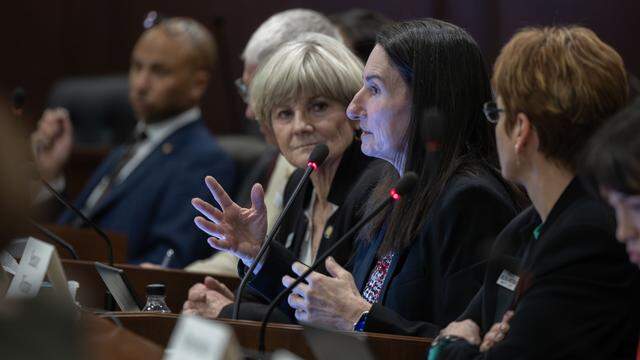 House Minority Leader Ilana Rubel, D-Boise, center, has come out against proposed legislation that chips away at providing health insurance to Idahoans through its Medicaid expansion program. Darin Oswald doswald@idahostatesman.com
The bill moved to the House with only Rubel and Rep. Megan Egbert, D-Boise, voting against it. If signed into law, it would take immediate effect to remove ineligible recipients for 2027.
The intent of the legislation was clear, Rubel said.
“While this isn’t full Medicaid expansion repeal,” she said, “it has roughly a third to half the damage of Medicaid expansion repeal in terms of people losing coverage, people appearing in hospitals uninsured … all of the bad things that would happen to us if Medicaid expansion were repealed.”
Rubel asked Vander Woude what his plan was for the hospitals — namely rural health clinics — that would now be made to shoulder the brunt of the uninsured care for tens of thousands of low-income Idahoans poised to no longer have health coverage if his bill became law. She wondered if the committee chair might consider helping to restore Idaho’s indigent and catastrophic health care funds.
“Not while I’m here,” Vander Woude responded, and laughed.
This story was originally published March 20, 2026 at 4:54 PM.
Related Stories from Idaho Statesman

Idaho Statesman
Kevin Fixler is an investigative reporter with the Idaho Statesman and a three-time Idaho Print Reporter of the Year. He holds degrees from the University of Denver and UC Berkeley’s Graduate School of Journalism.
Support my work with a digital subscription