
WEST PALM BEACH, Fla. — As a reporter, sometimes you just get the sense that you’re one document away from a great story. In my first interview on the Washington Nationals beat for The Athletic, I stood with pitcher Cole Henry at his locker and got that feeling.
It stemmed from a comment made months ago, when president of baseball operations Paul Toboni first arrived in Washington. He talked about “making the scoreboard visible,” and now Cole was fishing in his locker for a sheet of paper that would illustrate precisely what Toboni meant.
Every pitcher left in camp was listed on the left side of the paper. Each was given a designated row. Next to every name was a series of percentages that detailed how they’d performed thus far in camp.
“Here’s all the stuff that we want to be good at as a pitching staff,” Henry said, pointing at the columns at the top before shifting his focus to the numbers and colors below.
“Green is good,” Henry said plainly. “Red is — you know, not good. But like, we want to have a certain percentage. So it’ll tell you if you have a good percentage. Thirty-two percent whiff is good. Free-throw percentage is …”
Some of it should have been self-explanatory. But as I scanned the sheet, I realized that the only ones I understood were whiff rate and fastball velocity. When I admitted this to Henry, he was kind enough to walk me through the scoreboard:
• Whiff rate: How often the batter swings and misses.
• Fastball velocity: You probably can figure this one out on your own.
• Free-throw percentage: How often the pitcher got ahead early in counts.
• Attack percentage: How often the pitcher threw their pitches in the zone.
• Kill percentage: How often the pitcher put a hitter away in a two-strike count.
• Battle win percentage: How the pitcher fared in even counts (1-1, 2-2).
• Pre-two-strike WC: …
This is when Henry realized that he, too, needed a little bit of help.
“Hey Rut,” Henry called out to teammate Jackson Rutledge. “What is ‘Pre-two-strike WC.”
“Pre-two-strike win count,” Rutledge said.
“So kind of the same as the battle percentage,” Henry said. “I guess.”
It’s the kind of conversation that Toboni and the front office envisioned upon taking over in Washington, with players immersing themselves in the kind of data that had once been treated here with suspicion.
Despite needing an assist on the last category, Henry clearly understood the assignment.
He had spent the offseason working on his command. Now, he was proud to own the best attack percentage in camp. It turns out Henry’s row on the sheet was greener than any other pitcher on staff. It was not a detail that he offered on his own. But when I brought it to his attention, he confirmed as much with a nod and a smile.
For hitters, plenty of new video within reach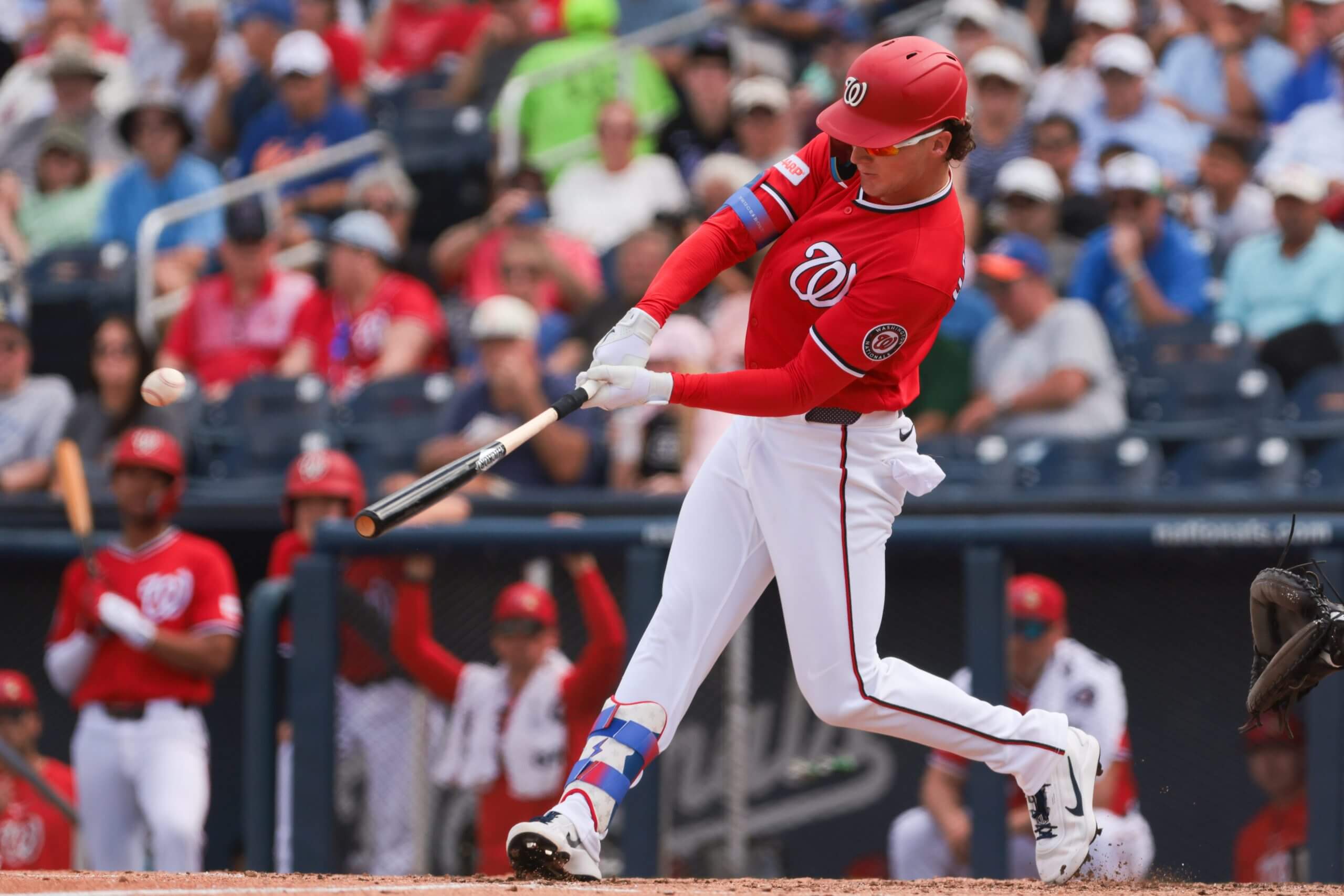
Robert Hassell III is batting .286 (8-for-28) in Grapefruit League play. (Sam Navarro / Imagn Images)
Pitchers and position players each have their own enclaves, and on the other side of the clubhouse, I found outfielder Robert Hassell III lounging in his chair, tapping away at his phone. He was eager to explain all the data that Nationals hitters could now access.
“I mean, I think it’s pretty cool,” Hassell said, his interest piqued. “I’m sure other teams had it before. Last year was kind of the basic pitch base. … Got a little video on the pitcher before, but it’s much more in-depth this year.”
The data is accessed through tablets, and though he didn’t have one in hand, his eyes and hands darted around as he conjured in his mind the virtual dashboard that acts as a gateway to anything he needed: videos, metrics, locations, past starts.
“Stuff like that all on one dashboard instead of having to go ask or wait till the next day to come in and ask — I think it’s really useful,” said Hassell, who will start the year in Triple-A Rochester. “For me, I learn just as much from playing the game as I do from watching video.”
“I love it,” he added. “I treat it like a little kid phone app game.”
I wanted to know how many angles were available on video.
According to Hassell, there’s more this year than in the past. Now, about 90 minutes after each game, he watches his swing from the open side, with the front of his body facing the camera, the way most hitters look at their mechanics. He then watches from the broadcast side, the view from the familiar center-field camera, to see if he is flying open or moving his hands too much. And finally, he watches from the closed side, or the view with the player’s back to the camera, just in case it offers an additional insight.
“They even have some of my high school pitching video on there,” he said.
When asked if he’d gone back and watched the film from his pitching days, Hassell looked up as soon as he realized he could find yet another practical use for all of this new data: getting some digs in about a couple of fellow Nationals prospects.
“I faced him back then, got him to ground out twice,” he said, grinning ear to ear, recalling a past encounter with Yohandy Morales. And then there was the time he got the best of Cayden Wallace. ”Struck him out,” Hassell said. “Make sure I told him that.”
Baseball’s youngest manager not afraid to get his uniform dirty
It was not as bizarre as when his predecessor brought camels to his first spring training camp. But this was different: The youngest manager in baseball standing behind a screen in Port St. Lucie earlier in the week, giving up tank after tank as he threw batting practice to members of his starting nine.
At times, manager Blake Butera, 33, has taken ground balls with the infielders. When he shagged baseballs with the outfielders, he tried to rile up his players by telling them, “Hey, you’ll drop more than me today.” (They never have.) And though it’s been out of earshot of the media, Butera has been known to talk smack.
The aftermath of “eating it” during a baserunning drill caught the attention of clubhouse advisor Mike “Wally” Wallace. “This is a new one,” Butera recalled Wallace saying. “I’ve never had a manager’s pants that are dirty.”
Butera explained that he is not alone in this sense. Los Angeles Chargers Coach Jim Harbaugh, he said, plays catch with quarterback Justin Herbert. JJ Reddick will run drills with his Los Angeles Lakers. Butera said he doesn’t plan to stop, if only because he’s afraid if he does, he won’t be able to pick it back up again.
“You don’t always get a chance to do that, because obviously, as you get older, the body starts to break down,” Butera said. “But I think it goes a long way for the players to see that you’re in it with them and that you’re not above anything. I’m not too good to throw BP.”