
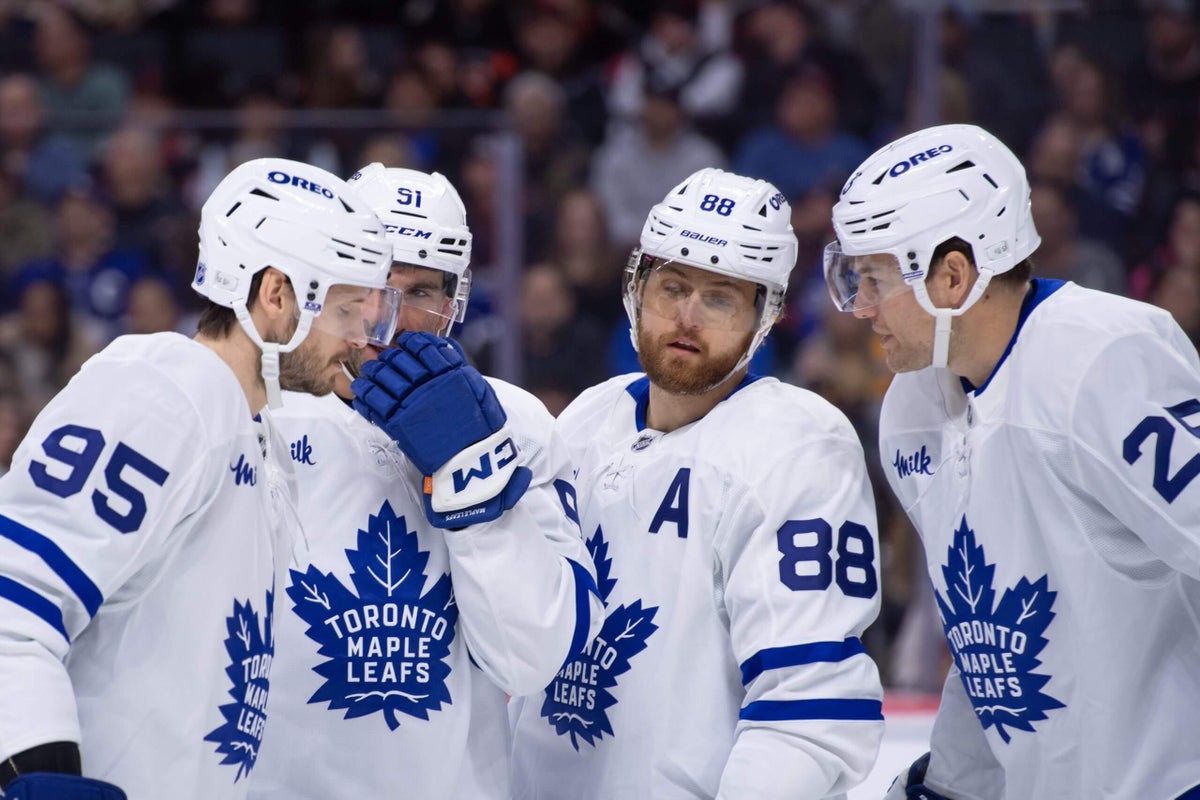
All my life, I’ve heard two things every year that were the Leafs’ shortcomings: The Leafs weren’t tough enough and the Leafs didn’t try hard enough. It’s never about the Leafs getting better; it’s always about the Leafs getting tougher and trying harder.
Frankly, it’s a load of crap that has put this team in its current mess, it’s a load of crap that colored past messes that led to this one, and it’s the same load of crap that’s currently being peddled to create future messes. It’s a tired excuse made to distract from the fact the team just isn’t good enough.
Case in point: the Radko Gudas incident on Auston Matthews. It is absolutely pathetic that no one stepped in as their captain’s knee was taken out; there’s no disagreement on that front.
But perhaps more pathetic is fans were told this is the exact team that was built to make sure stuff like that didn’t happen. Snot. DNA change. Truculence. Pugnacity. Belligerence. I already can’t wait for the next buzzword this summer. This franchise has been chasing toughness for over a decade, and none of it has mattered because stuff like this still happens, and it ends up taking up all of the city’s oxygen more than any amount of losses piling up.
More humiliating should be the reaction to it. It speaks volumes about the Toronto powers that be that the incident is getting more airtime in this city, internally and externally, than the shamefully miserable season it is housed in. The franchise seems significantly more embarrassed by this incident than by being last in the division in a year when they traded their first-round pick with only top-five protection.
This, from James Mirtle, is telling of that: “People inside and around the organization are disappointed, disgusted and down about the lack of response.” That’s strong language that hasn’t been used nearly enough about a team that entered the season with contending aspirations and will exit it as one of the league’s absolute worst. The organization is not disgusted enough with how the whole season has unfolded.
That shouldn’t even be a surprise, because being tough has always been a bigger priority than being good. The Leafs have prioritized it at almost every possible turn over the last decade across regimes, trying to address the very real issue at hand, rather than the larger issue, which is that they were never the best team in the Atlantic Division. With chances to get better and deeper, the Leafs have almost always opted for grit and grind at exorbitant costs. It’s Nick Foligno over Taylor Hall. It’s spending two future firsts on depth players at last year’s deadline. It’s a whole lot of other desperate moves in between that don’t move the on-ice needle enough because making the team “tougher to play against” was the goal, rather than making the team “tougher to beat.” It’s a team learning the wrong lessons from losses to Boston and Florida, who won with toughness, not because of it — toughness that was often organically created within the group by going deeper in the playoffs.
What they’re left with is a team that still has that issue and now also sucks on top of that. The Leafs traded all those picks and spent all those dollars for this? It’s a level of dysfunction fans should not stand for, because even within their twisted priorities, the Leafs still failed to deliver.
The bigger worry is what the Gudas incident signals, as it continues to be a talking point in the city. The very thought that this incident will shape the team’s offseason feels extremely ominous, as if the wretched stink of a wasted season will have no effect on the team’s priorities when toughness is always there as a ready-made excuse. Once again, the Leafs weren’t tough enough. That can’t be the story of this season. It’s a distraction from the team’s underlying issues, and focusing on it will ultimately lead only to a further downward spiral. The Leafs aren’t good enough is the story, and that would’ve been the story if the team were healthy and if the Leafs kept Mitch Marner, too. Every part of this summer needs to be spent addressing that reality first and foremost. The Leafs need to get “tougher,” but it can’t be at the expense of getting better.
This Leafs era is not too far gone to be saved with the right people in charge behind the bench and in the front office. We’ve seen teams turn around quickly with a new coach and make the right moves with a new general manager to aid that. It’s not over. But it can be in a hurry, because the Leafs are teetering on the brink of extinction. They’re in an extremely precarious position, where the wrong ideas can quickly push the Leafs into another decade of darkness, and it sure seems as if those wrong ideas are at the forefront of the discussion over the last week. After an abhorrent season such as this, it’s high time to shift the narrative away from the usual scapegoats.
The Leafs aren’t in this mess because they aren’t tough enough. The Leafs aren’t in this mess because they don’t try hard enough. The Leafs are here because they’ve built a team that isn’t good enough and routinely made it worse by chasing the wrong things.
At a vulnerable spot in Toronto’s trajectory, with its franchise player’s future in some doubt because of a season missing the playoffs, the Leafs can’t afford to keep making the same mistakes.
Stock watch
The biggest changes in projected value over the last 10 games.
Risers
Anthony Stolarz
Net Rating: up 1.7
One of the few bright spots of the last 10 games is the sense that Stolarz is back to looking like the guy who routinely stole games during the 2024-25 season. Stolarz has battled injuries all season and didn’t look like himself to start, but at his best, he can be one of the league’s top goaltenders. One of Toronto’s biggest potential weapons to inspire a 2026-27 comeback is an elite tandem, and getting Stolarz back on track is a huge part of it.
Over the last 10 games, Stolarz was a top-10 goalie by GSAx, and that’s boosted his projected rating back up. He’s not quite at the level he started the season, and Toronto’s projected goaltending as a whole has fallen out of the top 10 because of the yearlong struggles. But at the very least, the stretch offers some optimism that this team can still turn things around next year.
Fallers
Max Domi
Net Rating: down 2.1
Domi started to produce a bit more during the last 10-game stretch to inspire some confidence about his spot in the top nine, but as usual, that was just a mirage aided by being stapled to the team’s best player. Domi continues to be a massive liability at five-on-five, and over the last 11 has just one point to his name.
With the recent lull, Domi’s projected Net Rating is down to minus-3.2, a poor third-line rate made all the more damaging by a minus-2.2 Defensive Rating. That’s made Domi a continuously difficult top-nine fit, and the Leafs need to make it a priority to move off his contract this summer. There are way better ways to spend that money.
Jake McCabe
Net Rating: down 1.9
Toronto’s main matchup defender has had a tough go over the last little bit, which has dropped his value more than any other player’s. At his best, McCabe has been a passable No. 2 who can deliver strong defense against tough assignments, but in a lost season, he’s been crushed by that burden. That’s dropped his value to No. 3 territory, and you don’t need me to tell you that having a No. 3 as your best defenseman is not a great sign.
It’s hard to say how much of McCabe’s drop is from age, the lack of Chris Tanev or the system he’s in. He’s not a great driver in his own right and this season has had a mess of different partners who have struggled to cut it, so it’s possible Tanev (or an unrestricted free-agent defender) can bring back the most out of Toronto’s top pair. Upgrading the bench boss should have an even larger effect. But McCabe turning 33 in October and falling apart down the stretch has to be of some concern going forward. The Leafs badly need someone in the depth chart above him.
Troy Stecher
Net Rating: down 1.3
It was a nice run after he was claimed off waivers, but Stecher’s value continues to slip to a point it’s obvious why he was there in the first place. Over the last seven games he’s played during this stretch, Stecher had a 30 percent xG, the worst mark among defenders. He’s an OK No. 7 option for next season, but the Leafs can’t depend on him to be anything more than that if they re-sign him.
Stars and scrubs
The top and bottom three Leafs over the last 10 games, relative to expectations.
Stars
Anthony Stolarz
GSAx: +5.7
On a defensively porous team, Stolarz has looked like his normal self again, posting a .929 save percentage while facing over 30 shots per night. Would’ve been nice to get those saves in October, but maybe it’s for the best if the team corrects course in the right direction.
Matias Maccelli
Net Rating: +0.9
The first segment of the season was tough for Maccelli, but it’s impossible to deny his impact of late. He’s one of the few Leafs who are producing and pushing play in the right direction. He may be one of Brad Treliving’s few wins this season, and it’s a shame he’s rarely been utilized properly.
One specific example of that: The Leafs earned 54 percent of the expected goals and outscored teams 5-1 in 92 minutes with Matthews and Maccelli together. One of the team’s most gifted playmakers getting less than 100 minutes of run time with the team’s franchise goal scorer is baffling. That he’s not a defensive black hole like Domi makes the decision even more perplexing.
Maccelli is the exact level of forward in the second layer this team has long been missing — an offensively competent second liner — and it’s wild to see some of the most vocal discourse around him. With how he works with Matthews and how expensive players with his value are going to be in free agency, Maccelli should be a no-brainer on the 2026-27 roster.
Bo Groulx
Net Rating: -0.3
Three goals and five points in six games is nothing to scoff at, and it’s more than enough to get some recognition amid an otherwise sad-sack team. But there’s a reason Groulx has been in the AHL for so long and it might have something to do with the team-low 25 percent xG rate he’s put up during this NHL audition. Unless that perks up closer to the team average, I’d remain skeptical of his future utility.
Scrubs
John Tavares
Net Rating: -0.8
After a hot start to the season, Tavares has struggled over the second half. His two goals and seven points in 11 games aren’t good enough, but the even bigger problem has been defense. His 3.89 xGA/60 was the second-worst mark among forwards, ahead of only Groulx. A shift to the wing is probably necessary at his age to maintain Tavares’ top-six potential. It worked for Joe Pavelski and Claude Giroux; it should work for Tavares.
Jake McCabe
Net Rating: -1.6
This has been a tough stretch for everyone, but it’s been especially difficult for McCabe, who has been tasked with the thankless job of difficult minutes in a bad system all year. Over the last 11, he has just a 38 percent xG rate.
Simon Benoit
Net Rating: -3.0
An understated failure of this regime has been an abysmal third pair headlined by Simon Benoit. At minus-10.2, Benoit has the third-worst Net Rating in the league and was particularly brutal during this latest stretch, where he was outscored 10-3. Not having such a massive liability with the puck on the roster is one easy fix that can bring the Leafs closer to the playoffs next season. Addition by subtraction.

Quick Questions
A look at where the Leafs are and where they’re going.
Are the Leafs better than they were 10 games ago?
Change in Offensive Rating: -31.0
Change in Defensive Rating: -11.5
Change in Net Rating: -42.5
Ha!
A lot of the change is tied to the deadline and losing Matthews for the year, but it is also the result of a team that has obviously thrown in the towel on the season. Over the last 11, the Leafs have sunk to even further lows with 38.6 percent of the expected goals, the worst mark in the league by two percentage points.
For the year, the Leafs are now 27th at 47 percent. Unrelated: the 2013-14 Capitals had a 47 percent xG rate and jumped to 52.6 percent the following year. You can connect the dots as to why that’s relevant and why just one change can make the Leafs a very different team.
Where do the Leafs stand in the Atlantic?
Chances of finishing last in the division: 71.8 percent
Most likely landing spot: 8th
After winning the Atlantic last season, the Leafs will almost certainly find themselves at the bottom just one year later.
Are the Leafs a lottery contender?
Chances of 75 points or less: 0.5 percent
Chances of picking in the top five: 16.3 percent
League-wide ranking: 29th in Net Rating, 25th in projected points
This is what the people really want to know right now, and things have never looked better in this regard. The Leafs are down to 25th in projected points and the bottom five actually looks attainable right now with Matthews out and how poorly the team is playing as a whole.
But they’re not quite there yet and look increasingly likely to give Boston a top-10 pick the more they lose while not hitting the bottom five threshold. The Leafs have a 16 percent chance of landing in the top five, but a 62 percent chance of landing somewhere between six and 10.
The target: fourth worst in the league, currently projected at 76 points. The Leafs only have a 1-in-70 chance of sinking that low (winning just two or three of 12 is tough even for the worst teams), and will need plenty of help from teams below, or some lottery balls to get their pick back.
— Data via Evolving Hockey, Hockey Stats, Natural Stat Trick and Hockey Stat Cards