
How might challenges impact strategy?
The system has been tested in the minor leagues, as well as last season’s All-Star Game and spring training. During tests, there have been about four challenges per game and a 50 percent overturn rate.
It remains to be seen what kind of game strategy emerges during the season—that is, might players request challenges only in high-leverage moments late in a close game, which appears to have been borne out during the tests?
By choosing a challenge system instead of allowing every pitch in a game to be second-guessed, “players and teams will have to use these in a way that they get the most value out of them,” Martinez says.
While the goal is to ultimately correct erroneous calls, critics have argued that the use of instant replay in all sports has slowed down the games and fundamentally altered the fan experience, not always for the better. Besides, arguing with the ump is, for some fans, anyway, part of baseball’s charm.
If you’re wondering about how ABS impacts the length of a ballgame, the league reports that the test challenges have added about a minute.
“It’s actually a tribute to human umpires that baseball is not charging right into a system in which robots call every pitch,” wrote MLB senior writer Jayson Stark in The Athletic. “So in theory, umps can still control the pace of a game and call strikes the way humans see them.”
But Stark added that “in real life, if the experience in Triple A (minor leagues) tells us anything, those umpires are going to quickly get tired of having challenged calls overturned. So how can they avoid that? By calling balls and strikes the way they think the robots would call them.”
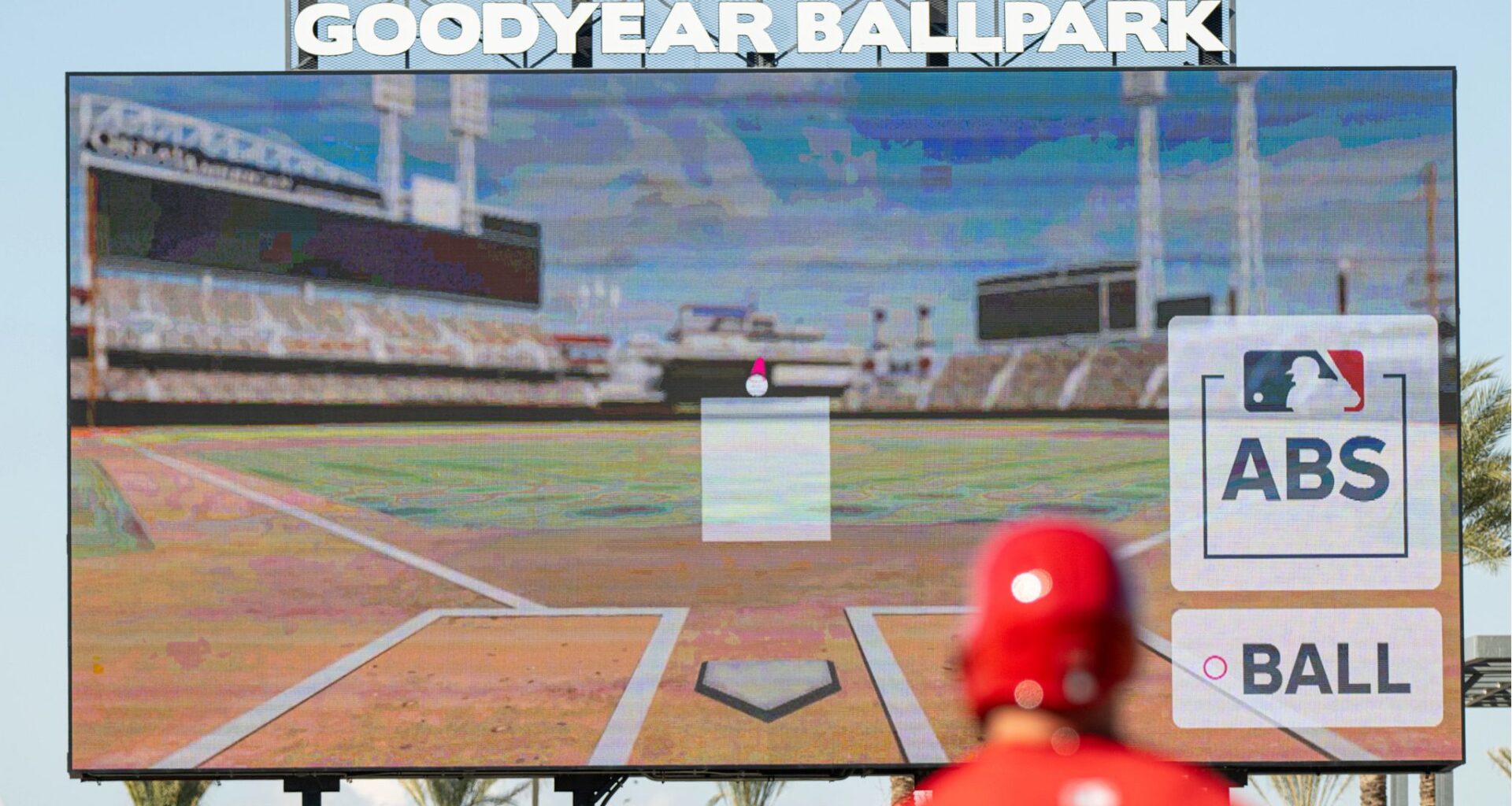
When the league posted a QR code on a jumbotron and solicited fan feedback during a spring training game last year, 52 percent of those who responded indicated that the impact of ABS technology on their experience was “very positive,” and 20 percent, “somewhat positive.”
In a routine he posted on his Facebook page, comedian Steve Hofstetter quipped, “I don’t understand why anyone is against the idea of a robot umpire. It’s like, ‘Well, it would take the human element out of the game.’ I’d be like, ‘You mean the mistakes?’ “
How accurate is the technology?
The system runs on a 5G private network provided by T-Mobile and incorporates a dozen Hawk-Eye-branded cameras placed around the perimeter of each ballpark.
ABS error rates have been very low during testing. Out of more than 88,500 total pitches in spring training, only four pitches were “untracked,” the league reports. Barring technical glitches, if you’re sitting in the ballpark, an animated graphic showing the outcome of a challenge will appear on the scoreboard, the same if you’re watching on TV.
If there is a snag, the umpire will announce the results of the challenge. If the system fails during a game, an ump’s call on the field will remain in effect.
Those watching from home won’t see a broadcast feed with a live strike zone box; any visuals with such a box will be delayed by at least nine seconds.
The era of robot umps is not likely to end with ABS. Major League Baseball is experimenting with a high-tech system progressing through the minor leagues to determine whether a batter has swung or checked his swing.
Play (robot) ball!