
As temperatures climb and trees bud with the arrival of spring, a native frog species is awakening after months being frozen and nearly dead.
Wood frogs are small, brownish-tan amphibians between 1.5 to 3 inches. They are found throughout Connecticut forests and are one of the first species to breed in large numbers just in time for spring. Many residents likely hear their calls without being sure what is making the sound.
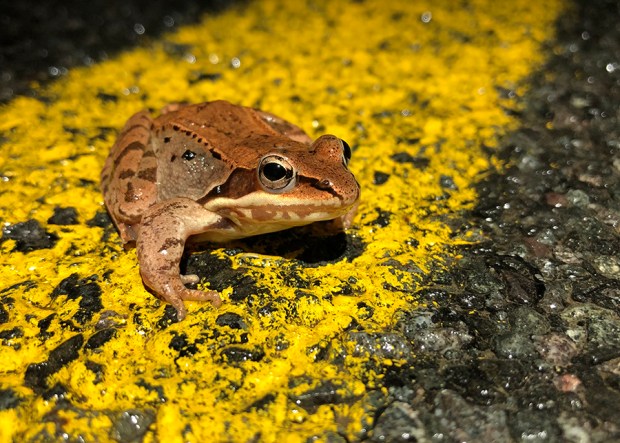 A wood frog crossing a street (Photo/Credit Paul Benjunas, CT DEEP outreach wildlife biologist)
But it’s their ability to survive harsh and freezing conditions that makes them among the most unique species in Connecticut, according to state wildlife biologist Mike Ravesi with the Connecticut Department of Energy and Environmental Protection.
“They are underappreciated and overlooked for their amazing ability to overwinter,” Ravesi said.
“These animals don’t produce their own heat and rely on external heat sources, yet they can spend a third of their life in freezing cold temperatures,” Ravesi said. “Their liver can convert glycogen to glucose that disperses throughout their body as a cryoprotectant. So it basically prevents their cells from being destroyed from bursting. The frogs do freeze over and are basically frozen solid, but they do not die.”
While most other frogs overwinter underwater where they do not freeze, the wood frog instead hides under leaf cover on the forest floor to survive the winter.
This provides little protection against the cold and elements, according to Ravesi. Because the liver produces large amounts of glucose that prevents the cells from freezing, they are able to survive with just a faint heartbeat. Ravesi said this strategy allows them to breed faster as temperatures drop quicker on land than in water.
“They’re basically in suspended animation, they are not dead technically,” Ravesi said. “But they just barely have a pilot light on. Their heart beats very slowly and their bodies are completely frozen over, but their cells do not freeze. In the spring, they start to literally thaw and look for vernal pools to breed.”
The wood frog is the only frog species capable of surviving north of the Arctic circle, he said. They are found throughout New England, Canada and as far north as Alaska.
In a Facebook post shared by Connecticut Fish and Wildlife, officials said during this time of the year, wood frogs are “waking up” and crossing roads to reach their critical habitat. Officials are urging caution to ensure that the frogs, which are declining in numbers, can safely cross the road.
“Wood frogs only breed in vernal pools. They cannot breed in ponds, swamps or marshes. If you hear wood frogs, you have found a vernal pool. Not only do wood frogs need vernal pools, they also need the surrounding forest where they spend most of their lives feeding on spiders, insects and worms, and hiding under the leaf litter,” according to Connecticut Fish and Wildlife.
Vernal pools are small and temporary wetlands that fill with water in winter and spring and dry out by summer, Ravesi said. A combination of snow melt and spring rainfall often fill them by March.
Ravesi said that the wood frog is not listed an endangered species, but its numbers are declining due to habitat loss.
“Despite most amphibians overwintering within just a quarter of a mile of their breeding pool, reaching the pool often requires them to cross roadways, which can be fatal due to motorists,” according to the Connecticut Fish and Wildlife. “Please use extra caution while driving during rainy nights to allow for their safe passage. If you are aware of a migration hotspot, consider taking an alternate route or simply avoid traveling on smaller, wooded roads.”
Stephen Underwood can be reached at sunderwood@courant.com.