
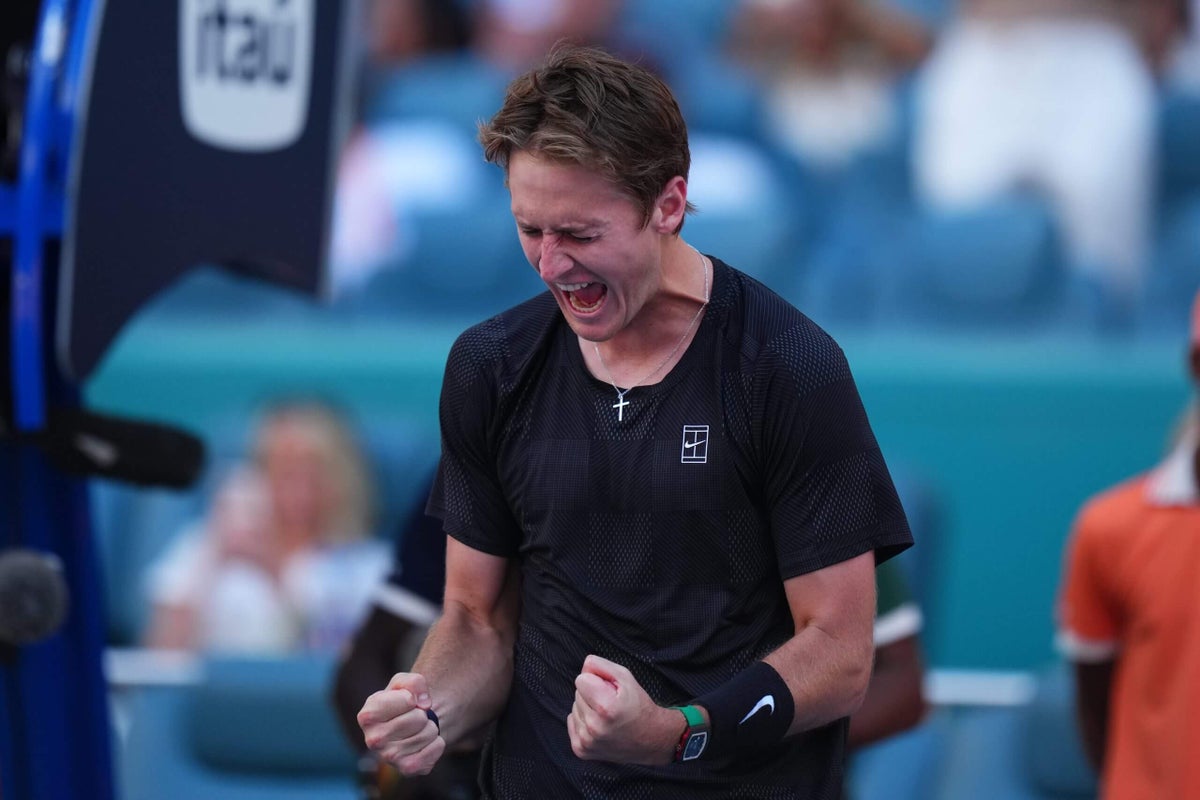
For the better part of a decade, the tennis world has been waiting for Sebastian Korda to arrive. A slew of injuries and a tendency to freeze up near the finish line have gotten in the way. But Sunday afternoon at the Miami Open, Korda showed why there has been so much belief for so long.
With a display of smooth, controlled aggression and a flurry of flat power, Korda, 25, knocked off world No. 1 Carlos Alcaraz on the court where the seven-time Grand Slam champion won his first ATP Masters 1000 title, in 2022. When healthy, Korda can play from every inch of the court. And that’s about what he did Sunday, riding his big serve to a 6-3, 5-7, 6-4 win in Hard Rock Stadium.
A week ago, Daniil Medvedev redlined his way to a semifinal win over Alcaraz at Indian Wells. Alcaraz arrived in Miami fired up for his first match Friday night, putting on a master display of power against João Fonseca, the rising star from Brazil.
Korda presented a different kind of challenge. He lacks the flash and overpowering pop of Fonseca, but he has all the power he needs. When he mixes it with a deadly slice and his love of moving forward and finishing points with deft volleys, Korda can do all sorts of damage, especially to someone like Alcaraz on an off day.
“It was a lot of tense moments, for sure. But I think today the ultimate thing was belief, going back to just believing, committing in every shot. Luckily I got it done at the end,” Korda said in his news conference.
Alcaraz landed just 60 percent of his first serves Sunday. Even worse, he followed those with a series of second balls at Korda’s body. Korda, who has stellar footwork, easily handled them, putting Alcaraz on his back foot in service game after service game.
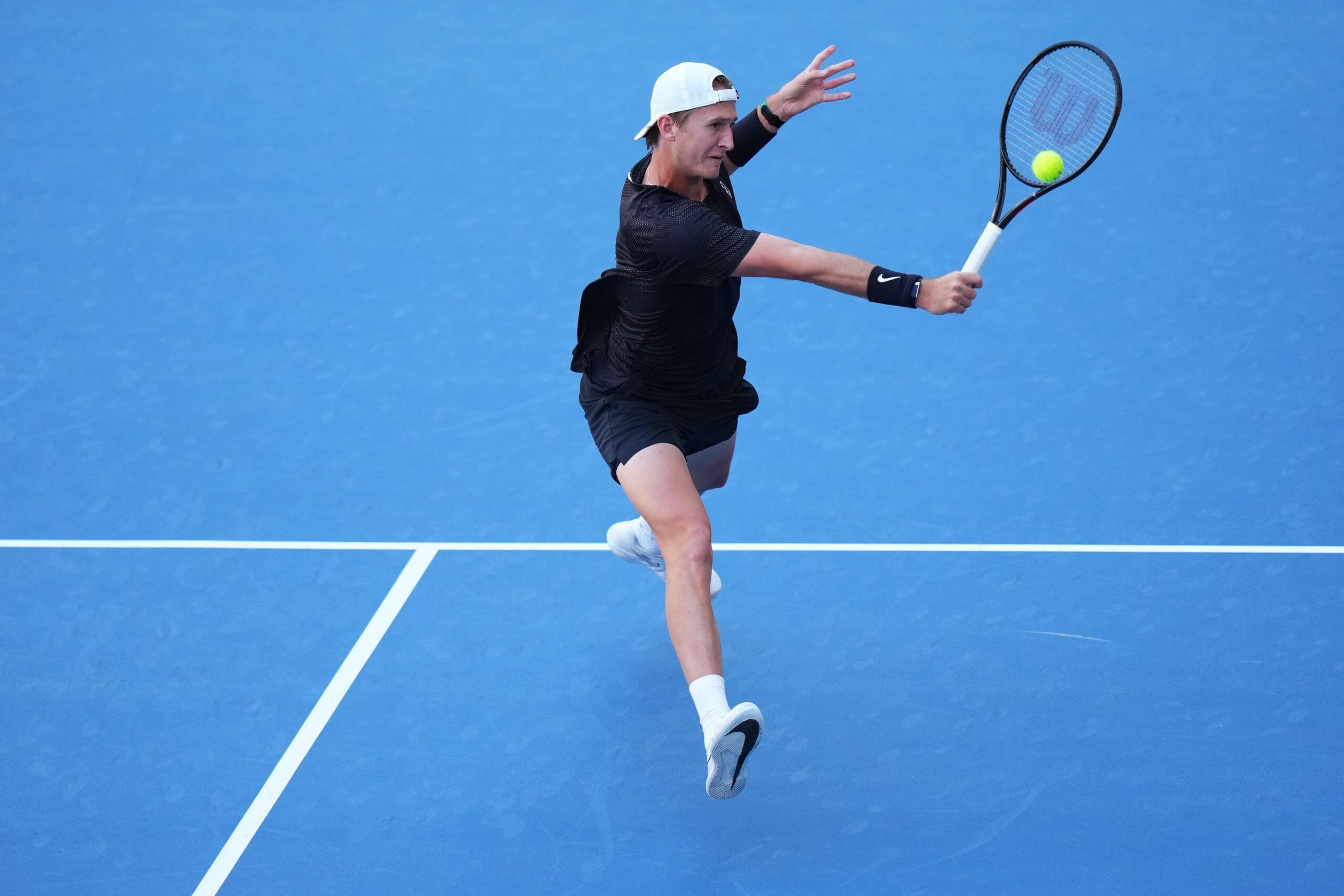
Sebastian Korda used his all-court tennis to get under Carlos Alcaraz’s skin at the Miami Open. (Rich Storry / Getty Images)
As he always does, Alcaraz produced a sprinkling of highlight-reel moments. There was a running forehand topspin lob that thrilled the stadium. There was a crosscourt backhand with his back against the wall, and a fancy lob off a drop return that sent Korda scrambling. And there was the near-death escape in the second set. Twice actually. A nasty kick serve to save a break point prevented him falling behind two service breaks. Then Alcaraz broke Korda at love when the American served for the match in the second set.
After that, it looked as if Korda was done. But he somehow stayed even with the world No. 1 through the first six game of the third set. Then, with Alcaraz suddenly playing a slightly sloppy game, his feet not floating the way they had for the past 10, Korda outlasted him in a crosscourt forehand battle. When Alcaraz sent a forehand wide, Korda was back where he had been about 45 minutes earlier, needing to hold serve twice to take the match.
This time, he didn’t freeze up. Alcaraz saved a first match point when Korda played a tentative approach shot. But on the next one, Korda slammed his serve down the middle of the court. Alcaraz sent the return long, and Korda closed his eyes with his racket above his head. Glory delayed, but not denied.
In his news conference, Alcaraz said he faced a different Korda at the end of the third set compared with at the end of the second.
“He just made three mistakes in a row that he didn’t make it in the whole match. I just made the most of it,” he said.
“But on 5-4 in the third set, I think he just knew what he has to do. He just played with a lot of first serves, which it’s tough when he plays with a big first serve. It’s kind of he was in that moment before. He just dealt with that much, much better.”
The loss moves Alcaraz to 17-2 on the season. He won his first two tournaments, taking the Australian Open to become the youngest man to complete the career Grand Slam, then winning the Qatar Open in February to move to 12-0.
He is just 5-2 since, with the semifinal loss at Indian Wells and Sunday’s round-of-32 setback in Miami Gardens, Fla. If there is a silver lining, the loss gives Alcaraz an extra week of rest before the start of the clay-court season, which will begin for him in Monte Carlo in early April.
Alcaraz was the best in the world on clay last year. He won the Monte Carlo Masters, the Italian Open and the French Open. He lost in the final of the Barcelona Open, where he suffered an injury that kept him from playing the Madrid Open.
Since 2022, though, Miami has caused him problems. Jannik Sinner beat him there in 2023. Grigor Dimitrov hit him off the court in 2024. Last year, he lost his opening-round match to David Goffin of Belgium, a solid but unspectacular journeyman playing out the final seasons of his career.
That loss was a wake-up call. He went 73-6 from that loss until Sunday. He was 10-6 after going down a set. He was 17-1 in his last 18 matches against Americans, the blemish a loss against Taylor Fritz at the Laver Cup.
Korda is a different sort of American, though. He is the lone U.S. man who, when healthy and in form, has some of the best qualities not just of his top compatriots, but of the European players who have dominated the Grand Slams the past 25 years. His serve may not be as big as Ben Shelton’s or Fritz’s, but it is plenty big. He has the touch and athleticism of Tommy Paul and the flat power of Frances Tiafoe. But he also has the easy movement and deftness of, well, Alcaraz. Just not quite to the same degree.
“Sebi was incredible today,” Alcaraz said. “Played such a great game. A lot of tight, tight moments that I just didn’t make the most of it. I think he was better on those points, on those moments. I would say that was the key of the match.”
Korda won the Delray Beach Open in February, his first title since the D.C. Open in 2024. The injury bug got him after that. On Sunday, he gave himself a chance once more for the start of something new.