
United States Hypersonic Technology Market Overview
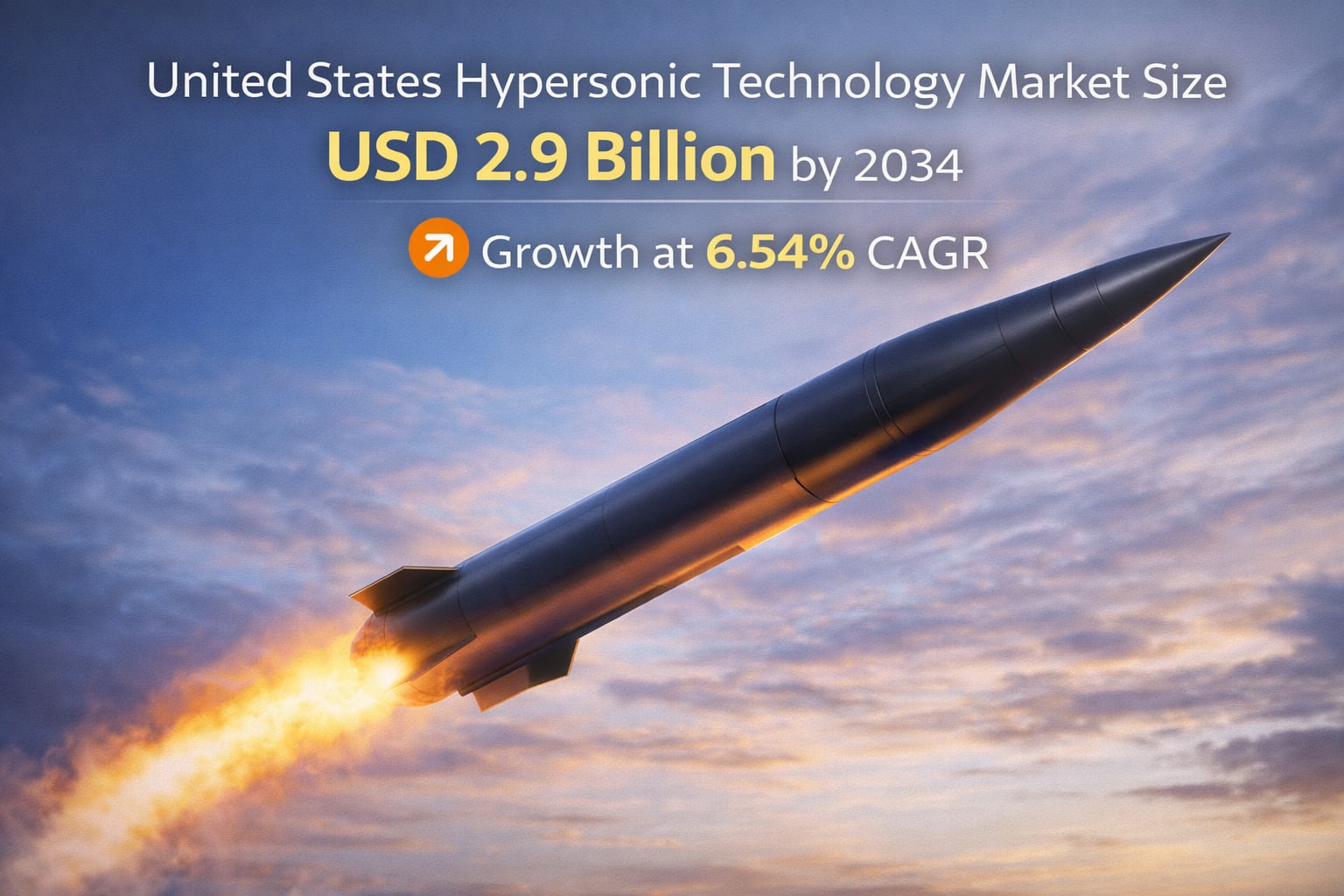
The United States hypersonic technology market is witnessing rapid advancements, driven by increasing investments in defense modernization and next-generation aerospace innovation. The market reached a value of USD 1.6 Billion in 2025 and is projected to grow to USD 2.9 Billion by 2034, exhibiting a CAGR of 6.54% during 2026–2034.
As of 2026, the market is gaining strong momentum due to the growing need for ultra-fast transportation systems and advanced missile capabilities. Hypersonic technologies, capable of traveling at speeds greater than Mach 5, are becoming a strategic priority for both military and commercial applications.
The rising demand to reduce intercontinental travel times and enhance passenger experiences is pushing aerospace companies to invest in hypersonic passenger aircraft concepts. At the same time, advancements in hypersonic missile systems are enabling improved precision, maneuverability, and survivability, further strengthening national defense capabilities.
Key Trends Shaping the United States Hypersonic Technology Market
The evolution of hypersonic technology in the United States is being shaped by several emerging trends:
• Defense-Focused Innovation: Increased funding for hypersonic weapons programs is accelerating R&D efforts across government agencies and private defense contractors.
• Commercial Aerospace Exploration: Companies are exploring hypersonic aircraft for ultra-fast travel, potentially reducing long-haul flights from hours to minutes.
• Advanced Material Development: New heat-resistant materials are being developed to withstand extreme temperatures generated during hypersonic flight.
• Testing and Simulation Technologies: Enhanced simulation tools and wind tunnel testing capabilities are improving design efficiency and reducing development risks.
These trends are collectively strengthening the technological foundation of the hypersonic ecosystem.
Major Growth Drivers in the United States Hypersonic Technology Industry
Several factors are driving the expansion of the hypersonic technology market:
1. Increasing Demand for Faster Travel
The need to significantly reduce travel time between continents is a major driver. Hypersonic aircraft could revolutionize global mobility by enabling near-instantaneous travel, improving both business and leisure experiences.
2. Advancements in Missile Systems
Hypersonic missiles offer superior speed, accuracy, and evasive capabilities compared to traditional systems. These advantages are prompting increased defense spending and accelerating innovation in this field.
3. Rising Investments in Research and Development
Government agencies and private companies are heavily investing in hypersonic research programs, focusing on propulsion systems, aerodynamics, and thermal protection technologies.
4. Strategic Military Importance
Hypersonic technology is becoming a critical component of national security strategies. The ability to deploy rapid-response systems is encouraging continuous development and testing.
Role of Hypersonic Technology in Aerospace and Defense Transformation
Hypersonic technology is playing a transformative role in both aerospace and defense sectors. In defense, it enhances the ability to respond quickly to threats while improving mission success rates. Hypersonic glide vehicles and cruise missiles are redefining modern warfare capabilities.
In the aerospace sector, hypersonic propulsion systems are enabling the development of next-generation aircraft designed for ultra-fast travel. These innovations are expected to reshape the aviation industry by introducing new standards for speed, efficiency, and performance.
Investment Opportunities in the United States Hypersonic Technology Market
The growing focus on hypersonic innovation is creating significant investment opportunities:
• Defense Contracts: Large-scale government contracts are fueling the development of hypersonic weapons and testing systems.
• Aerospace Startups: Emerging companies are working on hypersonic passenger travel solutions, attracting venture capital and strategic partnerships.
• Material Science Innovations: Investments in advanced materials capable of withstanding extreme heat are opening new research avenues.
• Testing Infrastructure: Expansion of testing facilities and simulation platforms is creating opportunities for technology providers.
These opportunities are encouraging collaboration between government agencies, research institutions, and private sector companies.
Challenges Impacting the United States Hypersonic Technology Industry
Despite strong growth potential, the market faces several challenges:
1. High Development Costs
The cost of designing, testing, and deploying hypersonic systems is extremely high, which can limit participation to large organizations and government-backed projects.
2. Technical Complexity
Hypersonic flight involves extreme conditions, including high temperatures and pressure, making engineering and material design highly complex.
3. Regulatory and Safety Concerns
Developing commercial hypersonic travel requires strict regulatory approvals and safety standards, which can slow down adoption.
4. Limited Testing Infrastructure
Although expanding, testing facilities for hypersonic systems are still limited, creating bottlenecks in development timelines.
Future Outlook of the United States Hypersonic Technology Market
Looking ahead, the United States hypersonic technology market is expected to experience steady growth through 2034. Continuous advancements in propulsion systems, materials science, and simulation technologies will play a crucial role in shaping the industry.
As of 2026, increasing collaboration between defense agencies, aerospace companies, and research institutions is accelerating innovation. The integration of artificial intelligence and advanced analytics in hypersonic system design is also expected to enhance performance and reduce development timelines.
The market’s future will largely depend on overcoming technical challenges, reducing costs, and expanding testing capabilities. With sustained investments and technological breakthroughs, hypersonic technology is poised to redefine both defense systems and global transportation.
Conclusion
The United States hypersonic technology market is entering a transformative phase, driven by the need for faster travel, enhanced defense capabilities, and advanced material innovations. With a projected growth from USD 1.6 Billion in 2025 to USD 2.9 Billion by 2034, the market presents strong opportunities for stakeholders.
As highlighted in structured market reports , technological innovation, strategic investments, and industry collaboration will be key to unlocking the full potential of hypersonic systems. Despite existing challenges, the market outlook remains highly promising, positioning hypersonic technology as a cornerstone of future aerospace and defense advancements.