
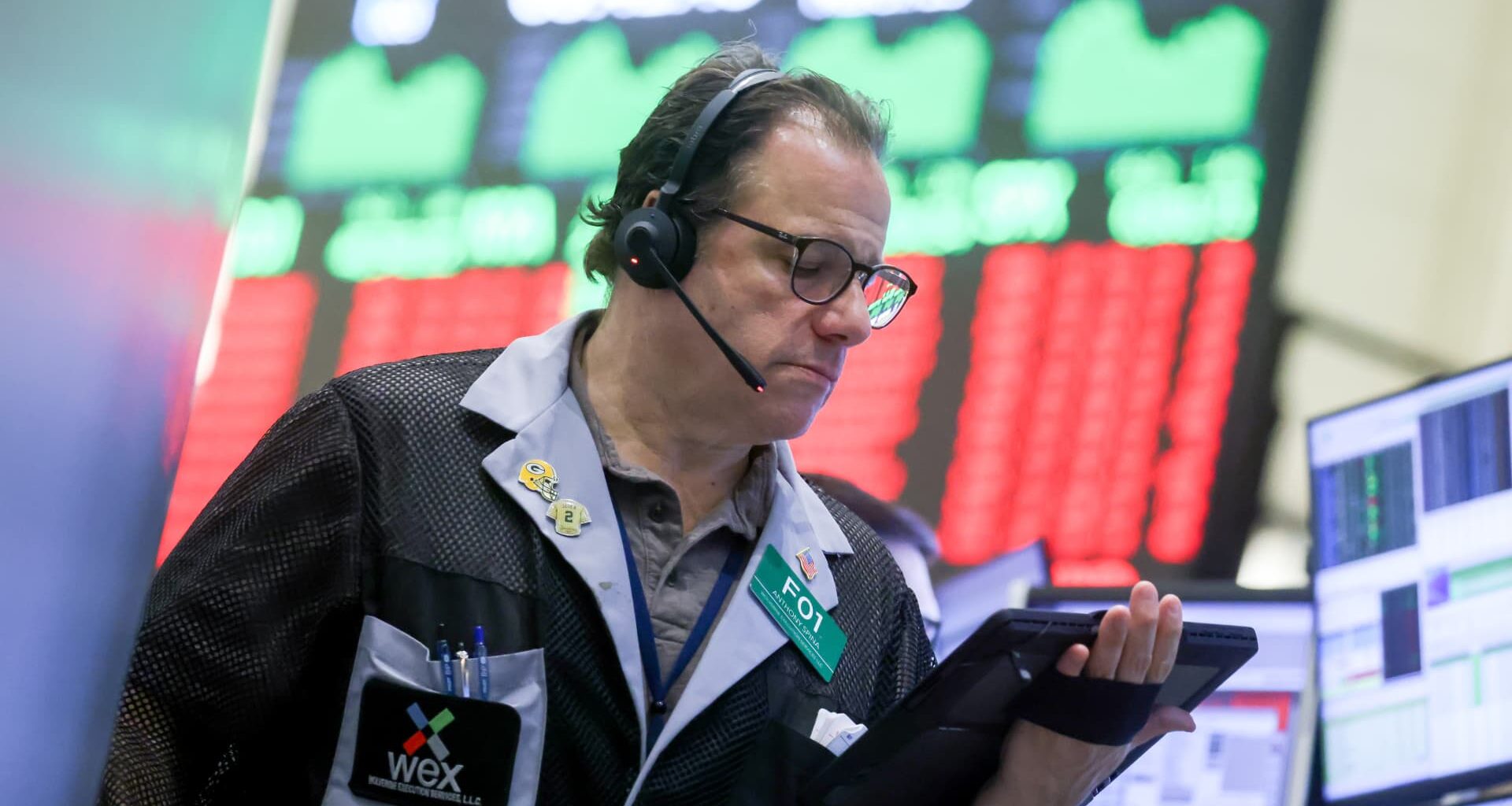
A trader works on the floor of the American Stock Exchange (AMEX) at the New York Stock Exchange (NYSE) in New York, US, on Monday, March 23, 2026.
Michael Nagle | Bloomberg | Getty Images
The Dow Jones Industrial Average and S&P 500 were relatively unchanged on Tuesday as the two indexes attempted to build on the strong gains seen in the previous session. Crude prices also resumed their rally while the Iran war moved further into its fourth week.
The 30-stock index traded up 0.1%, while the broad market index fell 0.1%. The Nasdaq Composite dropped 0.5%.
The major averages all rose more than 1% on Monday after President Donald Trump said in a Truth Social post that the U.S. and Iran have held “very good and productive conversations regarding a complete and total resolution of our hostilities in the Middle East.” Iranian state media reported that there were no direct talks between the two countries, however.
In the leadup to Trump’s announcement, the U.S. did engage with Iran in a series of closed-door discussions through Middle Eastern intermediaries, according to The Wall Street Journal, which cited people familiar with the matter. That said, the report stated that there was some doubt expressed privately by Arab mediators at the prospect of the two countries quickly reaching an agreement, as both sides were still far apart.
On Wall Street, confusion has grown among investors over how effective the talks to end the war were, given that Israel and Iran have since continued to exchange strikes in the wake of the president’s Monday comments, per Israeli authorities.
Oil prices rose Tuesday after tumbling in the prior day. Global benchmark Brent crude futures added more than 3% to trade above $103 a barrel. West Texas Intermediate crude futures jumped 4% to above $91 a barrel.
Despite Trump’s optimistic tone, Citi U.S. equity strategist Scott Chronert doesn’t believe that investors are out of the woods just yet.
“We still have a lot of wood to chop in terms of where oil prices end up shaking out; how those impact underlying economic conditions. So we think we’re okay for right now with this down 5% to 10% narrative, but we have to be on the lookout that the risks are still out there and are still pretty notable,” he said on CNBC’s “Closing Bell: Overtime” on Monday afternoon.
The developments came after Trump over the weekend had threatened an attack on Iranian power plants if the Strait of Hormuz wasn’t reopened. Iran, in turn, said that it would target U.S. infrastructure as a retaliatory tactic.