
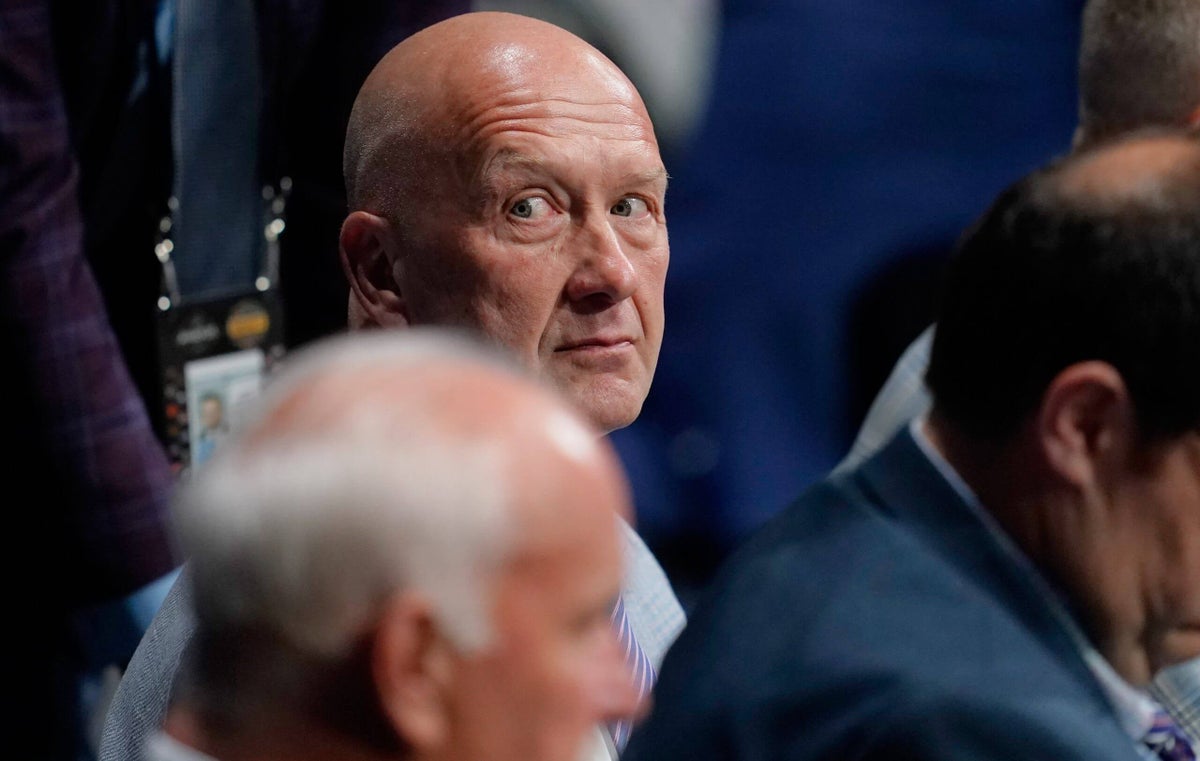
BUFFALO, N.Y. — Florida Panthers general manager Bill Zito learned everything he needed to know about Buffalo Sabres general manager Jarmo Kekäläinen on a pickleball court in the NHL’s playoff bubble in 2020.
Zito was the assistant general manager in Columbus under Kekäläinen. On an off day, he and Kekäläinen had a pickleball match against Tampa Bay Lightning general manager Julien BriseBois and assistant general manager Mathieu Darche. The problem was that Zito had never played pickleball. He didn’t even know the rules, but Kekäläinen insisted.
BriseBois and Darche, both a decade younger than Zito and Kekäläinen, saw an easy mark. They hit every ball they could at Zito.
“Poor Jarmo is in the back going from side to side, diving, smashing, spinning,” Zito said. “And I’m just in the middle messing the whole thing up.”
Somehow, Zito and Kekäläinen pulled out a win.
“I was actually impressed with his hands since he hadn’t played very much,” Kekäläinen said. “But he had a tough time grasping the rules. I chirped him and said, ‘You’re a lawyer and you can’t figure out pickleball rules?’”
Kekäläinen’s competitiveness and drive on the pickleball court weren’t much of a surprise to Zito. Zito and Kekäläinen have known each other since the 1990s, when the two were in the agent business. Zito then ended up working under him when Kekäläinen was the general manager of the Blue Jackets. And they’ve since been dealing with one another as competing general managers for the last six years. When Zito thinks of what has made Kekäläinen a successful general manager, he goes back to 1998.
That was before Kekäläinen’s decade-plus run as general manager of the Blue Jackets and before his decade-plus of holding high-ranking positions in the front offices of Ottawa and St. Louis. In the late 1990s, Kekäläinen was in his late 20s, fresh off a five-year pro playing career that saw him bounce from the NHL to European pro leagues. He then had a brief stint in the agent business before becoming a European scout for the Senators and the general manager of HIFK in Helsinki. That’s when Kekäläinen built one of the most dominant teams in the history of Finland.
The roster had future NHLers Olli Jokinen, Jarkko Ruutu, Brian Rafalski, Kimmo Timonen, Tim Thomas and Niklas Backstrom. A few of those players were Zito’s clients, so he had a close eye on that team throughout the season. That year, HIFK lost the first game coming out of the Olympic break. They didn’t lose another game after that, including the playoffs.
“Think about that,” Zito said, still amazed almost 30 years later. “That speaks volumes about his ability as a manager and as a leader.”
A smile spreads across Kekäläinen’s face when he talks about that team. He said his stint with HIFK gave him a taste of both the “heaven and hell” of being a general manager. That was his first GM job, and he was just 28 when he got hired. In his first full season on the job, HIFK missed the playoffs for the first time after 11 straight seasons in the playoffs. Even early in the year of that championship run, Kekäläinen got some on-the-job training in the leadership aspects of the gig. That team had a lot of big personalities.
“There was some turbulence early on in the year because of the personalities,” Kekäläinen said. “One thing that taught me was that a hockey team can’t be all choirboys. It’s a lot of different personalities, and you have to be able to manage them.”
That’s something Kekäläinen still puts a premium on as general manager of the Sabres. He doesn’t like formal meetings in his office, but he’ll pull a player aside while grabbing a protein drink in the cafeteria or ask a player to grab a coffee on the road. He’s interested in getting to know his players but also providing input on their game. He spends a ton of time in the coaches’ room, too, discussing ideas about the lineup and how certain players are performing.
“There’s a lot more to a manager’s job than just putting the roster together,” he said. “That’s something that I take very seriously.”
Leadership, Zito says, might be Kekäläinen’s greatest strength. He’s seen it at every step of Kekäläinen’s career, and it wasn’t a surprise to see Kekäläinen become the first European-born general manager in NHL history.
“If you had occasion to know him, you’re not surprised at all,” Zito said. “It’s just what he is. I appreciate the social impact as a European doing that, but for me, it was not even a thing. Saying Jarmo is a leader is like saying Wilt Chamberlain is tall. It’s just what he is. He was a leader, and that’s who he is as a person.”
Leadership isn’t always easy to define or describe. But Kekäläinen is easy to follow because of his actions. When he was a player, he willed himself into the league and took a hard path to becoming an NHLer. After time as an agent, he worked his way up the scouting ranks to climb from scout to director of player personnel to director of amateur scouting and eventually to an assistant general manager job. As he continued to rise in NHL front offices, he still spent a ton of time on the road, scouting in small-town rinks.
“He’s a guy that if he gave a set of instructions you would follow the instructions not because of his authority but because you didn’t want to let him down,” Zito said. “Because there’s substance behind what he does.”
The way Jokinen describes it, Kekäläinen is one of those people who, when he walks into the room, you feel his presence. It might be because, back in those days in Finland, Kekäläinen was able to beat some players at the team fitness test. Kekäläinen, who used to run marathons, laughed at the idea of being able to push players in the fitness test now at the age of 59. But little things like that helped his words carry a different weight with the players early in his career.
“He leads by example,” Jokinen said. “We had a saying here in the ’90s in Helsinki when Jarmo said everybody needs to be in good shape, that meant we need to be in better shape than Jarmo, because he’s going to be in good shape. He’s a GM, but he’s probably going to beat all of us in the fitness test.
“For some people, you have that thing where the person walks in the room, and it’s like, ‘This guy has the aura around him.’ And there’s immediate respect toward the guy just by the way he handles himself and the way he speaks.”
One of Kekäläinen’s favorite books is Geoffrey Colvin’s “Talent is Overrated: What Really Separates World-Class Performers from Everybody Else.” It aligns with Kekäläinen’s personal team-building philosophy, one he hasn’t strayed from since those days in Finland. Jokinen remembers the emphasis Kekäläinen put on backchecking, getting in shot lanes and other details that “everyone is capable of doing if you have the will to do it.”
“The way Jarmo was leading the team, if you had one off game, he let you know immediately,” Jokinen said. “Sometimes even between the periods. Most of what Jarmo really demands is the effort. It’s never going to be on the guys if somebody makes a mistake.
“For him, the main thing is about the character. It’s not so much if you’re able to do the stickhandling through the cones. He would rather take the guy who goes through the wall.”
Kekäläinen made that same point in his introductory news conference as the Sabres’ general manager. He said he defines talent a little bit differently, with an emphasis on work ethic and character. His message to the players was similar. Simple as it was, it clearly sank in. The Sabres were on a three-game winning streak when Kekäläinen took over. They extended that streak to 10 games, and since Kekäläinen’s first day on the job, the Sabres have a 30-6-3 record, the best in the NHL during that span.
“Our group has responded,” Sabres forward Alex Tuch said. “There’s a maturity and a development that I’ve seen out of this group. We are a hard team to play against. We are miserable to play against.”
It would be hyperbolic to say the Sabres’ turnaround is entirely the result of Kekäläinen and his leadership. The Sabres were missing some key players early in the season. Getting healthy was a big reason Buffalo’s season got back on track.
But the general manager change, like any major change in leadership, had an effect on the entire organization. Kevyn Adams had been with the Sabres for five and a half seasons without a postseason appearance. And while he made some strong roster moves during his tenure, his public messaging was, at times, ineffective and often inconsistent. His voice had grown stale. Early in the season, every bad game the Sabres played at home resulted in chants for Adams to be fired. That impacted morale.
In the NHL, the public often talks about the bump a team can get from firing a coach midseason. The Sabres got some of the same benefits by firing their general manager. Whether it was a wake-up call or just a change in messenger, the change got the attention of the players. The way Sabres veteran Jason Zucker explained it, players can feel a certain level of comfort with the general manager who drafted them or brought them in.
“There’s always that underlying safety of, ‘I’m his guy,’” Zucker said just before the trade deadline. “Not one person in this room can say that now.”
Zucker doesn’t think as much about the differences between Adams and Kekäläinen. Adams might have been chattier, whereas Kekäläinen is quieter and a bit more stoic. Zach Benson went as far as to say, “It’s intimidating to say good morning to him sometimes.” Zucker laughed that off as a childish comment from the 20-year-old Benson.
“Every GM has their own personality,” Zucker said. “For me, in any line of work, if you’re not yourself and you’re not the person that you show up as every single day, people are going to see right through you and have zero respect for you. People may not like you for who you are and what you do, but if you’re yourself genuinely daily, at least you can say, that’s who I am. I think Kevyn did that, and I think Jarmo did that. Obviously, they’re different personalities, but that doesn’t mean one is worse than the other.”
Kekäläinen deflects all credit to the players and coaching staff. They’re the ones getting results on the ice.
But Kekäläinen has played a role, too. When he got fired by the Blue Jackets in 2024 after making the playoffs five times in 11 seasons, he was out of work for the first time in almost three decades. He scouted for Team Finland ahead of the 4 Nations Face-Off, so he was still at the rink. But he also had more time to read, watch documentaries and explore his curiosities. One of those curiosities is A.I. He did some work for SprintAI, an athletic training platform for athletes and coaches. He visited the Los Angeles Rams’ training camp to see how they are implementing the technology and became further convinced that it’s the future.
“There’s so much data now in sports,” Kekäläinen said. “I always felt it was coming from different silos, whether it was performance side, analytics side, salary cap, all of this info was coming from different directions. How do we put all of this together? It’s so much that it’s hard to put together, but AI makes that more efficient and gives you real-time recommendations, and alerts and even predictions.”
Kekäläinen comes from a hockey family, but he and his brothers are also lifelong learners. His brother, Jari, Winnipeg’s director of European scouting, studied math and physics before his career in hockey. His other brother, Janne, a European scout for Nashville, studied psychology in college. Jarmo has two degrees and is still trying to stay on the cutting edge of technology at 59.
“I always try to learn,” he said. “I always say the day I don’t think I can get better is the day that I’ll retire.”
The question now is whether his tenure as Sabres general manager will be better than his stint in Columbus, where he accomplished a lot, made a ton of aggressive moves but ultimately fell short of his goal of winning the Stanley Cup.
The NHL trade deadline served as his first true test in the job. He was involved in talks for two big-time players in Robert Thomas and Colton Parayko. The Parayko deal fell through because Parayko declined to waive his no-trade clause. Kekäläinen ended up pivoting to adding depth pieces in Logan Stanley, Luke Schenn, Sam Carrick and Tanner Pearson.
The word Sabres coach Lindy Ruff used to describe Kekäläinen during a hectic deadline week was “calm.”
“Sometimes it’s an act,” Kekäläinen said. “I’m not so calm during the games, always when we’re turning the puck over with a 4-1 lead and five minutes left in the game. You’re learning in this business, too, that you can’t always let your feelings out for everybody to see yourself. So, yeah, I got the calm on the outside but a storm brewing inside.”
The only storm the rest of the league has seen is the Sabres climbing from last place to first place in the Atlantic Division. And as a rival general manager, one who has won the Stanley Cup two years in a row, Zito doesn’t think what’s happening in Buffalo is a fluke. Kekäläinen’s impact isn’t a mirage.
“I can tell you from the outside, I’m not even there, but I don’t have to be,” Zito said. “It’s real.
“It’s great for hockey. It’s good for everybody. It’s one of the most storied franchises. Fans are rabid. It’s awesome.”