
The New York Jets badly need wide receiver help.
Every Jets fan knows this by now. They just watched a season in which no player on the team’s roster could hit 400 receiving yards.
Yet, as we sit here with less than one month until the 2026 NFL draft, New York has not added a single wideout via free agency or trade.
Even so, perhaps that first sentence should be rephrased.
It might be more accurate to say this: The New York Jets badly need pass-catcher help.
Whether it’s a wide receiver or not, the Jets flat-out need people who can catch the football.
According to Pro Football Focus, New York had the NFL’s lowest-graded receiving unit in the 2025 season, posting a 60.3 grade. That grade is composed of every pass-catcher on the team, which means the tight ends and running backs are just as important as the wide receivers.
The Jets have a talented receiving back in Breece Hall. They also have a high-upside tight end in Mason Taylor, who was selected in the second round of last year’s draft.
Taylor’s ceiling is high based on his rookie-year performance, which featured a dazzling display of contested-catch reliability despite modest box-score totals due to poor quarterbacking. However, Taylor did struggle with drops (10.4% drop rate), and the Jets have essentially zero receiving skills at tight end beyond Taylor.
The Jets’ second-string tight end, Jeremy Ruckert, has caught one touchdown in four NFL seasons, and it came in garbage time against a horrendous defensive team. In a league where two-tight end packages are becoming more popular, it is a disadvantage to have a TE2 who cannot threaten defenses through the air.
New York’s lack of depth behind Taylor, as well as the fact that Taylor is still unproven, means that the Jets must consider every pass-catcher available to them in the first round of the 2026 NFL draft. Tight end is still very much a need for New York.
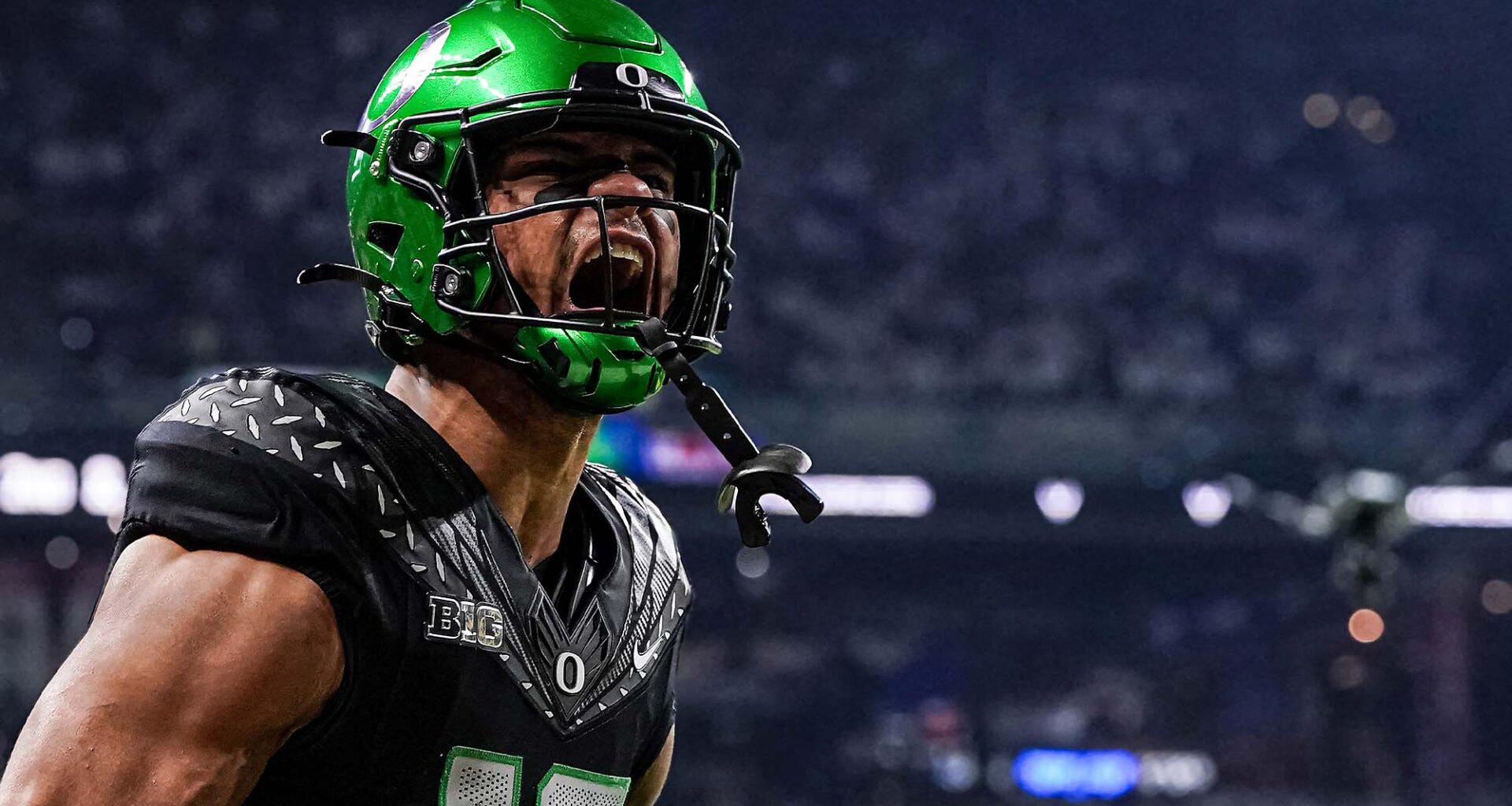
That is why Oregon tight end Kenyon Sadiq is rapidly gaining steam as a potential target for the Jets with the 16th overall pick.
Kenyon Sadiq to New York?
Many analysts and Jets fans are fully expecting the team to select a wideout at No. 16. With tantalizing options like USC’s Makai Lemon, Arizona State’s Jordyn Tyson, and Washington’s Denzel Boston potentially being on the board in that spot, it seems like a no-brainer for the Jets to address their pressing wide receiver need with a first-round pick.
But what if a wide receiver isn’t the best pass-catcher available in that slot?
Lemon could be off the board. Tyson’s medicals are highly concerning. Boston is only viewed as a second-round prospect by some analysts.
There is absolutely a world where Sadiq, the consensus No. 16 overall prospect according to NFL Mock Draft Database, emerges as the Jets’ best option to bolster their passing game in the mid-first round.
Sadiq only recently turned 21. Despite being under the legal drinking age this past season, he ripped collegiate defenses apart, recording 51 receptions for 560 yards and eight touchdowns in 14 games.
Alongside Sadiq’s production is a world-class athletic profile that gives him a tantalizing ceiling. At 6-foot-3 and 241 pounds, Sadiq ran the 40-yard dash in 4.39 seconds, a 98th percentile all-time mark for tight ends. He also recorded a 43.5-inch vertical jump (99th percentile) and a 133-inch broad jump (98th percentile).
Because of Sadiq’s otherworldly traits and lean frame for the tight end position, he can almost be classified as a quasi-wide receiver going into the NFL. In fact, this past season, Sadiq lined up in the slot on 58.5% of his routes run.
Sadiq was dominant on those reps, leading all FBS tight ends with five touchdown receptions out of the slot. That was only two fewer than USC wide receiver Makai Lemon, who is widely considered the best slot receiver in the 2026 draft class.
2. Defenders better not miss their jams against Sadiq. After motioning into the slot you can easily see the speed he brings on downfield routes. The defender is cooked. I love how Sadiq tracks the ball & goes full extension to reel it in away from his body for a 30-yard score. pic.twitter.com/KR32LCUWOA
— #AskFFT (@daverichard) March 5, 2026
We’ve established that Sadiq’s receiving upside is tremendous. But unlike wide receivers, the tight end position entails more than just pass-catching.
These boys have to be able to block.
If a tight end can’t block, then he won’t amount to much more than a slow receiver, negating the concept that he can be viewed as an equally valued player to a wide receiver. Being a blocking threat is what allows tight ends to gain an advantage in the receiving game. Without blocking skills, you’re just Mike Gesicki—and Mike Gesicki isn’t worth the 16th overall pick.
If he couldn’t block, it would be fair to be skeptical about the proposition of viewing Sadiq as a replacement for a wide receiver at No. 16. After all, at just 241 pounds with heavy slot usage, it’s a fair concern to raise.
But here’s the key that validates Sadiq’s status as a viable pass-catcher solution with the 16th overall pick: this man can block.
Sadiq isn’t a Mike Gesicki
At first glance, it would be easy to write off Sadiq as a gimmicky prospect who doesn’t back it up on the football field. He is undersized, lined up frequently in the slot, and a workout warrior. Those are common traits of players who underwhelm when you turn on the film.
Sadiq, though, is a rare breed. Not only is he a versatile, productive pass-catcher with freakish athletic traits, but he is also an excellent blocker. Sadiq is both willing and effective in that department, which puts him over the top as a legitimate all-around offensive weapon.
According to Pro Football Focus, Sadiq earned a 66.3 run-blocking grade in the 2025 season, placing him in the 83rd percentile among tight ends with at least 200 blocking snaps. He achieved it on a large workload, too, as his 332 run-blocking snaps tied for 22nd at the position, indicating that his coaching staff trusted him.
To boot, Sadiq was a stalwart in pass protection, allowing zero pressures on 47 pass-blocking snaps and earning a 70.4 pass-blocking grade.
Sadiq was one of only nine Power Four tight ends who maintained a 66.0+ run-blocking grade and a 70.0+ pass-blocking grade on at least 200 blocking snaps. That’s out of 100 qualifiers.
If Sadiq couldn’t block this well, his upside would be much lower. First and foremost, his team would avoid playing him on run downs, thereby minimizing his snap count and, in turn, his target total. You don’t draft situational players 16th overall. If you are going to take a tight end this early, he must be strong enough as a blocker to handle an every-down snap count.
Additionally, from a personnel-package standpoint, defenses will treat a poor blocking tight end as a wide receiver due to their lack of respect for his blocking, causing him to spend more time covered by defensive backs instead of linebackers. That negates his potential to be a difference-maker through the air.
The whole idea of the tight end position is that they can block well enough to demand the defense to put more size on the field, sacrificing speed, which then allows the tight end to expose the slower defenders in the passing game. This advantage is only possible if the tight end can first establish himself as a player who needs to be accounted for as a blocker.
Sadiq has those blocking skills, which means every bit of his receiving potential can be tapped into at the NFL level. Defenses will have to choose between letting him pummel DBs in the run game or praying that a linebacker can cover him, making Sadiq a true matchup nightmare.
It isn’t often that you get a chance to draft a tight end with slot versatility, plus-blocking skills in both phases, and sub-4.40 speed. If he is on the board for the New York Jets at No. 16, he should be considered every bit as much of an option to address the team’s pass-catching need as a wide receiver.
Given what we have learned about Sadiq, though, it is difficult to fathom a world where 15 teams pass on him.