
DALLAS — Moses Moody knew instantly.
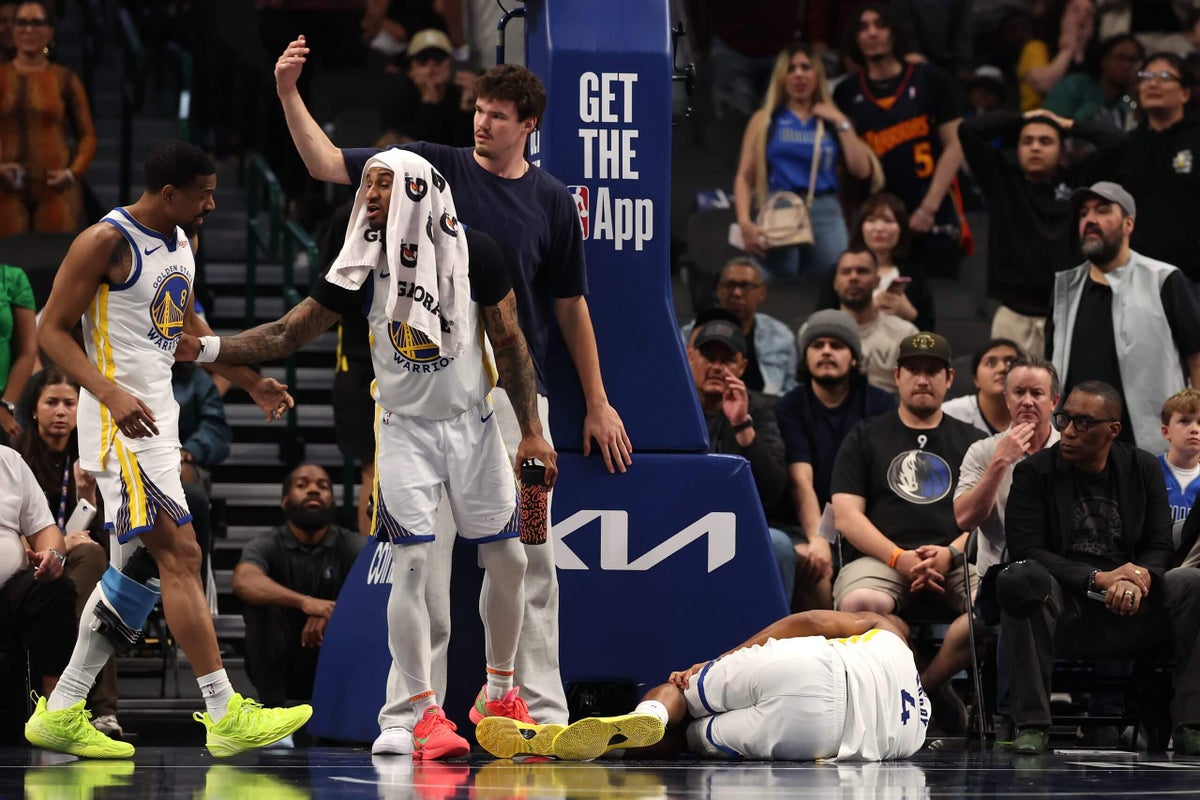
Long before a league source confirmed to The Athletic on Tuesday that Moody suffered a torn patellar tendon in his left knee, the 23-year-old swingman knew the moment he planted his feet for a breakaway dunk that something was terribly wrong. He quickly called for help from the Golden State Warriors bench. Gary Payton II, who was just a few feet away on the bench, went over to be by Moody’s side.
Moody will have surgery later this week, according to a team source, and miss the rest of the season. In an instant, the short-term arc of his basketball career changed. As the rest of his teammates started to congregate around Moody on the floor after a timeout had been called, they could see just how bad the injury was. Just like Moody — they knew.
“Yeah,” Payton said after the game, his voice trailing off. Payton II repeated the word five more times, as if he was reliving the moment each time he said it.
Payton’s response encapsulated how the entire team was feeling as it headed out of the American Airlines Center early Tuesday. The injury was gruesome — so bad that when staffers reached Moody on the floor, a towel was placed over his knee. Longtime Warriors forward Draymond Green hugged Moody as he was wheeled off on a stretcher. Injured star guard Stephen Curry and De’Anthony Melton, still in full uniform, waited outside the X-ray room as Moody was being evaluated. As soon as the X-rays were finished, several players went right in to check on their teammate and offer support.
As other teammates walked off the floor and toward the locker room, they described what they had just seen. The injury understandably overshadowed what had been a strong 137-131 overtime win over the Dallas Mavericks. It also underscored a harsh truth about pro sports — one that had to be on the minds of many of Moody’s teammates as they made their way out of the arena: One step can change everything.
The prevailing thought didn’t have to be spoken. It was etched across their faces as they watched the night unfold. The feeling was that Moody’s injury could have happened to any of them. It was a feeling that hung in the air, especially on a night when the young swingman had been so happy to return to the lineup after missing the last 10 games because of a wrist injury.
Both Payton and guard Brandin Podziemski spoke of how much they appreciate who Moody is. Warriors coach Steve Kerr echoed the sentiment in his brief comments, reiterating how much respect he has for not only the player Moody has become, but the person he is.
From the moment Moody suffered the injury, to the hushed wait as he was stretchered off the floor, to the painful sight of him making his way back to the locker room on crutches with a large brace on his knee, everyone connected to the Warriors’ organization will carry a memory from a night they would rather forget.
One of the most powerful moments came when Warriors vice president of player health and performance Rick Celebrini wheeled Moody out of the arena in a wheelchair as player development staffer Joe Chealey carried the same crutches Moody had just begun to use about 20 minutes earlier.
There wasn’t much talking after the game because there weren’t many words left to be said. The scene spoke for itself. Some players and coaches greeted friends and family outside of the locker room, stopping briefly for pictures with fans, while others got dressed and solemnly walked to the bus. Green took a moment to catch up with several people, including giving a jersey and taking a picture with Vanderbilt quarterback Diego Pavia, who was sitting courtside.
The NBA life doesn’t stop for anyone, but Moody’s injury cast a pall over what should have been a jovial atmosphere after a long six-game road trip.
Players packed to-go boxes with food for the bus as they ached for their friend and teammate. Moody is well-liked and respected by his peers for his attitude and his approach to the game.
“A quiet soul, but a wise soul, in terms of the wisdom he has,” Podziemski described Moody. “He does everything that’s asked of him, he doesn’t complain. It just sucks to see that happen to good people.”
Moody’s teammates knew his career, at least for the foreseeable future, was altered in just one step. It’s the risk they take as professional players — and the fear that each player must deal with as they navigate their own respective careers. Moody kept a positive, brave face as Celebrini wheeled him out of the building. It’s a stoicism and even-keeled nature that should serve him well in the coming months as his road to recovery begins.
If the outpouring of support early Tuesday is any indication, Moody will have an army of teammates and coaches behind him every step of the way.
— The Athletic’s David Aldridge and Sam Amick contributed.