

Why hasn’t the Iranian establishment collapsed yet?published at 08:41 GMT
08:41 GMT
 Ghoncheh Habibiazad
Senior reporter, BBC Persian
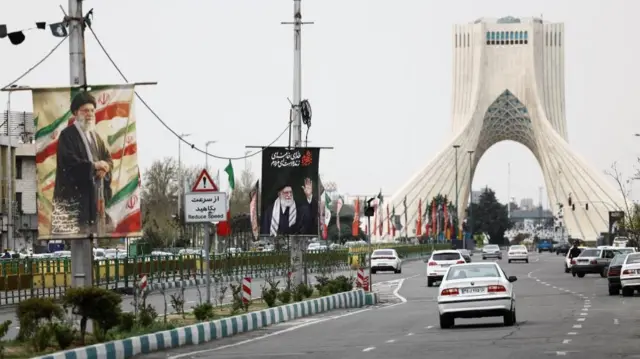 Image source, ReutersImage caption,
Banners of the late Supreme Leader of Iran, Ayatollah Ali Khamenei, seen in Tehran on Monday
It’s almost been a month since war started and Iran’s Supreme Leader, Ayatollah Ali Khamenei, was killed on 28 February.
Some people inside Iran I’ve been speaking to expected the war to end that same day, but it didn’t. And Iran’s establishment is still in place.
Iran has a very complex system of governing the country. While the Supreme Leader holds the highest authority, there is also a parallel state – the Islamic Revolutionary Guard Corps (IRGC), an institution whose power extends far beyond a formal military mandate.
Several high-ranking IRGC commanders have been killed during this war and in the conflict last summer. But they have repeatedly said that for anyone killed, there is a replacement ready to take their place.
The IRGC also controls the Basij, a volunteer militia with an estimated one million members, who are often deployed on the streets to use force to suppress dissent.
Israel has said it has targeted some Basij checkpoints, but from what I heard from Tehran this week, these forces are still very much present in the city, stopping cars and carrying out searches.
When it comes to protests, people inside the country have been threatened by the Iranian authorities, whether through statements or mass text messages, not to come out onto the streets to protest.
The internet has also been heavily restricted – see our previous post – making coordination among protesters very difficult.
So far, we haven’t seen mass anti-establishment protests erupt in the country since the war began, although state media shows nightly rallies by supporters of the establishment in different cities.
But the person we have yet to see in public is Iran’s Supreme Leader, Mojtaba Khamenei, since his succession in early March. So far, we have only seen several written messages from him in Iranian media. Israel had vowed to target him.
Although the Iranian establishment has replaced its leaders and manned its checkpoints, it has yet to prove it can govern a nation that currently appears to be held together apparently more by force, than by visible authority.