
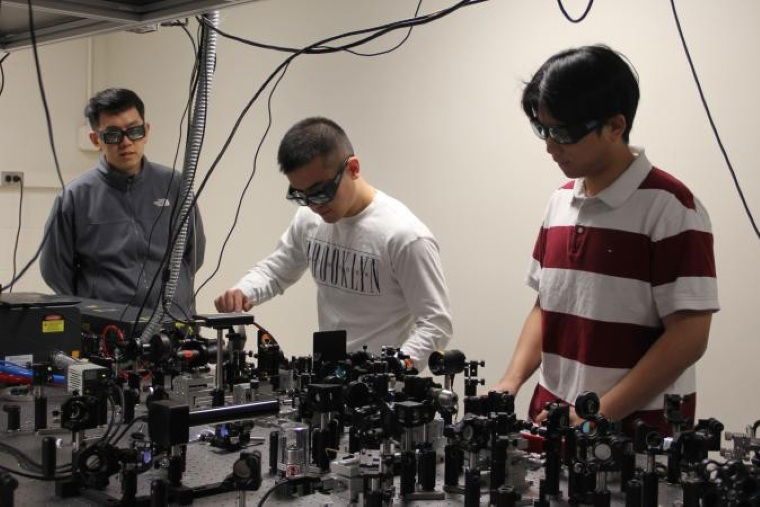
Researchers at Rensselaer Polytechnic Institute (RPI), with support from the U.S. Army Research Office, the National Science Foundation, the Defense Advanced Research Projects Agency (DARPA), and the Office of Naval Research, have announced the successful laser light-induced creation and manipulation of a new state of matter called a supersolid at room temperature.
The research team behind the historic achievement said that demonstrating that a supersolid can be created and controlled without the need for extremely cold temperatures by engineering how light and matter interact inside a nanoscale device overcomes a “long-standing limitation” in the study of such exotic states of matter.
Exotic State of Matter First Proposed in the 1960s
In nature, solids are defined as objects or materials with an ordered structure. Conversely, fluids are substances that can flow without resistance. Scientists first proposed the concept of a solid that could demonstrate fluid-like flow in the 1960s; however, the concept remained theoretical for decades.
Recently, researchers have successfully created a state of matter that combines the properties of both materials, called a supersolid. Last year, The Debrief reported on the creation of a supersolid using laser light. Still, the creation of this once purely theoretical state of matter has been achieved only under extreme conditions, including at very low energy states near absolute zero.
Now, the RPI-led team has achieved this, creating the first stable, room-temperature supersolid using the power of light.
“Our work shows that you can create and control this exotic state using light,” said Wei Bao, Ph.D., assistant professor in the Department of Materials Science and Engineering at RPI and senior author of the study, adding that it happens ‘at room temperature.’
‘Genuinely Random’ Patterns Confirm Effect is Not Caused Externally
To create a room temperature supersolid, the researchers built a device that combines a high-quality perovskite crystal with a specialized, precisely patterned nanostructure. According to a statement detailing the breakthrough, the nanostructure’s shape is designed to trap and shape light. Wei Li, a senior Ph.D. student in Bao’s lab and co-lead author of the study detailing the achievement, said the fabrication of the light-trapping nanostructure was carefully controlled to “ensure the device could reliably confine light and behave as designed.”
After fabricating the nanostructure, the team exposed it to laser light. According to Bao and colleagues, this process produces hybrid particles called polaritons, which are “part light and part matter.” When these particles are coaxed into behaving collectively, they can form a coherent quantum ‘fluid.’
As previously noted, such exotic states typically occur at low-energy states. However, when a condensed polariton fluid receives more energy, it begins to transform. According to the RPI team, instead of remaining uniform, the newly energized quantum fluid “spontaneously reorganizes into a striped pattern,” similar to a crystal.
Notably, this exotic matter maintains quantum coherence across the entire system. Bao said this dual nature is the “defining feature” of a supersolid.
“The system is both ordered and coherent at the same time,” the researcher explained.
When the team performed several experiments by increasing the energy input into their quantum fluid, they observed the exotic state of matter through the striped pattern. However, the team was surprised to find that the effect varied across experiments.
“Each time we repeat the experiment, the system chooses a slightly different configuration,” Bao explained.
According to the researcher, this randomness confirmed that the pattern was forming spontaneously rather than being ‘imposed’ by an outside force. Yilin Meng, a Ph.D. student in Bao’s group and a co-lead author, said a follow-up effort that included synchronizing the laser pulses with single-shot real-space imaging confirmed that the variations are “genuinely random and directly visualize different phase selections from run to run.”
“It’s exciting that our optical measurements let us observe this distinctive phase transition simultaneously in the emission spectrum and in real space,” Meng said.
“This is Just the Beginning”
When discussing the scientific implications of the achievement, the RPI team highlighted the benefits of studying quantum phenomena, such as their laser-generated supersolid, under “more practical conditions” than in earlier, highly complex experimental setups.

“This gives us a new way to study how complex quantum order emerges in nonequilibrium driven systems,” Bao explained. “It brings phenomena that were once limited to specialized laboratories into a more accessible and controllable setting.”
Beyond basic science, the team said their experimental achievement could have practical applications in photonics, optical computing, information processing, and other quantum-based technologies. They also suggest that this particular exotic state of matter involves multiple modes of light emission, which could support research into improved, potentially tunable lasers.
When discussing the versatility of their setup, Professor Bao’s team noted that it can be extended to create more complex geometries. If successful, such customized shapes could enable the study of ‘richer’ quantum behaviors, “including vortex dynamics and other collective phenomena.”
“We now have a platform where we can not only observe these exotic states but also design and control them,” the professor explained. “That opens up many exciting directions for both fundamental science and future technologies.”
“This is just the beginning,” Bao added.
The study “Hybrid perovskite–nanograting photonic architecture enables supersolidity at room temperature” was published in Nature Nanotechnology.
Christopher Plain is a Science Fiction and Fantasy novelist and Head Science Writer at The Debrief. Follow and connect with him on X, learn about his books at plainfiction.com, or email him directly at christopher@thedebrief.org.