
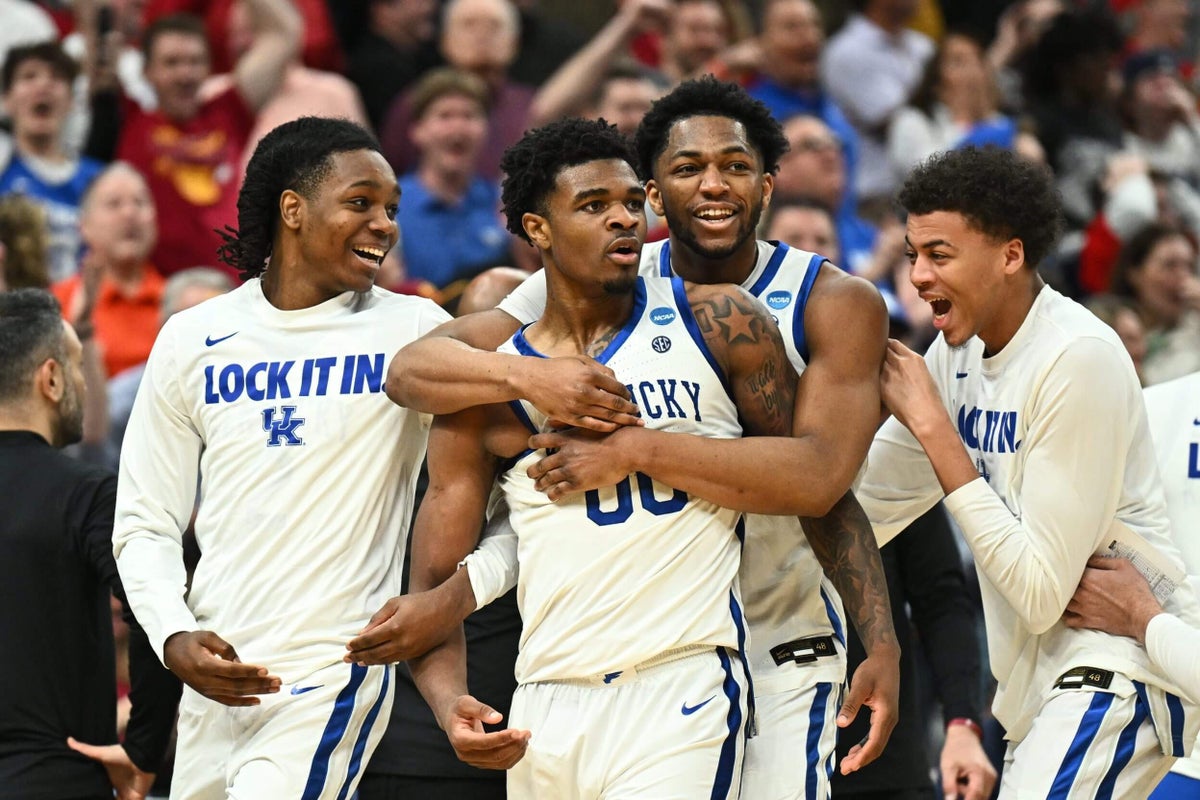
LEXINGTON, Ky. — Expectations hang from the rafters at Rupp Arena, which also echoed with disappointment too many times this season.
Kentucky men’s basketball — which exited the NCAA Tournament in Sunday’s Round of 32, blown out by Iowa State — became defined by a $22 million roster that didn’t play anywhere near its price tag.
That number, which multiple people briefed on the spending confirmed to The Athletic, is a staggering one-year total and undoubtedly the most expensive name, image and likeness budget in the sport. And it was an albatross around Kentucky’s neck.
Kentucky was ravaged by injuries this season, but first-weekend losses aren’t the results Big Blue Nation expects in March. Not for a program with championship aspirations and that level of resources.
The NIL budget wasn’t the only head-scratching headline, either. Last April, in anticipation of the House v. NCAA settlement and a new model of direct revenue sharing between schools and athletes, the University of Kentucky transitioned its entire athletic department to an affiliated nonprofit entity dubbed Champions Blue LLC. It was a first-of-its-kind move in major college athletics, one aimed at better positioning the program amid a sea change in college sports. Then in June, as that shift was underway, the department announced it could borrow up to $141 million from the university, part of which would cover $31 million in projected athletics deficits for fiscal years 2025 and 2026.
Those were eye-opening figures for an athletic program that posted $185 million in revenue in 2025 and that, for years, has proudly touted itself as “self-sufficient,” taking no state or university funds.
On top of it, head football coach Mark Stoops was fired in December after 13 seasons with the Wildcats, and the school negotiated extended payment terms for Stoops’ $37.6 million buyout, one of the largest in college football history. Former Oregon assistant and Kentucky native Will Stein was hired as the replacement on a five-year $28.5 million contract, with an $8 million staff in year one.
It’d be understandable to assume the Wildcats are in financial distress, an overly leveraged asset that would have financial expert Dave Ramsey folding his arms in disgust.
The reality, however, is quite the opposite. Kentucky athletics has access to plenty of money. Potentially swimming in it, Scrooge McDuck style. In an industry where a lot of schools, even at the power conference level, are scrubbing their budgets and pleading for Congress to step in, Kentucky is embracing the “adapt or die” mentality. It wants to be up there with schools like Texas and Ohio State, which already have annual budgets over $300 million.
“We are running to what is next in collegiate athletics,” said Eric Monday, a university administrator and Champions Blue board member. “We need to provide opportunities for our fans at a level beyond what we’ve traditionally done. We need to grow an athletics department beyond $200 million (a year) to $225 or $250 million so we can do more.”
As college athletics become more professionalized — with increasing player compensation, a push for new revenue streams and private equity interest — the University of Kentucky is making a bold move. One that could signal where the future of college sports is headed.
“Everybody I know thinks Kentucky has the smartest model in college sports,” said one industry source, granted anonymity to speak candidly. “It’s still kind of a mystery, but it’s working. All we know is that Kentucky keeps coming up with money.”
How an athletic department becomes an LLC
So Kentucky’s athletic department is now a limited liability company. Which means what, exactly?
“By shifting all aspects of a college athletic department into a business arm, you create the possibility to make it more efficient, maximize revenue,” said Melinda Roth, a visiting professor of law at Washington and Lee University who worked for 20 years at the World Bank and has done extensive research on the subject.
Other universities have dipped their toes into these waters. Schools such as Georgia, Louisville, Florida and Florida State operate their athletic departments as associations or “direct report organizations” that are financially tethered to the university but have their own board. More recently, schools such as Clemson, Michigan State and Texas Tech have spun off just their revenue generating positions into an LLC.
Kentucky, however, was the first to go whole hog.
Last summer’s House settlement, which permits schools to directly pay their athletes roughly $20 million this year across all sports, drove a final stake through the college amateurism model. For years, athletic departments jumped through hoops and funded lavish locker room renovations, spending revenues in order to operate as nonprofits. Now they’re finally having to function like businesses.
As roster budgets grow, maximizing revenue has become a necessary north star for these departments. Why cut or reorganize if you can increase the bottom line instead?
An LLC is a Goldilocks middle ground between a business partnership and a corporation, offering different contractual flexibilities along with more liability protections. It simplifies large-scale projects (like renovating a stadium) and taking on private, outside money, cutting through the bureaucratic red tape required of most public universities. It’s more nimble and aggressive with investment opportunities and takes on less risk.
Navigating higher education can often feel like a labyrinth. An LLC is more streamlined. More like a business.
“That’s what this new model represents — an understanding that in the market we are in, that we have to be creative,” Kentucky athletic director Mitch Barnhart said when the transition was announced last year. “We have to find new ways to generate revenue, manage expenses and think about opportunities to grow.”

University of Kentucky fans hope to have more reasons to cheer in basketball and football. ( Matt Stone / USA Today Network via Imagn Images)
Take the $141 million loan from the university to Kentucky athletics, which is more like an available line of credit. Of the $31 million marked for deficits, Kentucky has claimed only $8 million to this point. The other $110 million is earmarked for capital projects like renovations to the football stadium, which will feature a number of different design and architecture firms. Last month, the university announced plans to purchase a corner restaurant property near Rupp Arena and develop it into an entertainment district through Champions Blue: shops, restaurants, maybe even a hotel. Those businesses would benefit from game-day traffic, but also bring in money for athletics year-round.
The LLC model makes all of that less complicated.
“The ability for it to quickly enter into transactions, whether it be real estate or other things,” said Rob Edwards, another university administrator and Champions Blue board member. “You just have laser focus that the capital projects need to be invested in areas that generate new revenue.”
On a smaller scale, an LLC lessens hiring restrictions and benefits costs. It allows for better commission incentives for sales employees. And it can lean more heavily on outside experts and professionals, including the president of a local horse racing auction house and a former executive at Fanatics, both of whom sit on the Champions Blue board.
“They see things before we do institutionally, understand entertainment and pro markets,” said Monday.
Kentucky’s particular model was inspired by the university doing something similar with its hospital system, which previously bought two in-state existing hospitals and folded them into UK HealthCare. The system has been a financial and operational boon for the university — one it is attempting to replicate with athletics.
There’s still plenty of overlap between Champions Blue and the University of Kentucky. The board of governors features seven voting members, including university president Eli Capilouto, Monday, Edwards and another university administrator. One of the two non-voting members is Barnhart. The LLC is still a component of the university, subject to the same debt liability and open records requests with intentions to remain a nonprofit.
There are unknown aspects, including how transitioning to an LLC could be interpreted legally in terms of tax and employment status of college athletes, or the ability for athletes to collectively bargain. But Edwards pointed to similar questions across the industry.
For now, it’s mostly a back-end, behind-the-scenes change. Fans might notice the stadium upgrades or eventual entertainment district, but the players still wear “Kentucky” across their chests.
“We hope fans see the benefits, but we’re not interested in it being about ‘Champions Blue,’” said Monday. “It’s UK athletics and the University of Kentucky. It’s a vehicle to compete at even higher levels. And I’m not just talking about the courts and the fields.”
Impact on NIL
The moment big-time college sports adopted a revenue sharing cap, Kentucky became a fascinating case study. Most power conference schools earmarked about 75 percent of the $20 million to football players in year one, leaving about 17-18 percent for men’s basketball.
But Kentucky is not most schools.
Football is king in the SEC and dictates the buckets of television money the conference doles out. For the Wildcats, however, men’s basketball brings in more ticket revenue and commands more in sponsorship interest than football.
So Kentucky found a way to fund both.
Another aspect of the LLC is Kentucky deepening its relationship with JMI Sports, the school’s multimedia rights (MMR) partner that handles sponsorship and advertising. For some schools, this is an in-house team — maybe even an LLC, like at Clemson. But many still contract out to a third-party partner such as Learfield, Playfly or JMI.
In this new era, MMR partners can facilitate outside NIL deals for athletes — such as inking the quarterback to a deal with the local car dealership — that do not count against the school’s rev share cap. So when it gets reported that the star QB is earning $5 million for the season, a good chunk is probably coming from those over-the-cap dollars. It’s become the new arms race for the top programs.
Fortunately for Kentucky, its multimedia rights are a goldmine, thanks in large part to Big Blue Nation and the generations of basketball-crazed fans. Last August, UK announced an extension with JMI through 2040 “with a conservative estimated value exceeding $465 million, making it one of the largest deals in all of intercollegiate athletics,” according to the university’s own press release. JMI has more than 200 corporate partners — Barnhart called it a “war chest” — and one industry source told The Athletic that JMI generates more than $30 million a year for Kentucky athletics.
As part of the extension and creation of Champions Blue, Kentucky and JMI formed what is essentially a joint in-house NIL collective for Kentucky athletics, with JMI dedicating 80 percent of the revenue it brings in to Champions Blue.
“We’ve been incredibly successful driving new dollars to NIL for our athletes,” said Paul Archey, president of JMI Sports Properties and another non-voting board member of Champions Blue. “We’re as competitive as anyone in the country in that regard.”
The new setup makes bringing in those outside, private dollars and distributing them to players a more seamless and aligned process — and can also blur the lines between revenue sharing, fundraising, sponsorships and over-the-cap NIL funds in advantageous ways.
“All the money is in one pot, so to speak,” said another industry source familiar with the program but unauthorized to speak publicly. “It sounds like money laundering, but I swear it’s not.”
The $20 million revenue sharing cap feels more like a floor. Multiple industry sources estimate the total roster budget for Kentucky football will be close to $25 million for the 2026 season, and one source said a few men’s basketball players already have over-the-cap deals in place for the 2026-27 season. Michigan forward and Big Ten Player of the Year Yaxel Lendeborg recently told the Associated Press that Kentucky offered him “$7 (million) to $9 (million)” when he entered the transfer portal last offseason.
The enhanced partnership garnered some local criticism recently over JMI partners having exclusivity to use Kentucky logos and uniforms in third-party NIL deals, and questions on whether those constraints might be alienating high-profile basketball recruits who signed elsewhere. But sources inside and outside the program describe the conditions as largely industry standard. Both Barnhart and Pope publicly dismissed the criticism.
“We have this incredible partnership with JMI that’s enabled us to do so much,” Pope told reporters in December. “I have a whole team of people that are working contracts, working possibilities.”
Third-party NIL deals are subject to review and approval by the newly formed College Sports Commission, which recently cited a surge in NIL deals from “associated entities” like MMR partners for slowing down the approval process. These deals have to meet certain standards, whether an athletic department is an LLC or not, but so far, oversight and enforcement have been lacking.
“In this gray area of uncertain times, why not try to operate under a business entity that has more flexibility and can take advantage of the situation?” said Roth.
Is private equity next?
An LLC model lays the groundwork for private equity investments. It’s what the University of Utah did late last year when it partnered with Otro Capital, a private investment firm that will have an ownership stake in a new, for-profit structure to fund Utes athletics.
Many believe that taking on private equity or some form of private capital is the next frontier in college sports. And most outside investors won’t invest without limited liability protections.
There is no shortage of concerns on that front, either.
“What happens if the business, meaning the athletic department, fails?” said Roth. “How much control will these outside investors have?”
To this point, Kentucky has not engaged any private equity. Athletics is projecting deficits, but on a much smaller scale than some of its power conference peers. The multimedia rights are plentiful, the university has shown a willingness to lend money, and the donor base is strong, including megaboosters Joe and Kelly Craft. Multiple people familiar with the program said that Barnhart, who has been athletic director for a quarter-century, isn’t the PE type.
He also announced earlier this month that he will retire in June and step into an advisory role that pays nearly $1 million in annual salary.
“We have to listen and learn and understand,” said Monday. “There are discussions that we want to continue to have to understand that market.”
Champions Blue isn’t pushing the private equity button. Yet. But it can if it wants to.
What’s next?
Kentucky is first through the door in many ways, a pioneer that will be watched closely and could influence how widespread this movement becomes.
“There’s a lot to learn about what works and what doesn’t, but I think this is the wave of the future,” said Roth. “It doesn’t have to be private equity, but I believe the future is separating the business of college athletics in order to maximize revenue.”
As Archey put it: “Kentucky is not afraid to swing and miss.”
Results will tell the story, especially in the revenue sports. It didn’t go as hoped for Pope and the Wildcats this season, but Kentucky will always be a factor in men’s hoops, and there is early optimism for Stein’s football program.
Whether the investments pay off remains to be seen, but any shortcomings won’t be for lack of resources.