
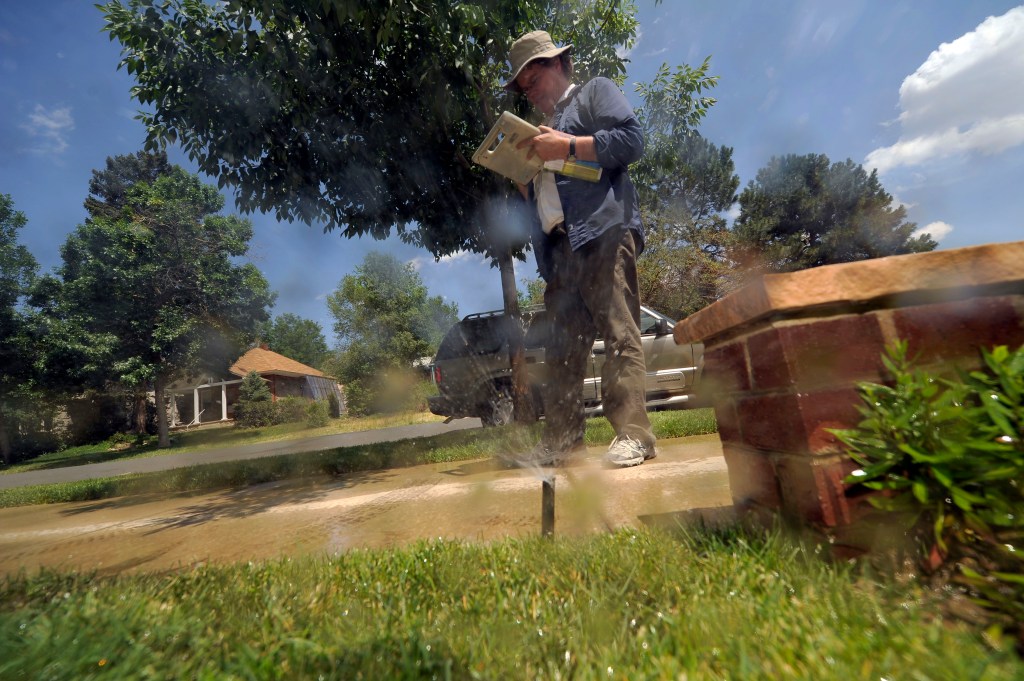
The Denver Board of Water Commissioners enacted Stage 1 drought restrictions Wednesday across the water provider’s metro service area, becoming the latest utility to limit outdoor watering.
The restrictions, which were put in place immediately, limit residents to using water outside their homes, such as for their lawns, to twice per week. The last time Denver Water implemented these restrictions was in 2013.
Residents will need to follow schedules based on their addresses. Those with addresses ending with an even number will be permitted to water on Sundays and Thursdays, and those whose addresses ending with odd numbers will be assigned Wednesdays and Saturdays.
Denver Water’s typical rules for the summer months will also still be in place, including limiting outdoor watering to the cooler hours between 6 p.m. and 10 a.m.
“We are asking customers to not turn on their irrigation systems until mid-May,” said spokesperson Travis Thompson. “They may need to hand water trees and shrubs until then. Once they begin irrigating their lawns, they must follow their assigned watering days and water no more than two days per week.”
The Colorado River basin’s snowpack is at 53% of normal, making it the lowest coverage on record for this date, said Nathan Elder, Denver Water’s manager of water supply. There’s a low probability that reservoirs will fill up this year, he said.
“Current conditions indicate that this is going to be an exceptionally challenging year for our water supply,” Elder said. “The recent heat wave has exacerbated an already poor situation from a water manager standpoint.”
Denver Water staff plans to return to the board on April 8 to recommend the implementation of higher drought pricing as well. After the utility takes those measures, officials will watch how conditions change and how customers respond before deciding whether to take further action later this summer.
“We’re dealing with conditions we’ve never seen before,” board President Tyrone Gant said during the meeting.
The goal of Stage 1 drought restrictions will be to reduce average customer usage by 20%. Beyond limiting outdoor watering to two days per week, Denver Water will establish water budgets for its large customers.
 Denver Water’s service area, outlined in red on the map, includes the city of Denver and several suburban areas, totaling 1.5 million residents. (click to enlarge) (Courtesy of Denver Water)
Denver Water serves 1.5 million people — or about a quarter of the state’s population — with a service area covering Denver and some of its surrounding suburbs, including Lakewood, Littleton, Centennial and Lone Tree.
Denver isn’t the only city implementing water restrictions. Officials in Erie told residents and businesses on March 20 that they must shut off all their sprinkler systems through the end of the month. They said they will turn off water service at any properties that don’t comply with the request. The town switches to its summer water distribution system, which provides more water, on April 1.
Thornton was the first city in the metro Denver area to enact Stage 1 drought declaration earlier this month. That includes a mandatory twice-weekly limit on outdoor watering.
Earlier this month, Gov. Jared Polis activated the state Drought Task Force for the first time since 2020 to monitor the conditions and recommend mitigation efforts.
Nearly three-quarters of the state is experiencing some level of drought, according to a U.S. Drought Monitor map released last week. The worst drought conditions are on the Western Slope, in areas including Summit, Eagle and Pitkin counties. Much of that area is considered to be in “extreme drought,” with some sections in the worst possible “exceptional drought.”
About 3.6 million people live in the areas experiencing some level of drought, which also includes most of the Front Range.
Stay up-to-date with Colorado Politics by signing up for our weekly newsletter, The Spot.