
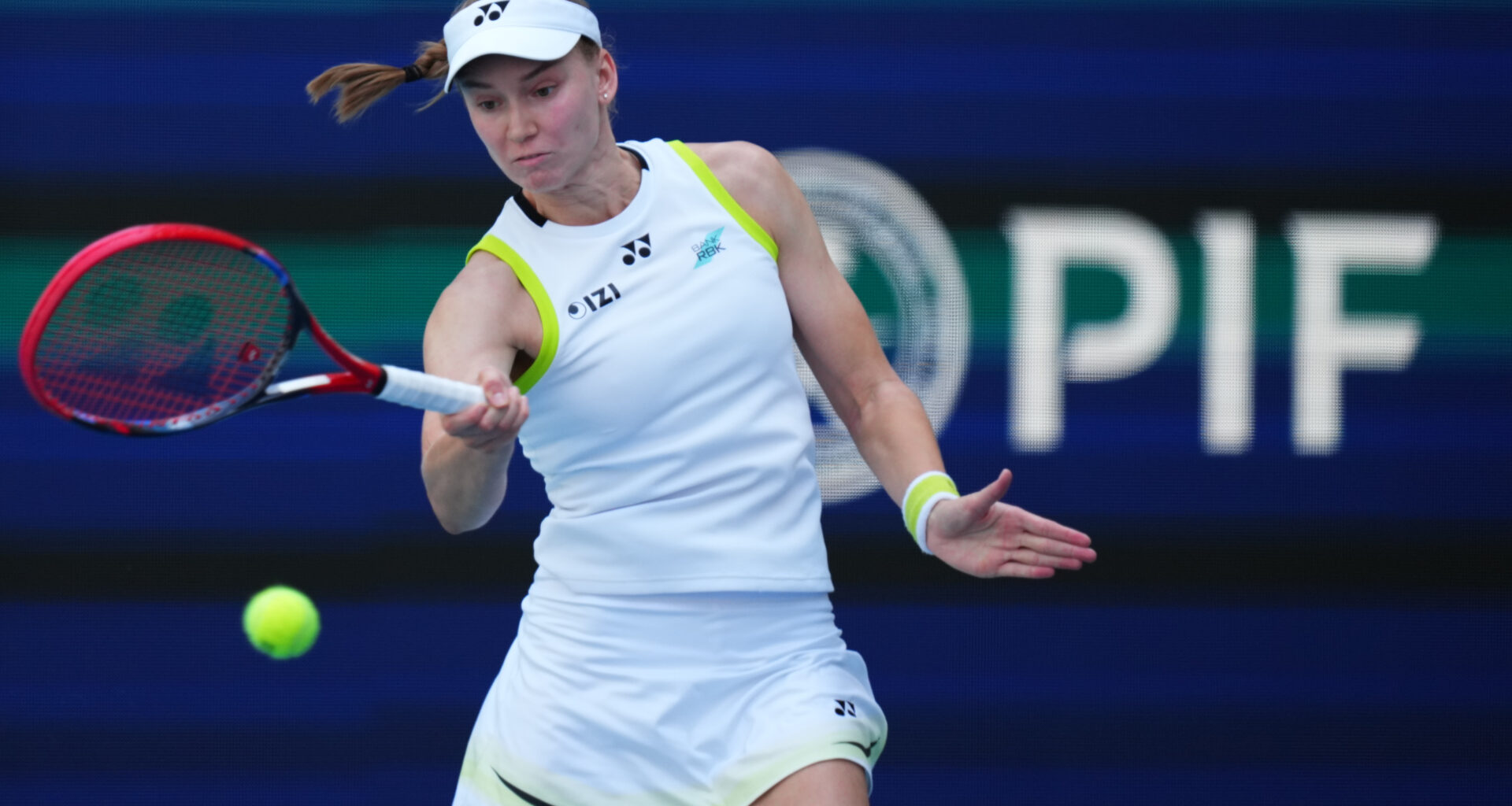
No. 3 seed Elena Rybakina extended her recent dominant record against No. 5 seed Jessica Pegula to reach her third Miami Open semifinal, recovering from a slow start to advance 2-6, 6-3, 6-4 in 2 hours and 15 minutes.
Miami: Scores | Draws | Order of play
Rybakina had lost three of her first four meetings with Pegula in 2022 and 2023. They did not face each other again for nearly two years — and since then, the Kazakhstani has emphatically turned the rivalry in her favor with a run of five victories over Pegula in the past seven months. Wednesday’s result follows wins in the Billie Jean King Cup Finals, the WTA Finals, the Australian Open semifinals and the Indian Wells quarterfinals. She now leads the head-to-head 6-3.
World No. 2 Rybakina advances to her second semifinal of 2026, having lifted her second major crown at the Australian Open in January. She will next face either World No. 1 Aryna Sabalenka in a rematch of the Australian Open and Indian Wells finals, or the unseeded American Hailey Baptiste.
Rybakina has a 2-0 record in Miami semifinals to date, having defeated Pegula in 2023 and Victoria Azarenka in 2024; both times, she went on to lose the final, to Petra Kvitova in 2023 and Danielle Collins in 2024.
Set one: Rybakina’s slow start
On the first point of the match, Rybakina slammed a scorching crosscourt forehand winner.
It was a false dawn. That wing let the 26-year-old down throughout the first set, and was responsible for most of her 12 unforced errors. Sensing vulnerability, Pegula targeted it repeatedly while keeping a clean stat sheet of four winners to just two unforced errors herself. Even more impressively, the American conceded just six points on serve in total, and saved the only break point she faced with her best play — an exquisitely executed drop shot.
Set two: The turning point
The turning point, ironically, was also the one that saw Rybakina hit her worst errors. She’d already saved a break point in the first game of the set, but at 2-2 found herself in trouble again after missing a trio of overheads — two wide, one in the net — that drew gasps from the crowd.
But Pegula was unable to convert three break points — the first after netting a forehand, the next two as Rybakina came up with solid backhand one-two punches. Rybakina escaped with an unlikely hold, and from that point on her game clicked fully into gear.
Intriguingly, though she lost the match, Pegula won more total points, 100 to 98.
Set three: Rybakina holds off Pegula in high-quality home stretch
Rybakina’s surge took her through seven of the next eight games for a 3-1 lead in the decider, with three clean return winners having garnered her an opening break in it. To Pegula’s credit, she managed to put a stop to the one-way traffic, and the home stretch of the contest was also its highest-quality passage of play as both players raised their levels at the same time.
Pegula fought off three break points to avoid going down 4-1, and then stretched Rybakina all the way in a six-deuce tussle on the Australian Open champion’s serve. Brilliant returning from Pegula saw her hold one point to get back on serve, but a Rybakina service winner snuffed it out. Rybakina also came up with a pair of brilliant half-volley winners in this game, and closed it out with one of her 15 total aces.
That game would prove to be Pegula’s last opportunity to reel Rybakina back in. The quality remained high in the final few games, but ultimately Rybakina’s serve was enough to hold Pegula off.
“It’s always very difficult matches with Jessica,” Rybakina said in her on-court interview. “She started playing well, and I was a bit rushing and frustrated, but I’m happy that I managed to bounce back and turn it around in the second set. Then we were just fighting, and the early break helped me a little bit.
“Couple times I got lucky. I was trying to come a little bit more to the net — Jessica plays very fast and sometimes short, so it was not easy to just stay back I had to adapt a little bit.”