
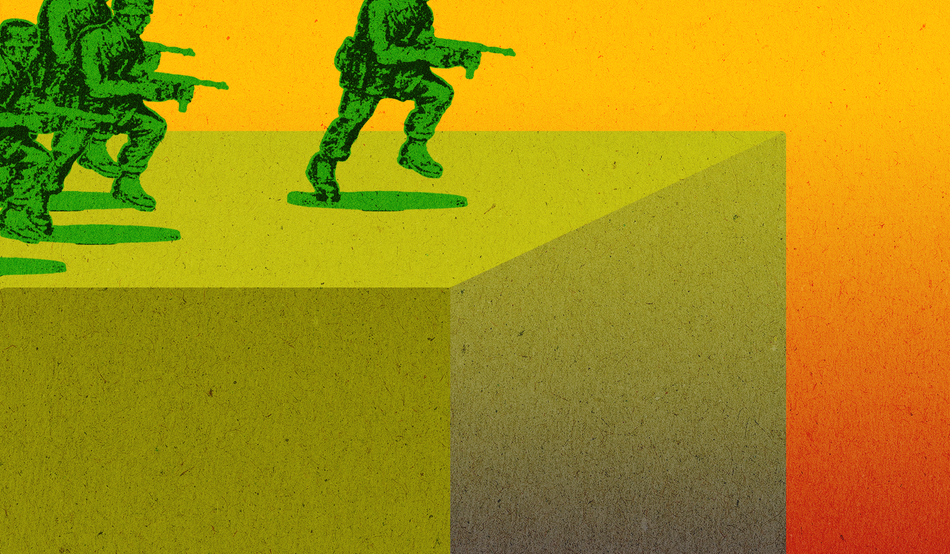
Donald Trump is confused about whether the United States has “won” his war on Iran or not. It almost certainly hasn’t.
It’s hard to know if you have won if you don’t know what winning looks like. And that is difficult if your objectives are not clear. Even when they are, reality rarely conforms to common expectations: video games and heroic movies present a version of war in which lantern-jawed warriors inexorably prevail against uniformed adversaries and are garlanded by grateful civilians. They also give sweets to the children. Episodes such as the careless slaughter of more than 100 schoolchildren tend not to make the cut.
The US boasts a formidable arsenal, even if it is not always accurately targeted. It is still the richest country in the world, and its defence budget exceeds $900bn, substantially more than China’s estimated $300bn. The US also has 1.3m active-duty troops, fewer in absolute numbers than China’s two million, but many more as a proportion of its population. Among its most important assets—and it would be helpful if someone could mention this to Trump—it operates 750 military bases across 80 countries. Just in the last three weeks, US bombers, drones and ships have depended on bases in the UK, Germany, Portugal, Italy, France and Greece. It is its allies that allow US forces to operate in every theatre.
With all these assets, why is the USA so bad at winning wars? It’s a question worth asking in this moment of global peril and commander-in-chief confusion. Trump and his secretary of state for war, Pete Hegseth, may labour under the delusion that allies are an unhelpful burden, but in the last 100 years the US has conducted only three solo military operations—not wars—that could be counted a win.
Operation Urgent Fury was the bombastic title given to the invasion of the tiny Caribbean island of Grenada (population approximately 100,000) in 1983. Operation Just Cause in 1989 successfully deposed Panama’s ruler, Manuel Noriega, and on 3rd January 2026 US forces successfully kidnapped Nicolás Maduro and his wife in Venezuela.
Medals all round, no doubt. But larger operations in recent times have been more problematic. We can count the Second World War as a success: there was a clear objective and serious assistance from allies. The first use of nuclear weapons against civilian populations was also decisive but is best not repeated.
Next up, the Korean War (1950 to 1953) was a UN operation involving 22 nations under US command. It was described as a “police action” in response to Kim Il Sung’s invasion of South Korea, and it would be fair to call it a draw: three years of fighting ended in a stalled armistice that continues to this day, and the Korean peninsula remains divided.
The next US-led war, in Vietnam (1954 to 1975), ended in a decisive and clear-cut victory, but not for the US. Washington had the support of 60,000 Australian troops, 40,000 from Thailand and an impressive 300,000 from South Korea. (Trump showed his gratitude in 2019 by trying, unsuccessfully, to extort $5bn a year from South Korea for the privilege of continuing to host approximately 28,500 US troops.) The war ended in the collapse of the US-backed South Vietnamese regime and an unedifying US scramble for the helicopters.
The smaller wars in Central America in the 1980s, beloved by the Reagan administration, were constrained by Congressional disapproval and relied heavily on proxies, many of whom had a notably relaxed attitude to the torture and murder of civilians. The legacy of US interventions in El Salvador and Guatemala is seen in broken and violent societies. In Nicaragua, some 40 years after the US-funded war against the revolutionary socialist Sandinistas, Daniel Ortega, an original Sandinista leader, remains in power.
The First Gulf War (1990 to 1991) was a limited success. Triggered by Saddam Hussein’s 1990 invasion of Kuwait, the UN sanctioned operation comprised one million service personnel from 39 countries, including the UK, France and many Arab nations, in addition to the US forces. After more than a month of bombing, the land war lasted just five days and Kuwait was liberated.
Neither the Second Gulf War (2003 to 2011) nor the war in Afghanistan (2001 to 2021) were as short or as decisive. The second Gulf War was not sanctioned by the UN, and relied on a coalition of the willing of 48 countries that contributed various levels of support. The UK contingent of 45,000 troops was among the largest.
Although Hussein was swiftly deposed and executed, the weapons of mass destruction that were the excuse for the invasion did not exist, and Iraq swiftly descended into sectarian violence. US troops finally withdrew in 2011 leaving behind a fractured and unstable country after a war that had cost an estimated 461,000 lives and $3 trillion.
Afghanistan was worse. After 20 years of the US war against the Taliban, Trump negotiated a US exit that Joe Biden was then obliged to implement. After the chaotic and violent departure of the US and others in February 2020, the Taliban returned to power unchallenged.
In none of these wars did the adversaries have anything near the firepower or resources of the US, but nevertheless the ostensibly weaker party won. The US looks more impressive, but in asymmetric warfare the weaker side’s advantage is the capacity to bear pain—and often the righteous conviction of a national cause. For them, survival is victory. For the apparently stronger side, clear objectives and a story that secures the support of the nation are essential, but support can prove hard to maintain over time.
Big bombs that look impressive when their explosions are broadcast on TV certainly kill a lot of civilians. The recurring lesson of the last 50 years is that rarely does that deliver a meaningful victory.