
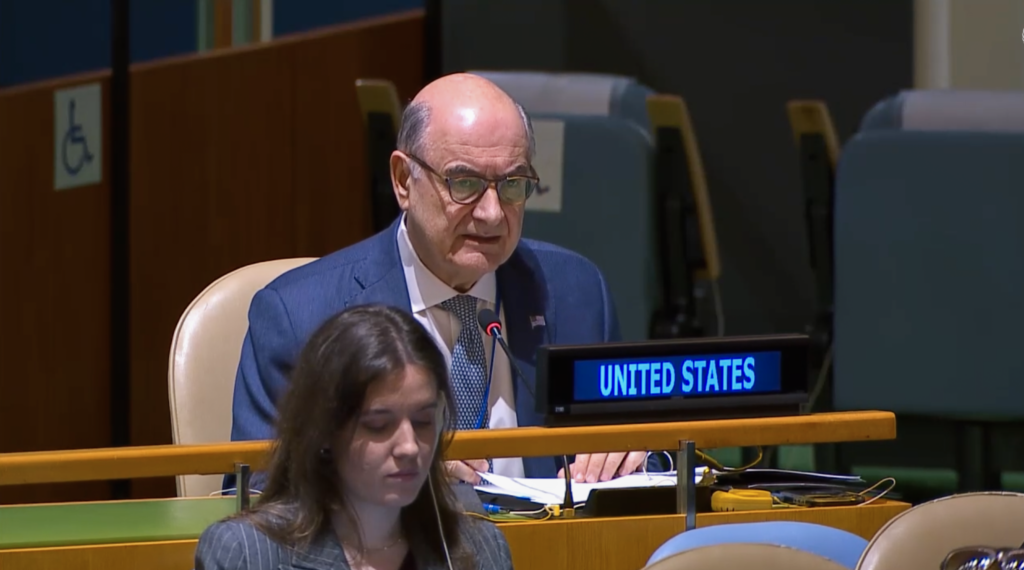
Ambassador Dan Negrea
United States Representative to the United Nations Economic and Social Council
New York, New York
AS DELIVERED
Thank you, Mr. Chairman.
The United States remains steadfast in its opposition to and condemnation of the historic wrongs that resulted from the trans-Atlantic slave trade, the trans-Saharan slave trade, and all other forms of slavery. We remain committed to the acknowledgement that these are historical wrongs. Despite this, the United States observes that the text of this resolution remains highly problematic in countless respects. Consequently, the United States cannot support the adoption of this resolution.
We regret that the United States must once again remind this body that the United Nations exists to maintain international peace and security. It was not founded to advance narrow, specific interests and agendas, to establish niche international days, or to create new costly meeting and reporting mandates. This resolution does all three.
The United States has defined, long-standing objections to the framing of “reparatory justice” and the “duty of reparation” for historical wrongs. While we acknowledge the horrors of the past, we do not accept this resolution’s assertion that historical facts from the 15th through 19th centuries constitute violations of jus cogens as that term is understood in contemporary international law. The United States also does not recognize a legal right to reparations for historical wrongs that were not illegal under international law at the time they occurred.
In addition to its obvious legal problems, this resolution is also unclear as to whom the recipients of “reparatory justice” would be. The drafters and supporters of this resolution seem to believe it is them. The United States strongly objects to the cynical usage of historical wrongs as a leverage point in an attempt to reallocate modern resources to people and nations who are distantly related to the historical victims.
As stated at the outset of these negotiations, the United States also strongly objects to the resolution’s attempt to rank crimes against humanity in any type of hierarchy. The assertion that some crimes against humanity are less severe than others objectively diminishes the suffering of countless victims and survivors of other atrocities throughout history. This is not a competition. This attempted ranking is also simply incorrect as a matter of law.
The United States would also like to express disappointment in the arbitrarily historical perspective of the text. Trafficking of African slaves began long before the 15th century and sadly continued even after the 19th. These dates were clearly selected for political reasons rather than historical accuracy. All trafficking of enslaved Africans and racialised chattel enslavement of Africans deserves to be condemned, not merely the politically expedient.
Also, there are some fake news articles suggesting that the sponsors of this resolution called into question President Trump’s support of the Black community. We reject any such suggestions. Indeed, President Trump has done more for Black Americans than any other president and enjoyed historic support from the Black community in the 2024 election. He is working around the clock to deliver for them and make our country greater than ever.
Finally, we must express our deep disappointment regarding the process that led to this text. Throughout drafting, the United States and other delegations offered constructive contributions aimed at aligning the text with established international legal frameworks. These contributions were ignored.
For these reasons, the United States will vote “no” on this resolution.
Thank you.
###