
As tears dried and champagne flowed in the afterglow of Venezuela’s dramatic defeat of the United States in the World Baseball Classic final, even those walking away with silver medals declared victory for the sport.
Philadelphia Phillies star Bryce Harper, whose late home run helped morph the game into an instant classic, said, “I thought baseball won.” Team USA’s youngest player, 21-year-old Boston Red Sox outfielder Roman Anthony, echoed that sentiment: “The game’s in a better place than it’s ever been.”
The final was the most-watched game in WBC history, drawing nearly 10.8 million viewers on Fox and Fox Deportes — more than doubling the viewership (4.48 million) of the 2023 final, and exceeding the seven-game average of the 2025 NBA Finals (10.2 million). Last fall, Fox recorded its highest average World Series viewership (15.7 million) since 2017, propelled by global superstar Shohei Ohtani and the dynastic Los Angeles Dodgers.
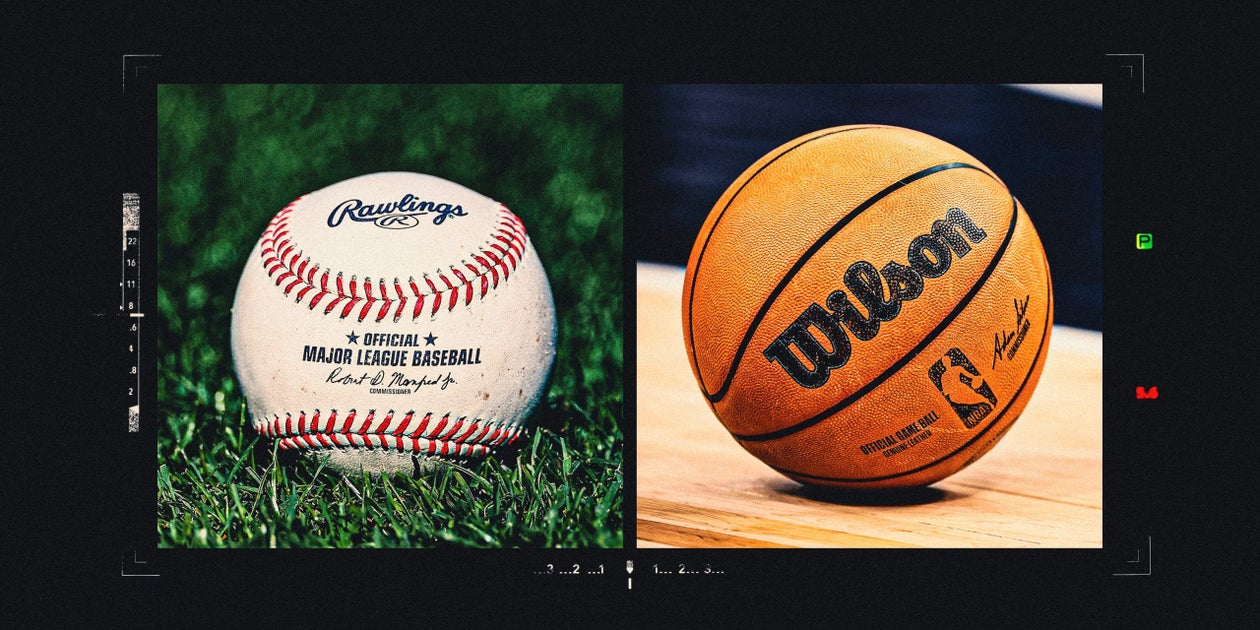
As baseball stacks wins and another Opening Day dawns, a debate has resurfaced in barrooms and on social media: Has Major League Baseball overtaken the National Basketball Association as America’s No. 2 league?
“If you were listening to which ways the winds were blowing even a couple years ago,” said Scott Rosner, who leads Columbia University’s sports management program, “there really wouldn’t have been a conversation.”
Not long ago, baseball was fading from the picture. In 2017, Kareem Abdul-Jabbar wrote, “All signs point to the NBA replacing the NFL as the league of America’s future.” (Stephen A. Smith agreed.) But in recent years the NFL has extended its lead, the NBA has lost momentum, and MLB has reestablished itself with rule changes to enliven the action on the diamond.
Who’s No. 2 now?
That depends upon the metrics you’re using. So, in an attempt to apply some level of rigor to this debate, we consulted a handful of subject matter experts, from sports economists to pollsters, and came up with categories to consider when comparing the leagues.
Polling
Since 1937, Gallup has periodically asked Americans which sport is their favorite to watch. The NFL surpassed MLB in 1972. The NBA slid into second place for the first time in 1997 — the height of Michael Jordan mania. But over the past quarter-century, the NBA and MLB have yo-yoed back and forth in the poll. The only constant: falling further behind the NFL.
However, another Gallup poll asking Americans to say whether they are a fan of each sport, shows both pro baseball and pro basketball have gained fans. From 2001 to 2019, the percentage of respondents identifying as baseball fans was up from 46 to 54 percent, and those identifying as basketball fans rose from 36 percent to 44 percent.
There is clearer signal in 2025 polling conducted by Sports Poll — a service managed by the survey and market research firm SSRS — which showed MLB outpacing the NBA in casual fans (61 percent to 55 percent), avid fans (15 percent to 14 percent) and fans who identified that league as their favorite (9 percent to 7 percent).
Each month, Sports Poll asked fans, “Which sport are you most interested in right now?” The NBA only led MLB during baseball’s four offseason months.
By that question, “MLB is pretty clearly ahead of the NBA,” said Chad Menefee, executive vice president of strategic intelligence at SSRS. But there are others.
Social Media
Where the NBA is pretty clearly ahead: the internet.
“It’s night and day,” Rosner said. “The NBA is on a totally different level from a social-media perspective. The currency that that has in today’s world is really meaningful.”
The NBA is a highlights league, which play well on social media, but the growth has not happened by chance. It’s been a league priority. NBA league accounts are not the only ones running laps around MLB; NBA teams and individual stars have far higher follower counts, too. The NBA has more than six times as many followers as MLB on Instagram, nearly four times as many on Twitter, and more than three times as many on YouTube. Analysis of Google Trends shows roughly twice as many searches for “NBA” than “MLB” in an average year.
The NBA maintains far greater cultural relevance. NBA stars are household names in a way MLB stars are not, even with the rise of Ohtani. Polling bears that out: While Sports Poll respondents were 4 percent more likely to say their favorite team was an MLB club than an NBA team, they were also 4 percent more likely to say their favorite athlete played in the NBA than in MLB.
While MLB has made strides internationally lately, the NBA’s global growth began decades ago and has them “light years ahead” of the other four major U.S. sports, Rosner said, “The NBA wasn’t an overnight success. That really was the byproduct of very intentional business decisions that were made over a stretch of time. You don’t just flip a switch and say, ‘We want to be more global.’”
Ratings
One obvious way to figure out which league is more popular is by simply looking at who gets more people to watch on TV. That should be easy enough.
Ah well, nothing is simple enough in the media world these days.
MLB, which has long relied upon strong local TV viewership figures, is coming off its best season of national viewership in a while. It averaged 1.8 million viewers per game on ESPN’s “Sunday Night Baseball” and 2.04 million on Fox. It also averaged 462,000 viewers for TBS games, up 29 percent from the previous year.
The NBA is having a good year, too. It made the move to new TV partners this season, adding NBC and Amazon Prime Video as broadcasters and dropping TNT, while continuing its relationship with ESPN/ABC. NBA games are currently averaging 1.8 million viewers across those three networks, according to SportsMediaWatch, up 16 percent from the 2024-25 season.
NBA games on NBC are averaging 2.6 million viewers on average, while ESPN/ABC games are averaging 2.06 million viewers, and streaming-only games on Amazon are averaging 1.06 million viewers.
By those numbers, the NBA is winning the viewership battle of late.
Yet, MLB has posted better numbers for big events in recent years. The 2025 World Series far surpassed the NBA Finals in viewership for their two respective Game 7s: Thunder-Pacers drew 16.61 million viewers, while Dodgers-Blue Jays averaged 25.98 million viewers. That was a continuation of a recent trend in viewership for the two sports, where average viewership for the World Series surged above the Finals.
Of course, there are other factors at play. The last two World Series have included the big-market Dodgers, New York Yankees and Toronto Blue Jays. The Finals, by contrast, had its smallest-market matchup ever last June, and a brief five-game series in 2024 between the Dallas Mavericks and Boston Celtics. Short series and smaller markets make for lower ratings. That’s why the 2023 World Series, between the Arizona Diamondbacks and Texas Rangers, was a viewership dud, too.
The title contenders change each year, as does what other competition is on TV. Certain matchups will entice more unaffiliated fans, and others more gamblers. David Carter, principal of the consultancy the Sports Business Group, said the championship viewership figures, like the other NBA-MLB comparison categories, “are interesting snapshots, but only snapshots.” He added, “All of these are interesting data points, but it’s a little bit of a fool’s errand to say with absolute certainty across the board that one is more popular than the other.”
Media rights
As close as MLB and the NBA are in ratings, their national media-rights deals are radically different.
Baseball’s media situation is in flux after it was dumped by ESPN in 2024 and unexpectedly had to hit the market to find a new home for its marquee in-season package, “Sunday Night Baseball,” as well as other nights.
MLB pulls in somewhere north of $2 billion annually from its national partners. About $1.35 billion of that comes from Fox and Turner, which carry the bulk of the sport’s playoff games. The remainder comes via deals with Apple, Netflix, NBC and a reunion with ESPN, which is paying about $550 million.
But the new ESPN arrangement muddies a direct comparison with another league. Besides the rights to typical national game telecasts, ESPN also acquired a slew of MLB teams’ local rights, as well the league’s out-of-market package, MLB.tv.
No matter how it’s counted, though, baseball’s national haul is a far cry from the NBA’s mega media-rights deals that kicked in this season. The 11-year, $77-billion collection of deals with Amazon, ESPN and NBC surpassed expectations and made the NBA the envy of every sports league in America outside of the NFL. The heft of basketball’s national deals, Rosner said, “has put them on a different plane, at least for now.”
The demographics of NBA viewership seem to be far more attractive to network executives than MLB’s fanbase. A 2024 study from Playfly Sports determined the NBA had “the youngest and most diverse fanbase of the four major U.S. sports,” with 56 percent of the league’s fans under 44 years old and 40 percent non-white. For MLB, 51 percent of fans were under 44 years old, and 33 percent were non-white.
“What baseball had been experiencing for the better part of a half century, maybe more, was an aging,” said Michael Leeds, an economics professor at Temple. “People like me — old people — still enjoyed baseball, but it was not doing anything to really attract younger fans, casual fans and, to an extent, missing out on people of color.”
MLB has touted gains in attracting younger viewers in recent years, however.
“We always look at the younger population,” added Shirin Mollah, an economics professor at Loyola Marymount. “Are they watching sports? What sports are they watching? How can advertising come into place where they capture the younger demographics?”
Demographics change slowly. A key for MLB entering its next national media rights deals — the current ones expire after the 2028 season — will be continuing to show its viewership getting younger as the game evolves.
“The older the fanbase, the less monetizable it is,” Carter said. “Baseball has been working very hard to lower the age of its average fan, because even if they have the same number of eyeballs, the eyeballs are not equally profitable.”
Revenue
If you ask an economist, they’ll tell you the best way to distinguish which sports league is No. 2 is to observe spending.
“People reveal what something’s worth to them by what they’re willing to pay to have it,” said Victor Matheson, an economics professor at Holy Cross.
In 2024, MLB had $12.1 billion in total revenues. That record high is barely half the NFL’s $23 billion total revenues from the 2024-25 fiscal year, but it is closely in line with the NBA’s growth. The NBA reported about $12.8 billion in gross revenue in 2024-25, according to Sportico, and is projected for $14.3 billion this year. Rosner, the Columbia sports management professor, said his students are always surprised about how close the revenues are between the MLB and NBA.
“Major League Baseball was well on its way to getting eclipsed by the NBA in terms of total revenue until they started to take some actions to make it the sport of the next generation — not the sport of my grandfather’s generation,” Matheson said.
Generally, economists would also consult attendance as a primary indicator of league success. But that’s a tricky endeavor in this case. MLB not only has twice the number of games, but its ballparks are on average twice the size of NBA arenas. Still, when comparing year-over-year attendance trends, the NBA has reported a gradual climb over the past 25 years — from a 16,864 per-game average attendance in 2000 to 18,153 in 2024-25 — while MLB has fluctuated.
MLB’s average attendance in 2025 (29,373) was almost identical to its 2000 average (29,377), yet in between the average attendance spiked as high as 32,696 in 2007, dropped as low as 28,203 in 2019, and has rebounded nicely since the pandemic.
Franchise valuations
Let’s continue to follow the dollar signs. Investors are (mostly) rational, and how they spend their wealth can be an indicator of how they view the two sports.
Franchise value is a valuable indicator of league health “because it’s more forward-looking” than revenues, Mollah said. “With franchise values, you’re looking more at the long run — the media deals coming in, the international growth potential, the pricing power, fan engagement.”
Right now, franchise values tell us the NBA is in a much better position than MLB. The average NBA team is valued at $5.51 billion, per Sportico, while the average MLB team is worth $3.17 billion. The Golden State Warriors are the most valuable NBA team, at $11.33 billion, and are worth nearly $2 billion more than the Yankees. The cheapest NBA team is worth $4 billion; the cheapest MLB team is valued at $1.45 billion.
In the past two years, the Tampa Bay Rays sold for $1.7 billion and the Baltimore Orioles for $1.725 billion, respectively. The San Diego Padres are likely to sell for more than $3.5 billion, shattering MLB’s previous record sale: Steve Cohen’s $2.42 billion purchase of the New York Mets. Meanwhile, the Los Angeles Lakers sold at a $10 billion valuation, the Boston Celtics for $6.1 billion and the Portland Trailblazers for more than $4 billion.
“An economist would say, the proof is where your money is,” Matheson said. “Revealed preference tells you what’s most popular. And revealed preference is: What do I do when I have money in my pocket? As of now, the NBA and MLB are pretty much tied (in revenues). Investors’ money thinks that the NBA is the better long-term bet, hence higher franchise valuations.”
Matheson offered two reasons that leagues with similar revenues might have vastly different franchise values. The first is that investors expect revenues to grow faster in the NBA than in MLB. The second is that they are focused less on revenues than profits, and it could be that they view NBA franchises as more likely to be profitable because, beyond the booming revenues, the NBA has the cost certainty of a salary cap. MLB owners do not have that — though they are expected to again fight for it soon.
While the NBA is soon expected to command record-setting expansion fees of as much as $10 billion, MLB commissioner Rob Manfred in 2021 gave credence to the idea that about $2.2 billion could be a reasonable figure in baseball, based on an estimate of average franchise values. Those values have only grown since then.
Admittedly, expansion fees and franchise valuations aren’t a clear-cut argument that the NBA is more popular than MLB. More popular among the people buying sports franchises? For sure. Among the rest of us hoi polloi? Not necessarily. Not even all economists find franchise valuations persuasive. Leeds said, “I shy away from franchise valuations because, in terms of popularity, I’m not sure that really captures everything.”
Vibes
Leeds, the Temple economics professor, said he hasn’t seen MLB in this position of strength in decades. Baseball is resurgent. Rule changes have sped up games. Ratings are up. Attendance is up. Ohtani and Aaron Judge are megastars in huge markets. Leeds’ wife, who grew up in the former Czechoslovakia, insisted upon the couple staying up late to watch the Czechia’s WBC games.
“Everything is coming together beautifully for baseball,” Leeds said. “And I’m afraid they’re going to blow it.”
The greatest threat MLB’s current heater is a potential work stoppage. In The Athletic’s reader poll, 77 percent of respondents believed MLB will miss games because of a lockout in 2027, and 67 percent indicated such a disruption would negatively impact their fandom. Yet fans bothered by the league’s current competitive balance could be willing to accept a prolonged lockout if it results in the adoption of a salary cap system — a measure 68 percent of survey respondents supported.
The rise of the Dodgers and the way they use their financial might has deeply troubled many in other fan bases. And on the field, MLB is still plagued by high strikeout rates and low batting averages. But overall, the league has shed its reputation as a tough watch. MLB has “been very effective at finally kind of throwing off the old school and saying, ‘Hey, we really need to do some things to make sure this game stays relevant,’” Matheson said. MLB continues to tinker; the Automated Ball-Strike challenge system is the latest innovation.
Now, the NBA is facing criticism for its product.
Its in-season tournament has promise but hasn’t been a breakout success. Action is overwhelmed by 3-pointers. Final scores can balloon into the 140s. The last minute of games can be a slog. Lately, the league has been busy with off-court hurdles: addressing tanking, investigating possible cap circumvention and dealing with a gambling scandal that has commanded more public scrutiny than MLB’s own gambling scandal.
While MLB has changed its rules in recent years to great success, the NBA is now trying to do the same. It has made a push to make its star players get on the court more frequently and eat at the pesky load management conundrum that drew criticism from fans and media alike. This season’s All-Star Game was a success after years of trying and failing to fix it, boasting its biggest audience in 15 years (8.8 million), nearly twice as many viewers as watched last season. Foul grifting is trending down. Young stars are emerging to transition the league into a new era, even if they might not replace LeBron James and Steph Curry.
Dennis Coates, a UMBC economics professor, grew up at a time when baseball was still king, and the NBA far behind in third place. He’s not yet swayed by arguments about MLB’s sudden resurgence — partially because some of the rule changes (like the extra-innings runner) rankle him; because his local team, the Baltimore Orioles, have underwhelmed recently; and because a fight for which league is a distant No. 2 to the NFL is admittedly trivial. But that’s what makes it a great bar debate, Coates said.
“Well, I’m not sure it’s great,” Coates corrected, with a laugh. “It makes for a common bar conversation about which is the more popular of these sports. The academic in me says the owners are making money hand over fist, so I don’t think it makes much difference to them whether they’re the most popular or the least popular.”
With reports from The Athletic’s Chad Jennings and Matt Gelb