
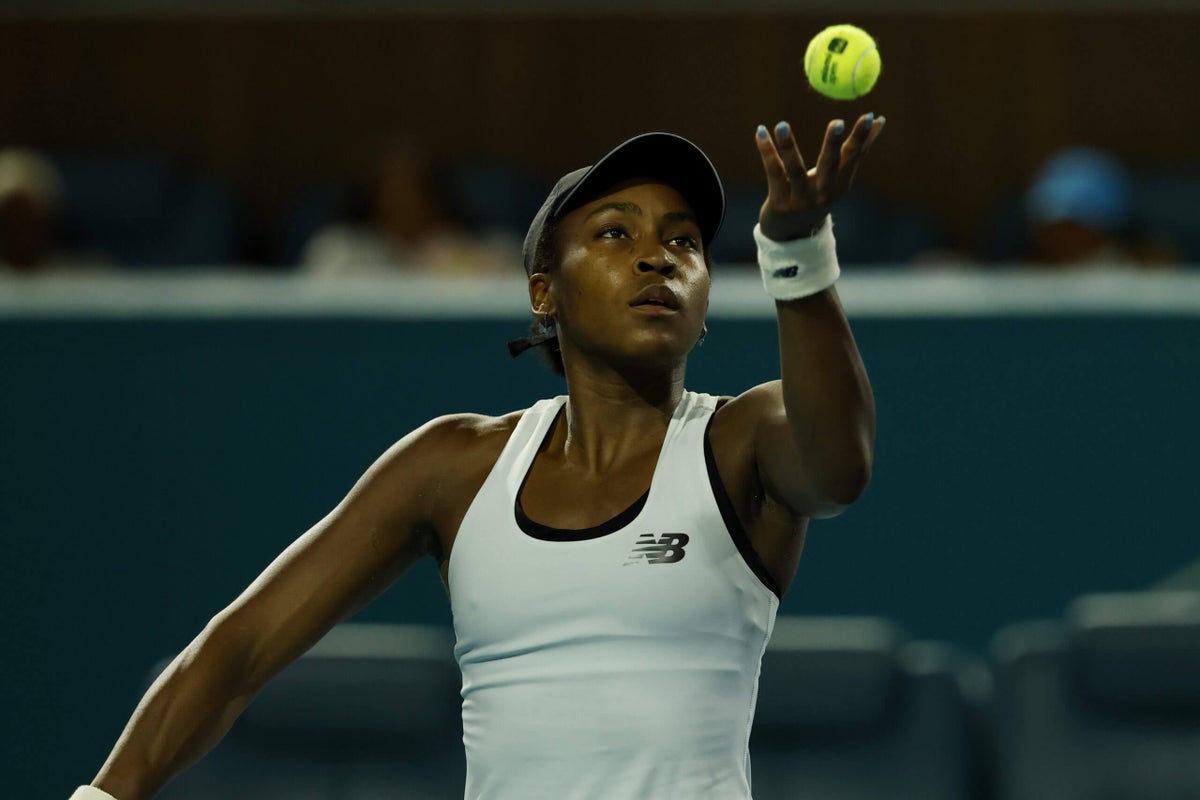
MIAMI GARDENS, Fla. — Coco Gauff is standing in the tunnel that leads out to the biggest court at the Miami Open.
She’s hearing Andrew Krasny, one of the voices of tennis intros, run through her accomplishments.
Twice a Grand Slam champion. The world No. 4 — and its No. 2 both not so long ago and perhaps again next week. An 11-time title winner. Champion of the WTA Tour Finals, and WTA 1000 events in Cincinnati, Beijing and Wuhan. Already, having turned 22 this month, 11th on the women’s all-time prize money list with more than $31 million banked.
Suddenly, it dawns on her.
“Oh, actually, I do have a good career.”
Everyone who has ever felt the pangs of professional insecurity, which is probably just about everyone who has ever had a pulse, can count Gauff as part of their tribe.
“Sometimes, I can get impostor syndrome,” Gauff said in a news conference late Tuesday, after she gutted out a quarterfinal win over Belinda Bencic, the quick-hitting maestro from Switzerland whose rolling, short-hop groundstrokes can be nightmares for opponents.
Gauff will now play Karolína Muchová in the semifinals Thursday afternoon. She is 5-0 against Muchová, beating her most recently in three sets at January’s Australian Open. Miami is her hometown tournament. The stadium will be filled with family and friends.
But Muchová is 18-0 on the year against opponents outside the top 3 in the world. She won her first WTA 1000 title last month in Doha, Qatar. She has seemingly added efficiency to her beautiful game.
“It’s just who can outthink the other in the 30-all or deuce point,” Gauff said of their upcoming meeting. “That’s really how I view matches when I play someone over and over.”
It’s been that kind of nine months for Gauff.
She won the French Open last June, to cap off a killer clay-court season that saw her make the finals of the Madrid and Italian Opens before her three-set comeback triumph against Aryna Sabalenka in Paris. That title was the destination of a first journey into the tennis unknown, Gauff’s first attempt to rework her serve and forehand: two of the sport’s most important shots, which never quite seem to behave as she wants them to.
And then her game, especially her serve, just went away again.
She lost in the first round of Wimbledon a few weeks later, and largely spiraled from there, ending up in tears after her second-round win at the U.S. Open in late August because she could barely roll in her serve. She brought on Gavin MacMillan, the biomechanist who helped to rebuild Sabalenka’s serve, to break down and rebuild hers.
From match to match, even set to set and game to game, Gauff has no idea if it will be there. She’s been struggling with some of the most basic elements of the shot — tossing the ball in the same neighborhood each time, keeping her chin up as her arm comes through the ball.
She is 15-5 this season, about the same winning percentage as the past three years. Entering the Miami Open, only seven women had started 2026 better. For Gauff, that number feels more like 70.
“Especially with my serve, it just feels like, I don’t know, that I shouldn’t be where I am,” she said. “But tennis doesn’t lie. The ball doesn’t lie. So I just have to believe in myself. My coaches have been reminding me, ‘Remember who you are, and you’re a good player’.
“They’ve been putting that into my head. And at moments I believe it, and at moments I don’t. So I’m just trying to believe it more.”
She is right that tennis does not lie.
Gauff spends so many matches losing far more second-serve points than she wins, ballooning forehands to all parts of the court, going breaks and sets down — and then winning anyway. Last year, she gave away one point shy of an entire bagel set’s worth in double faults, and still beat compatriot Danielle Collins at the Canadian Open, because she can leaven the impact of that shaky serve on the rest of her game.
In tennis, the best players often talk about their doubts, about walking onto the court thinking they are about to face a daunting challenge, or wondering in a big moment whether they will find the courage to hit the big serve, or aim for the back of the court with a forehand with their back to the wall. It can be a little hard to believe, though, when it comes out of the mouths of stars such as Jannik Sinner, Carlos Alcaraz, Elena Rybakina and Sabalenka, players who so often play deep into the biggest tournaments and come up with something big in the biggest moments.
Nobody in the sport talked about the power of doubt more than Rafael Nadal, who won 22 Grand Slam titles, including 14 at the French Open.
“I’m much more of the Nadal side of the coin and most players, I think, are,” says Jim Courier, the Tennis Channel commentator and former world No. 1. “Doubt is what drives you. It’s what keeps you sharp, keeps everything at bay, because you have got to keep going. It’s like sharks always swimming.”
The past week in Miami has put that on full display, showing just how fragile even some of the steeliest of tennis minds can be.
After her opening-match loss to Magda Linette, Iga Świątek, the reigning Wimbledon women’s champion and a six-time Grand Slam winner who has come back from the dead on the biggest stages, spoke of the “chaos” in her mind.
World No. 1 Alcaraz spent long stretches of his third-round loss to Sebastian Korda complaining to those sitting in his box about how feckless he felt, telling them long before it was over that he was going home. This from a player who saved three match points in last year’s French Open final against Sinner, then came back from a set down to prevail in a championship-deciding tiebreak with a scintillating display of guts and power and beauty.
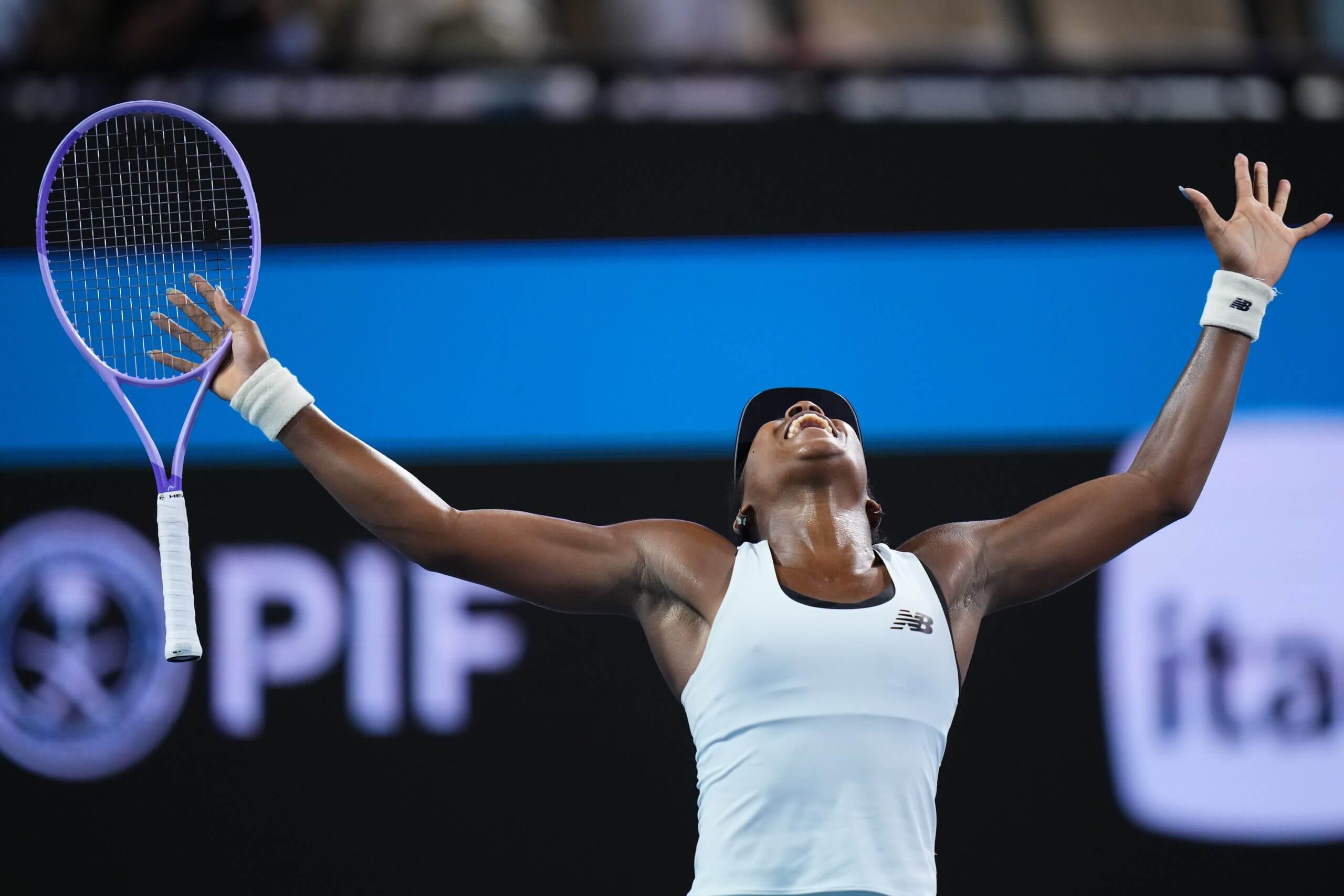
Coco Gauff has played four matches at this year’s Miami Open, winning all of them in three sets. (Rob Storry / Getty Images)
Then there was Gauff Tuesday night, taking everyone on a raw journey inside her head to explain how she climbed back from a disastrous second set, and a miserable start to the third, to break back against Bencic and surge to the finish line.
After winning the first set 6-3, her goal was to get a lead in the second and keep it. That didn’t happen. Bencic seized control. Gauff couldn’t catch up with those fast, rolling shots, or at least not enough of them, losing 6-1. On to the third set they went.
Gauff fell behind, but then found a way to start extending points, switching them from defense to offense. It became a contest to see who could get more balls just beyond the other player’s reach. And once Gauff found a way to match Bencic’s level, as the Swiss player tried to play through menstrual cramps, she decided the match was going to turn on grit and fitness. In other words, on her terms.
“I felt pretty confident on my end that I could outlast her physically,” she said.
Still, it took a while to get there. And even after it was done, taking that final set 6-3, Gauff still wasn’t sure exactly how she’d won the last point. She did the thing she had told herself ahead of the match that she absolutely would not do: Hit a drop shot.
In her preceding fourth-round meeting with Sorana Cîrstea, Gauff nearly gave the match away with a series of poor drop shots. She told herself she would not hit one on any pressure points, and she then did not bother practicing them during her hitting session before facing Bencic. She did not want her brain to choose a drop shot on an important point.
And then, on her first and only match point, with Bencic behind the baseline, she forgot about all that. She popped the ball just over the net into the front of the court. Bencic barely caught up to it, and Gauff was there to block a volley into the open court.
After spending all these months inside her own head, thinking about whether she was a good player, whether she belonged at the top of the sport or was actually an impostor, Gauff knew what the lesson was, something that even the sport’s finest need to be reminded of often.
“Sometimes, you just play tennis and you’re not even thinking,” she says. “It’s the best when you play when you’re not thinking.”