
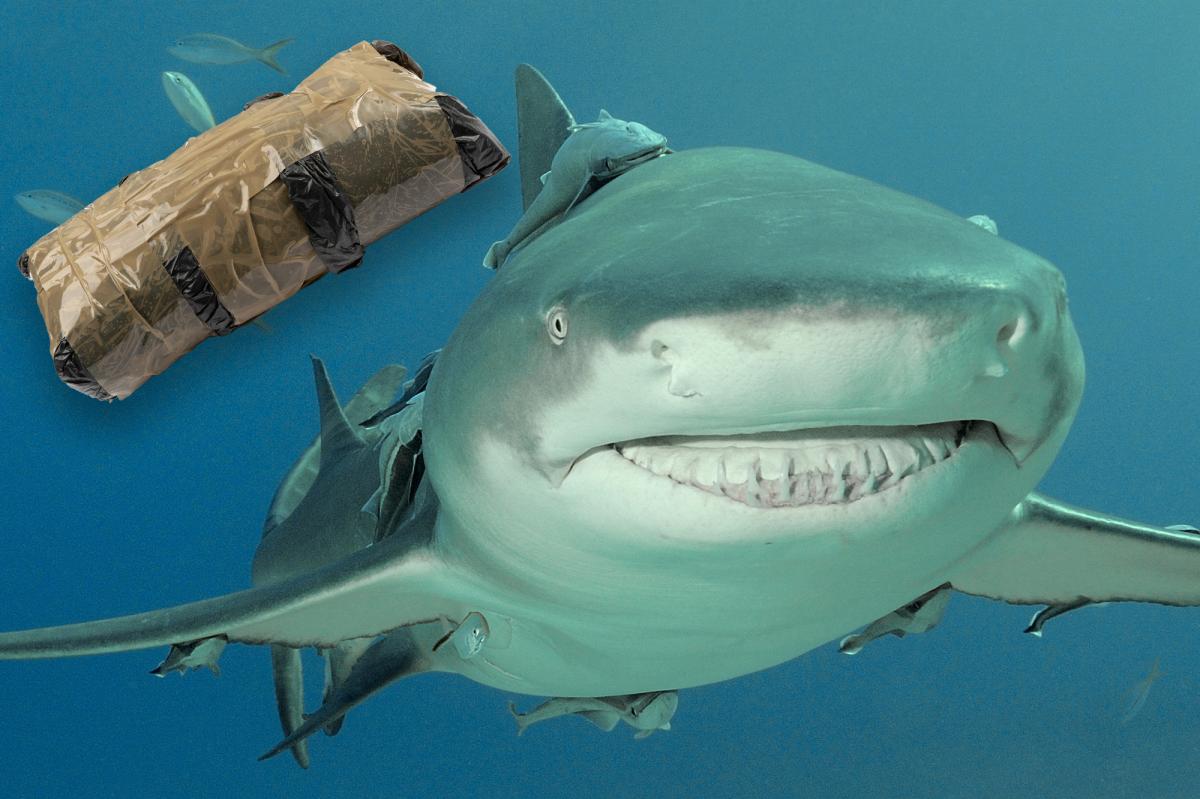
This puts the “white” in “Great White.”
Move over “Cocaine Bear.” Brazilian scientists have discovered traces of nose candy, caffeine and painkillers in sharks swimming in waters around the Bahamas.
These “blow-fish” aren’t getting hooked on purpose — it’s the fallout from an uptick in marine pollutants, per an a-jaw-calyptic study published in the journal Environmental Pollution.
“Pharmaceuticals and illicit drugs are increasingly recognized as contaminants of emerging concern (CECs) in marine environments, particularly in areas undergoing rapid urbanization and tourism-driven development,” the researchers wrote while describing the troubling shark-otics trend.
The sharks had tested positive for cocaine, caffeine and painkillers. Joseph – stock.adobe.com
This marked the first time sharks had tested positive for cocaine in the Bahamas. New Africa – stock.adobe.com
To see whether these marine marauders were under the influence, the team had reportedly analyzed blood samples from 85 specimens around Eleuthera, one of the Bahamas’ most remote islands. The subjects were drug-tested for both legal and illegal substances.
Of the samples, a shocking 28 sharks spanning three species tested positive for drugs, the most common of which was caffeine. This was followed by acetaminophen and diclofenac, the active ingredients in the popular painkillers Tylenol and Voltaren.
Meanwhile, two of the animals tested positive for cocaine, which researchers attributed to them chomping on drug packets that fell into the water.
“They bite things to investigate and end up exposed,” study author Natascha Wosnick of the Federal University of Paraná in Brazil, told Science News.
This reportedly marked the first time cocaine had been detected in sharks in the Bahamas — trace amounts had previously been found in sharks in Brazil — and the first instance of the critters testing positive for caffeine anywhere on Earth.
Researchers noted that the drug-addled predators had been taken from popular tourist and dive spots, suggesting that they’d been exposed to wastewater from boats and urban developments, which may have been polluted with the aforementioned substances.
“They bite things to investigate and end up exposed,” said study author Natascha Wosnick of the Federal University of Paraná in Brazil. Eric Carlander – stock.adobe.com
It’s yet unclear what effect the drugs are having on the predators’ behavior, but the researchers found changes in metabolic markers in sharks with contaminated blood.
This indicated that exposure to this chemical runoff was causing them to experience stress and burn more energy while attempting to metabolize the pollutants, according to Tracy Fanara, Florida oceanographer who was not involved with the study.
The researcher previously helped produce “Cocaine Sharks,” a documentary on how sharks were potentially being exposed to cocaine from distribution networks operating in the Caribbean.
Coincidentally, research on goldfish found that caffeine ups their energy and focus just like with humans, per Wosnick, although it’s yet unclear how this would affect their toothier counterparts’ behavior in the wild.
Nonetheless, scientists found their accidental drug use concerning, given the remoteness of the locale, suggesting that not even pristine marine environments are safe from the worldwide pollution scourge.
“We’re talking about a very remote island in the Bahamas,” lamented Wosnick.
Fanara said that ultimately this narcotic trickle-down effect serves as a “reminder that coastal infrastructure, tourism and marine food webs are tightly connected.”