
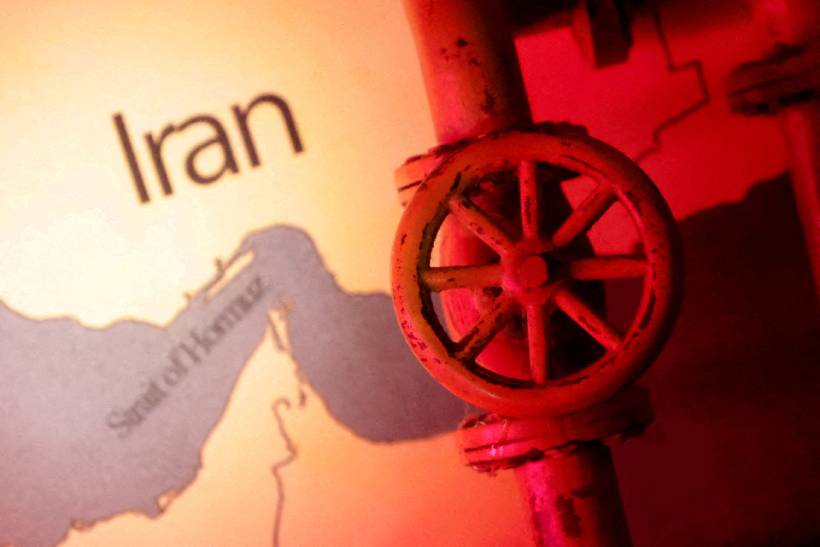
The disruption in the Strait of Hormuz has sent shockwaves through global energy markets, raising a key question: why hasn’t the United States used military force to secure one of the world’s most critical shipping routes?
Despite its naval dominance, Washington’s restraint is deliberate. It reflects a calculated strategy shaped by geography, risk, and competing military priorities.
Geography Gives Iran the Edge
The Strait of Hormuz is a narrow passage bordered by Iran’s coastline, giving Tehran a major advantage. From land, it can launch drones, missiles, and small naval attacks at relatively low cost while forcing the U.S. into a much more expensive defensive position.
This means control of the sea alone is not enough. Any real effort to secure the strait requires dealing with threats on land.
A Two-Stage Military Challenge
Reopening the strait safely would require a structured military campaign.
The first stage would involve destroying Iran’s ability to strike ships. That includes targeting radar systems, drone launch sites, weapons depots, and command networks. While the U.S. can hit fixed targets, Iran’s mobile drone systems are harder to locate and eliminate.
The second stage would focus on maintaining security. This includes constant surveillance, air patrols, naval escorts, and rapid-response forces. Even then, the goal is risk reduction, not complete safety.
Without completing the first stage, any attempt at escorting ships would remain highly dangerous.
Why the U.S. Is Not Stepping In
The decision not to act immediately comes down to four key factors.
First, military priorities lie elsewhere. Under Donald Trump, the focus has been on weakening Iran’s nuclear and missile capabilities. These operations require significant airpower and intelligence resources, leaving little room for a large-scale maritime mission.
Second, escalation risks are serious. Striking Iran’s coastal systems could trigger a broader regional conflict. What begins as a mission to protect shipping could quickly expand into a larger war.
Third, the scale of the operation would be massive. Securing shipping lanes would require continuous deployment of warships, aircraft, and surveillance systems across a wide area. This is not a quick or limited operation.
Fourth, there is the risk to personnel. U.S. naval ships carry hundreds of crew members. Iran has already shown it can hit vessels using drones and unmanned systems. Sending ships into that environment without first reducing threats would put lives at significant risk.
The Mine Warfare Factor
Even the possibility of naval mines complicates everything. Iran does not need to deploy many mines to disrupt shipping. Just the threat alone can deter commercial vessels.
Clearing mines is slow and complex. It involves specialized ships, divers, and remote systems, often taking weeks or months. Doing this under threat would be even more difficult.
At the same time, Iran is unlikely to heavily mine the strait, since it depends on the same route to export its own oil.
Drones and Modern Asymmetric Warfare
Iran’s use of drones highlights a shift in modern conflict. These systems are cheap, mobile, and difficult to detect before launch.
Unlike missiles, they do not rely on large fixed infrastructure, making them harder to eliminate completely. This creates a constant, unpredictable threat environment.
Bigger Strategic Priorities
The U.S. is focusing on long-term goals rather than immediate fixes. By targeting Iran’s missile systems, nuclear program, and regional networks, Washington aims to reduce the overall threat at its source.
From this perspective, securing the strait without weakening Iran first would only offer a temporary solution.
Global Impact
The disruption in the Strait of Hormuz is already affecting global energy supply. Oil prices are rising, trade routes are under pressure, and economies dependent on Gulf energy are feeling the strain.
For U.S. allies, the situation raises concerns about security guarantees. For regional states, it highlights their exposure to conflict driven by larger powers.
A Deliberate Strategy
The U.S. decision not to secure the Strait of Hormuz militarily at this stage is not hesitation. It is a calculated move to avoid escalation while focusing on broader strategic objectives.
The risk is that the longer the disruption continues, the greater the economic and political fallout. But acting too soon could trigger a far more dangerous conflict.
For now, restraint is not weakness. It is strategy.
With information from Reuters.