
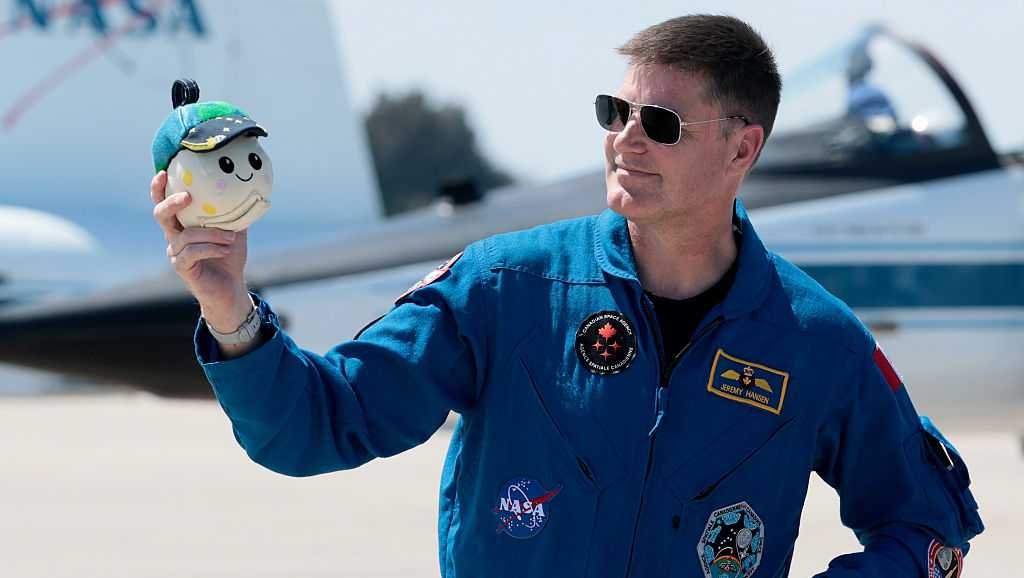
We are holding our uh our 0G indicator rise, and Christina will make *** few comments about this. Yes, we’ll see if I can get this microphone in place, but. We are thrilled to announce today the winner of the 0G indicator or ZGI contest which was participated in worldwide, and our buddy here named Rise was submitted by 2nd grader Lucas Yee from California. Thank you, Lucas. The crew personally participated in selecting our buddy, our stowaway to fly with us, and this little guy Rise really resonated with us because the theme is actually the Earthrise photo taken on Apollo 8, which is. Inspirational to all of us and it is *** mission that sort of mirrors our own and we’ve incorporated it into our mission patch and also into our ethos and values as *** crew so welcome aboard Rise. It was *** great first flight with you. We look forward to the next one. Uh, thank you, thank you. Uh, 11 last cool little note on Rise is on the bottom of Rise, there’s *** little tiny zipper right here and the, uh, micro SD card that has everyone’s names that they’ve submitted. There’s still time. I think it closes tonight. Courtney can make sure, uh, but this is where that SD card will live, so it will be right here on our ZRG indicator, *** great little feature of, of our little buddy Rise. Thank you. That’s right, we’ll be taking submissions until 5 p.m. tonight, so you still have time to get your name in if you’re interested.
Meet Moon Mascot ‘Rise,’ the zero-g indicator for NASA’s Artemis II mission

Updated: 9:14 PM MDT Mar 27, 2026
NASA’s Artemis II crew on Friday revealed that “Rise” has been selected to be a zero-gravity indicator that will fly aboard the agency’s Artemis II test flight.In its “Missions” blog, NASA explains that zero gravity indicators are plush items that are small and provide a visual indication of when the spacecraft and its crew reach space.According to NASA, for the first eight minutes following liftoff, the plush item and the crew members will be pushed into their seats by gravity. NASA on Friday celebrated Rise’s unveiling on Friday. In an Instagram post on the nasaartemis page, NASA said, “The zero gravity indicator for the Moonbound crew was selected from thousands of submissions from over 50 countries and is named ‘Rise’” NASA, in the Instagram post, said that during the selection process, the crew “narrowed a list of 25 finalists to five top designs.”Rise was designed by Lucas Ye of Mountain View, California, according to the post. The other finalists in the top five were: “Big Steps of Little Octopus,” Anzhelika Iudakova, Finland“Corey the Explorer,” Daniela Colina, Peru“Creation Mythos,” Johanna Beck, McPherson, Kansas“Lepus the Moon Rabbit,” Oakville Trafalgar School, CanadaImages of the other designs were posted to the NASA Artemis account on X, formerly known as Twitter. NASA said the design for Rise was inspired by the “iconic Earthrise moment from the Apollo 8 mission.”A photo of the plush posted to Facebook by NASA shows that it looks like a moon with a smiling face, and appears to be wearing a hat that looks like the Earth, which has a black bill and features two spacecraft zooming through star-filled space. >> More about the design winner and contest here ___Sister station WESH in Orlando, Florida, contributed to this report.
NASA’s Artemis II crew on Friday revealed that “Rise” has been selected to be a zero-gravity indicator that will fly aboard the agency’s Artemis II test flight.
In its “Missions” blog, NASA explains that zero gravity indicators are plush items that are small and provide a visual indication of when the spacecraft and its crew reach space.
According to NASA, for the first eight minutes following liftoff, the plush item and the crew members will be pushed into their seats by gravity.
NASA on Friday celebrated Rise’s unveiling on Friday. In an Instagram post on the nasaartemis page, NASA said, “The zero gravity indicator for the Moonbound crew was selected from thousands of submissions from over 50 countries and is named ‘Rise’”
NASA, in the Instagram post, said that during the selection process, the crew “narrowed a list of 25 finalists to five top designs.”
Joe Raedle
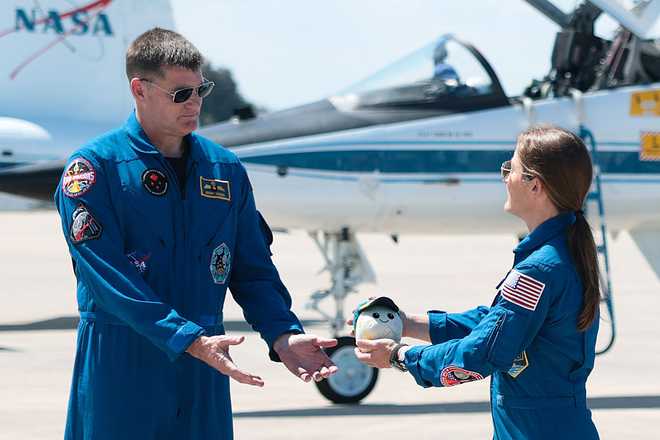
Artemis II crew mission specialist Christina Koch (R) hands mission specialist Jeremy Hansen of CSA (Canadian Space Agency) a plush toy of the “moon mascot” after arriving at the Kennedy Space Center on March 27, 2026, in Cape Canaveral, Florida. The astronauts arrived to begin preparations for an April 1, 2026, launch for a 10-day mission, which will take them around the Moon and back to Earth. (Photo by Joe Raedle/Getty Images)
Rise was designed by Lucas Ye of Mountain View, California, according to the post. The other finalists in the top five were:
“Big Steps of Little Octopus,” Anzhelika Iudakova, Finland“Corey the Explorer,” Daniela Colina, Peru“Creation Mythos,” Johanna Beck, McPherson, Kansas“Lepus the Moon Rabbit,” Oakville Trafalgar School, Canada
Images of the other designs were posted to the NASA Artemis account on X, formerly known as Twitter.
NASA said the design for Rise was inspired by the “iconic Earthrise moment from the Apollo 8 mission.”
A photo of the plush posted to Facebook by NASA shows that it looks like a moon with a smiling face, and appears to be wearing a hat that looks like the Earth, which has a black bill and features two spacecraft zooming through star-filled space.
>> More about the design winner and contest here
___
Sister station WESH in Orlando, Florida, contributed to this report.