
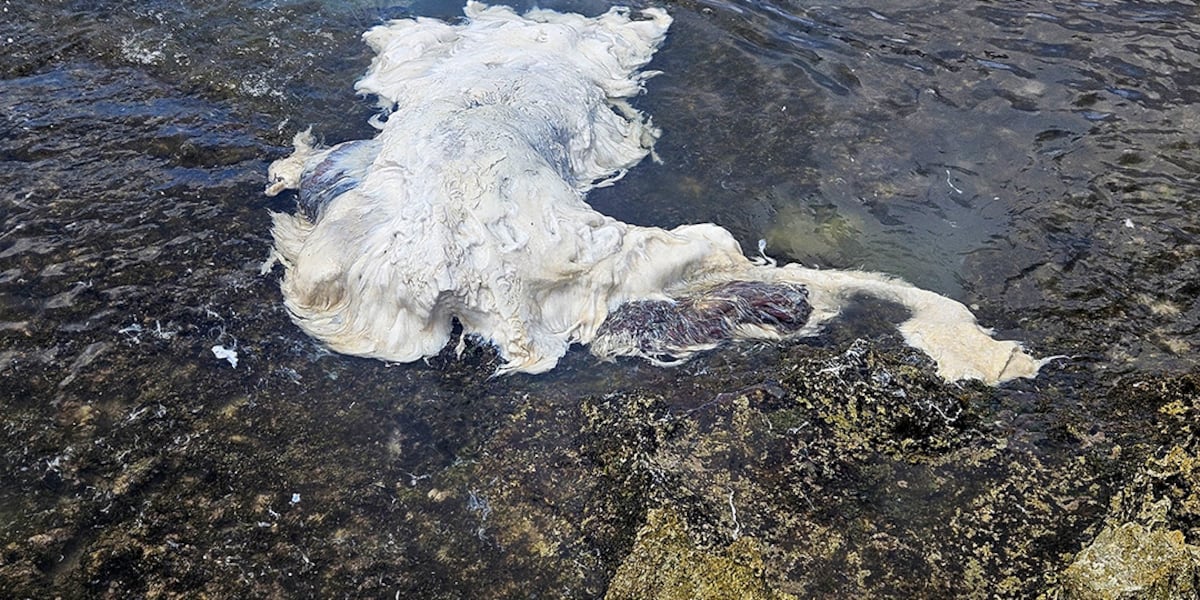
HONOLULU (HawaiiNewsNow) – The Hawaii Department of Land and Natural Resources is warning the public of a sperm whale carcass off Oahu’s southwest shore.
On Friday, DLNR’s Division of Aquatic Resources (DAR), in partnership with cultural practitioners, the University of Hawaii Marine Mammal Stranding Lab (UHMMSL), and the National Oceanic and Atmospheric Administration (NOAA), is monitoring the carcass.
Officials said blubber, bones, and other remnants are washing ashore between Nanakuli Beach Park and Barbers Point, which has attracted large predators such as tiger sharks.
DLNR said the tail section moved with the tides just outside of the Ko Olina Lagoon areas. UHMMSL has removed the largest section.
The state advises visitors to the area to avoid contact with smaller pieces of blubber that may still be in the waters and on the rocks and sand.
For the safety and protection of the wildlife, the public is asked to adhere to the following guidance:
Stay out of the water: The presence of large predators feeding on the remains poses a significant danger to humans.Be aware when you are at the shoreline: Take time to check for signs of whale carcass remnants in the area such as oil slicks, pieces of blubber on the sand and rocks, as well as in the water, especially if there is a strong smell of decay in the air.Do not approach or touch: To prevent illness, do not swim in or near areas where remnants are found on the beach and do not touch or interact with the carcass or remains of any size that may be found on the shoreline.Follow federal laws: All marine mammals, living or dead, are protected under the Marine Mammal Protection Act (MMPA). Palaoa are endangered and are also protected under the federal Endangered Species Act. The taking of marine mammal parts is prohibited.
DAR said the public should leave any pieces of the whale carcass where they found them, as the remnants will naturally biodegrade back into the environment and help provide food for birds, crabs, smaller fish, and other wildlife in Hawaii’s ocean and coastal ecosystems.
“With aloha (love), this kupuna palaoa (sperm whale) has chosen to return home to the shores of Waiʻanae Moku. We remember this palaoa connects us to our ancestors as recounted in the Kumulipo, Wā II. We humbly invite everyone to ‘e mālama kou ponoʻī’ (please hold space from where you are) for such a sacred moment to honor the transition of this kupuna palaoa to pō. Do not enter the area, except for those entrusted with kuleana. Refrain from drones, photography, video, and social media posting, for public and spiritual safety,” said Dr. Lelemia Keoho Irvine, kupukaaina as well as a member of Ka Hui Kupukaaina o Waiʻanae and assistant professor of Physics at the University of Hawaiʻi at West Oʻahu.
Copyright 2026 Hawaii News Now. All rights reserved.