
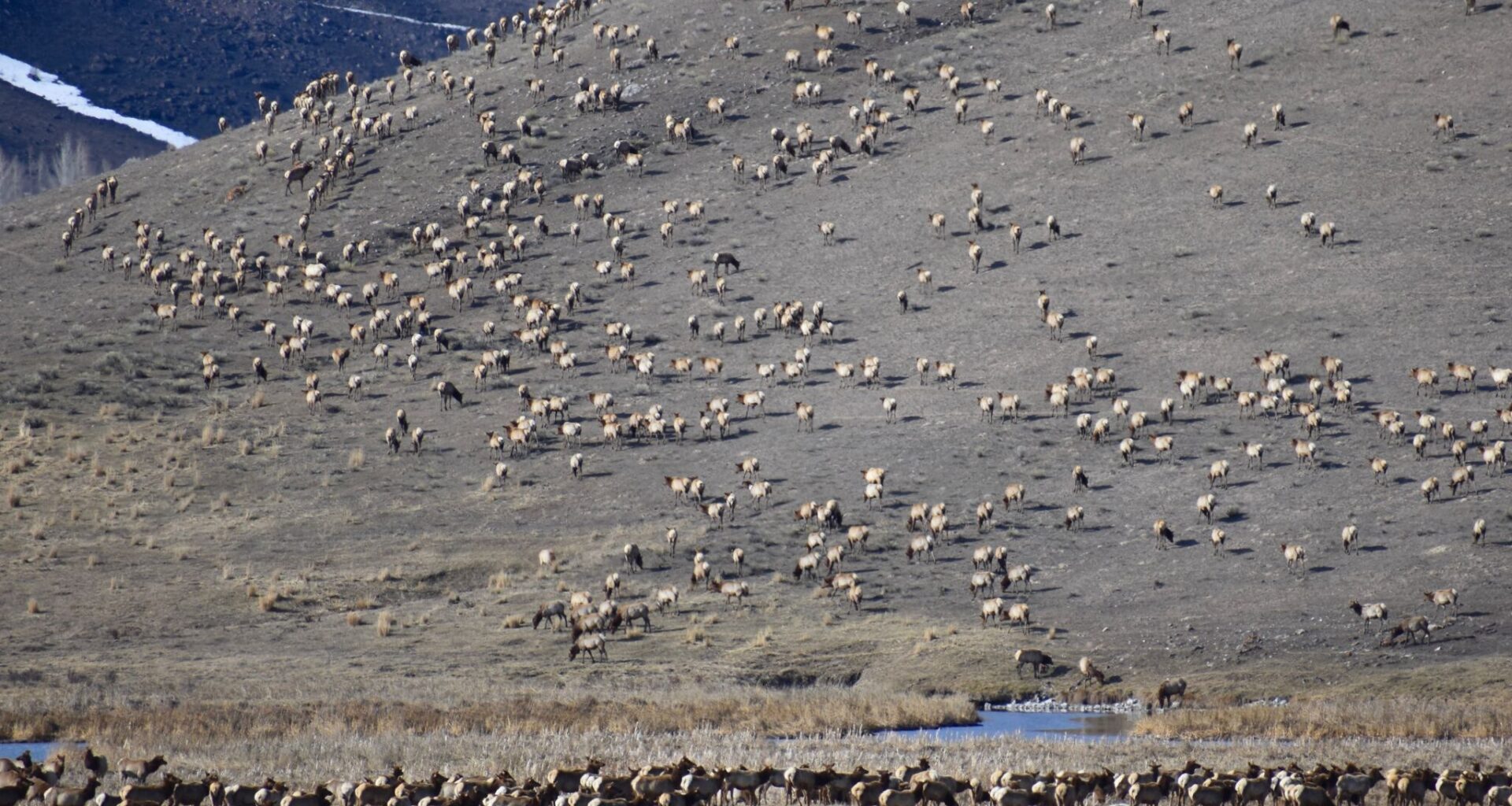
Hoofbeats across the sagebrush flats are a sure sign of spring in northwestern Wyoming. As the days lengthen, snow melts and temperatures rise, the thousands of elk that spend winters on the National Elk Refuge just outside Jackson, Wyoming, begin their journey north.

Their final destination: in and around Grand Teton National Park, where they’ll spend the summer grazing at higher elevations.
But this year, this seasonal rhythm — which typically kicks off in late spring or mid to late-April in Wyoming — has started earlier than expected, signaling an atypically meek winter for the region.
Article continues below this ad
The Jackson Hole News & Guide reported that, since early January, at least 1,600 elk have left the refuge. Elk numbers on the refuge vary by winter; this winter, roughly 6,500 were counted at peak season.
Then, the Cowboy State Daily reported that, as early as late February, “mobs” of elk had left the refuge, urged onward by a warmer and dryer-than-usual winter. WyoFile reported that more elk are beginning to leave again in late March.
FILE: Spring on the National Elk Refuge in Jackson, Wyo., in 2021.
Kari Cieszkiewicz/USFWS
Elk in and around the Tetons perform a seasonal dance, moving down in elevation from the Grand Teton and Yellowstone national parks, the Bridger-Teton National Forest and the Gros Ventre mountains to places with ample food and less snow during cold winter months, when hillsides are usually caked with snow that hinder foraging.
Article continues below this ad
Make SFGATE a preferred source so your search results prioritize writing by actual people, not AI.
Add Preferred Source
That brings the elk closer to the town of Jackson and onto private land on the valley floor, as well as the flats of the almost 25,000-acre National Elk Refuge, which is managed by the U.S. Fish and Wildlife Service. Elk can usually be seen here from mid-December through early April, according to the refuge’s website. (Visitors can safely get close to the elk on horse-drawn winter sleigh rides.)
Refuge managers usually feed the elk to bolster populations during the winter, a controversial practice that some say congregates the elk in a way that could spread disease.
The refuge didn’t feed the elk this year, given the low snow cover. It’s been a weirdly warm winter in western Wyoming, with record-setting heat and a rapidly melting snowpack.
Article continues below this ad
Earlier migration than usual isn’t necessarily a bad thing for the elk, who will find what they need to nibble outside the refuge as long as a spring snowstorm doesn’t drive them back south. But like the early end of Death Valley National Park’s wildflower season and the early fruiting of Joshua trees in the eponymous national park, the elk’s early migration is yet another indicator of a warming climate.
FILE: Elk on the National Elk Refuge near Jackson, Wyo., in April 2020.
Gannon Castle/USFWS
Wildlife watchers looking to spot the elk should explore Gros Ventre Road, which runs between the refuge and Grand Teton National Park.
But drivers should also keep an eye out for elk on all roads, especially at night when visibility is limited. Grand Teton National Park has warned visitors in the past to watch for wildlife on the move. “As elk, pronghorn, and mule deer make their way north into Grand Teton for the summer, they often cross roads, especially near river corridors and snow-covered areas … slow down, stay alert, and be extra cautious at dawn and dusk when animals are most active,” a Facebook post from 2025 reads.
Article continues below this ad
Obeying speed limits, some of which are lowered in key migratory corridors, scanning for movement, and braking instead of swerving can help drivers avoid wildlife collisions.
The Jackson elk herd that winters on the National Elk Herd is known for its prodigious migrations. It’s one of North America’s largest elk herds, according to the Wyoming Game and Fish Department. Some elk trek as far as Yellowstone National Park, which is over 60 miles away. But a growing number of elk are migrating shorter and shorter distances. Wildlife managers captured and collared some this winter to better understand their journeys.
We love national parks just as much as you do, so we have a newsletter that covers them from top to bottom. Sign up here.