
He was just a boy walking the streets of Budapest when he first recognized himself in a stranger.
A man stood at a canvas, brush in hand, painting in the open air. The child, not yet old enough to understand ambition, didn’t dream of becoming an artist.
Instead, a simpler thought crossed his mind, ”He does what I do.”
That quiet moment would follow Andor Paposi-Jobb across continents and decades — through war, escape and a lifetime devoted to art.
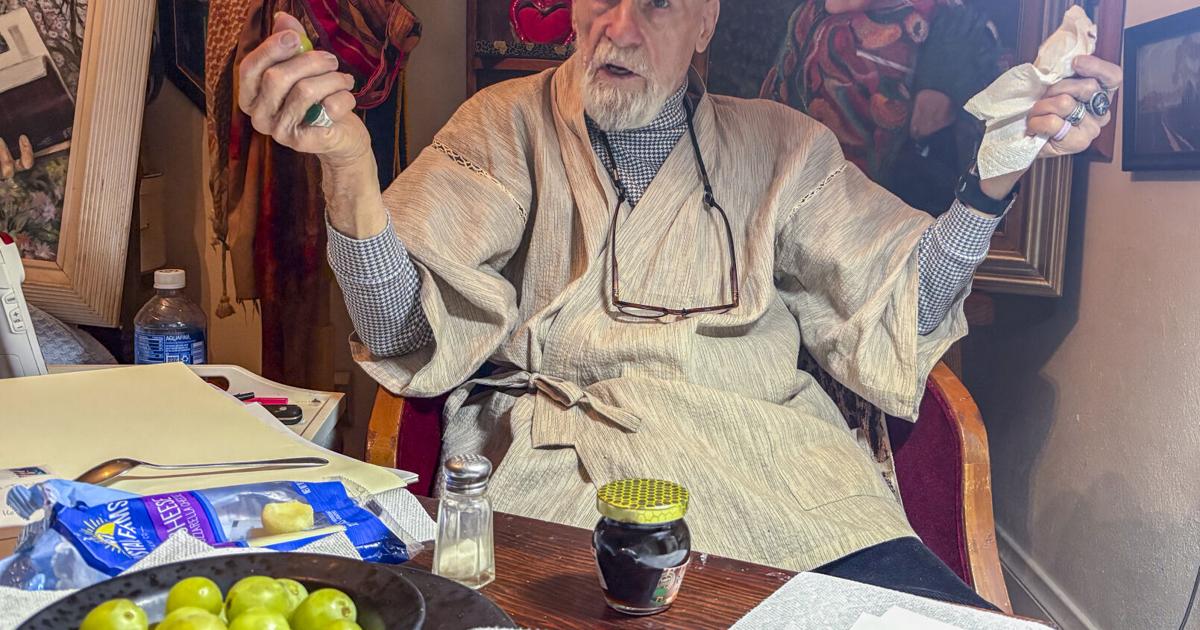
Now, at age 92, the Emlenton artist is preparing to leave the home that he has known for 27 years and move to Indiana, Pennsylvania, to be closer to family.
Along with relocating to Indiana at the end of the month, Paposi-Jobb has other goals in mind, including creating additional portraits and completing a book on language.
It marks another turning point in a life shaped early by upheaval.
Born in 1934 in Hungary, Paposi-Jobb grew up without his father after the age of 4, coming of age in a country scarred by World War II. By 1956, he was a third-year student at the Applied Art Academy of Budapest when history intervened.
“On October 23, 1956, the Hungarian ‘so-called’ revolution against communism and against the Soviet occupation takes place,” he recalled.
The uprising, known as the Hungarian Revolution of 1956, forced him and his older brother’s family into a decision that would change everything: to flee.
They escaped from Hungary and found refuge in Austria, leaving behind their homeland but carrying with them the skills and instincts Paposi-Jobb had been honing since childhood.
Talent at a young age
Even before he knew the word “artist,” others recognized it in him.
In kindergarten, he was already creating drawings that drew attention.
“Everyone says, ‘This is going to be an artist,’” Paposi-Jobb said. “I don’t even know the word, but they appreciate what I do.”
As a boy, his work held value, not in galleries, but in small exchanges that hinted at a future.
“I am selling them for a little gift, an apple or a piece of bread. I am earning my future,” he said.
By grade school, his talent had become impossible to overlook.
Teachers would pull him from his classroom near the end of the day and take him to other rooms, asking him to transform their chalkboards into vivid illustrations for the next morning’s lessons.
It was the beginning of a lifelong pattern: art not just as expression, but as contribution.
That contribution would grow into a career spanning continents and institutions.
Arriving to America
When Paposi-Jobb arrived in the United States in 1956, he landed in New York City and was given an opportunity to prove himself.
At Bard College, he had about a month to complete language training and pass an exam demonstrating rapid proficiency in English.
His performance earned him a scholarship to Kent State University, where he studied art and earned degrees that launched his career as a teacher.
As a professor emeritus at Clarion University of Pennsylvania, from where he retired in 1991, Paposi-Jobb left his mark not only on students but on the walls of the region and beyond.
When he was hired in 1963 by then-Clarion State College President James Gemmell, he became, according to his recollection, the first employee of European background at the institution.
“Now I have to live up to expectations,” he said.
Paposi-Jobb taught a range of subjects, including painting, art history and jewelry-making.
His portrait work can be found across PennWest Clarion, and over at Lincoln Hall and the Foxburg Library below it.
His portraits of bank presidents also were present in the administrative halls and boardroom of Farmers National Bank of Emlenton, and in places that extend far beyond western Pennsylvania — including the Butler Institute of American Art in Youngstown, Ohio, and among private collections around the world.
He also has a book titled “The Judo Greats” accompanying a collection of judo masters, of which he also is one.
Community advocate
From chalkboards to galleries, from a war-torn childhood to an enduring artistic legacy, Paposi-Jobb’s life traces a path shaped as much by circumstance as by instinct.
As a founding member of Allegheny RiverStone Center for the Arts, in Foxburg, Paposi-Jobb also helped shape the cultural life of the region. He recalled how he and his late wife, Jae Ann Brown, became involved with Dr. Arthur Steffee around 2005 or 2006.
“Jae becomes the secretary, promoting the organization visually through the computer and advertising,” he said. “I gave support in helping to recondition Lincoln Hall above the (Foxburg) Library.”
He also described traveling with another organizer to meet musicians and recruit performers who could, as he put it, “create something beautiful for the community.”
When asked about his tendency to donate his work, Paposi-Jobb reflected on the meaning of art itself.
Some artists seek recognition in art history, he said, but necessity can shape a different perspective.
“If you were hungry, a bowl of soup is OK for a painting,” he said. However, “I did make money on painting portraits, wall paintings, as a matter of fact.”