
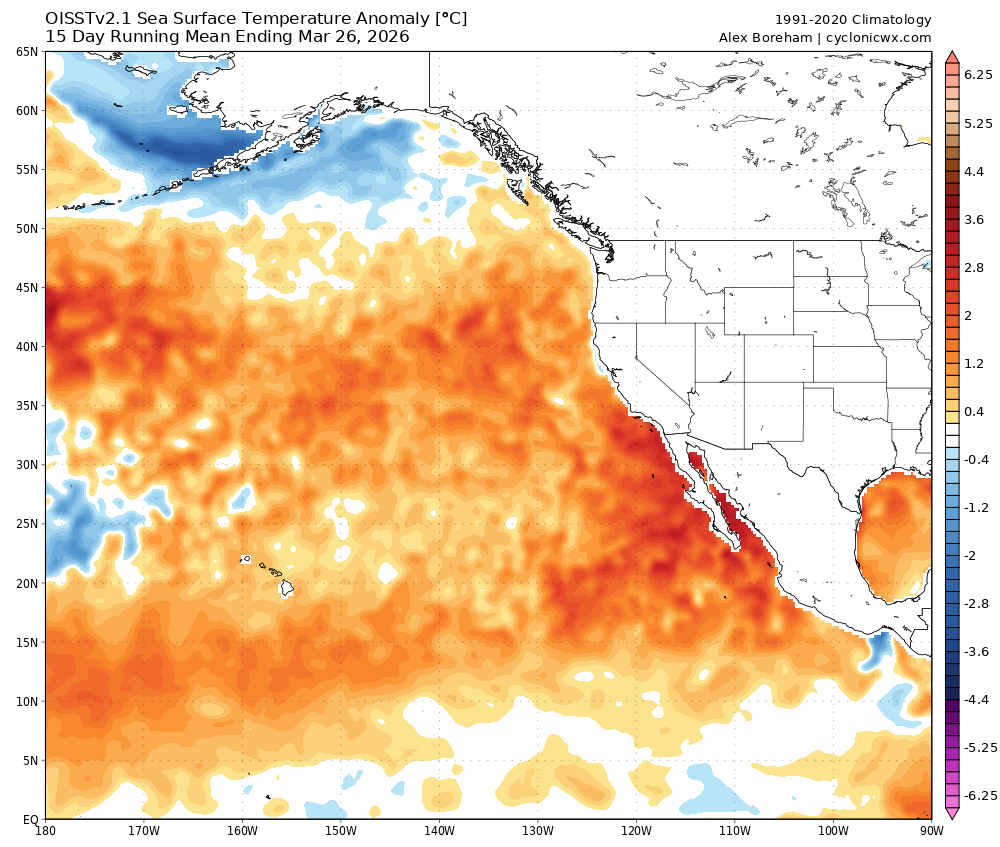
A broad zone of unusually warm ocean water stretches across the eastern Pacific in this March 26 sea surface temperature anomaly map, with some of the strongest warmth concentrated along the Baja California and Southern California coast.
cyclonicwx
On the last day of winter, as California was in the midst of a historic early-season heat wave, the ocean off Southern California crossed a striking threshold.
At Scripps Pier in La Jolla, a long-running sea surface temperature record topped out at 71 degrees, the warmest March reading in the station’s history. It was not an isolated spike. The reading broke a daily record, as had the day before. And the day before that.
“The Scripps Pier sea surface temperature bucket measurements have been hitting some all-time highs for the past few months,” said Art Miller, a researcher at Scripps Institution of Oceanography who studies the dynamics of water currents.
Article continues below this ad
Scripps Pier’s sea surface temperatures have surged well above the long-term March average in 2026, with multiple daily records already set and late-March readings climbing to over 70 degrees.
NOAA
Experts like Miller say the warm ocean temperatures are part of something larger now taking shape. A strong marine heat wave has developed off the Southern California coast, and the next several weeks will determine whether it fades or deepens into something that carries real ecological and meteorological consequences into summer.
How did we get here?
The same stubborn atmospheric pattern that fueled California’s heat wave on land also helped warm the ocean.
San Francisco Chronicle Logo
Make us a Preferred Source to get more of our news when you search.
Add Preferred Source
A stable, unusually strong ridge of high pressure has lingered just off the Southern California coast for the past three months, according to Miller. That persistent ridge weakened the winds that normally help drive upwelling along the coast. Upwelling is a natural process that occurs each spring off the California coast, where winds push surface water away from the coastline or in the open ocean, causing cold, nutrient-rich water from the deep ocean to rise and replace it. A reduction or complete shutdown of upwelling would reduce the supply of cold water rising from below, and allow solar heating to build with relatively little interruption.
Article continues below this ad
“Together that leaves the upper ocean anomalously warm off the coasts of SoCal and Baja compared to normal conditions at this time of year,” Miller said.
The warming is not limited to one pier or place. Across a broad stretch of the eastern Pacific, sea surface temperatures have been running above average for months, though the warmth has been especially notable near Baja California and along the Southern California coast.
What happens next?
At this time of year, the California coast usually undergoes what oceanographers call the spring “upwelling” transition. Stronger winds push warm surface water offshore and pull colder, nutrient-rich water up from below. It’s one of the main reasons California’s coastal waters stay cool through spring and summer.
If that transition kicks in over the next few weeks, this marine heat wave will likely weaken.
Article continues below this ad
But if it doesn’t, the warmth could become entrenched.
“If upwelling fails or is delayed, it could wreak havoc on the entire ecosystem which relies on that primary production to fuel zooplankton that provide food for many fish, seabirds, and baleen whales,” Miller said. “Time will tell.”
Dillon Amaya, a research scientist at NOAA’s Physical Sciences Laboratory who studies Northeast Pacific marine heat waves, said forecast models are already leaning in a concerning direction. Current guidance shows a 50% to 60% probability that marine heat wave conditions persist into at least July.
That may sound like a coin flip — but numbers at that level are extremely unusual. Marine heat waves have only about a 10% baseline likelihood at any given time, Amaya said. A 50% to 60% probability means the odds of unusually warm coastal waters this summer are running roughly five to six times above normal along the Southern California coast.
NOAA forecast guidance shows marine heat wave conditions remaining unusually likely into July across parts of the eastern Pacific, including waters off Baja California and near the Southern California coast.
NOAA
Even if spring upwelling arrives late rather than failing outright, the ocean warmth could still persist past the transition.
Article continues below this ad
That’s because if coastal waters stay warm, the usual blanket of low clouds could thin or burn off more efficiently, allowing more sunlight to reach the ocean surface. And that extra sunlight could add more heat, further suppress cloudiness and help sustain the marine heat wave deeper into summer. Scientists call it a low-cloud sea surface temperature feedback.
That would result in less May Gray or June Gloom conditions.
What it means for the coast
If ocean warmth persists into June with no significant offset from upwelling, the consequences go well beyond a brighter spring and summer for San Francisco.
From 2014 to 2016, prolonged marine heat wave conditions in the Northeast Pacific were linked to northward shifts in fish populations, widespread kelp forest decline, harmful algal blooms, major seabird die-offs and more whale entanglements in fishing gear as marine food webs were disrupted.
Article continues below this ad
Amaya cautioned that a strong marine heat wave does not guarantee those outcomes. What matters most is whether the warmth lingers, deepens and overlaps with the seasons when California’s coastal ocean is normally being replenished by cold, nutrient-rich water from below.
Later in the year, if storms approach the coast over an unusually warm patch of ocean, that extra heat and moisture could help juice rainfall and thunderstorms along the shoreline.
California is nearing the end of the atmospheric river season, but if a storm passes over warmer waters, “rainfall could be more intense,” said Amaya.
It may take some time to know if and when the upwelling has arrived: Amaya said the data measuring ocean temperatures can be delayed for several weeks.