
Southeast Asia is entering an uncertain era in which American security guarantees can no longer be relied upon. This challenge is becoming more urgent as a Taiwan contingency grows increasingly plausible – not because the region will be directly targeted, but because it will be drawn into the operational and political pressures of great-power conflict regardless of its choices.
China is watching for signs of American hesitation in Iran and Ukraine before acting on Taiwan, and the PLA already treats Southeast Asia as critical to any Taiwan contingency, with its Southern Theatre Command given the job to secure its southern flank. Regardless of how Southeast Asian states position themselves diplomatically, they will face the same operational demands: whether to permit access to their airspace and waters, and whether to sustain defence partnerships that may be seen as enabling one side or the other.
Yet regional responses suggest that many governments have not fully grasped the nature of this challenge. Recent simulation exercises by the International Institute for Strategic Studies indicate a tendency to treat a Taiwan contingency primarily as a logistical problem – focused on evacuating citizens – while leaving its longer-term implications unexamined. Planning assumptions continue to rely on external support, whether from China or the United States, as if the problem ends once civilians are moved.
A crisis in the Taiwan Strait is unlikely to end with evacuation. After civilians are removed, Southeast Asian states will face a different set of decisions: whether to grant access, sustain basing arrangements, or support external operations under conditions of pressure. These are not logistical questions, but strategic ones. The issue is no longer how to exit the crisis, but how to position themselves within it – and none of the available options, whether alignment with the US or China, or neutrality, offers protection on its own.
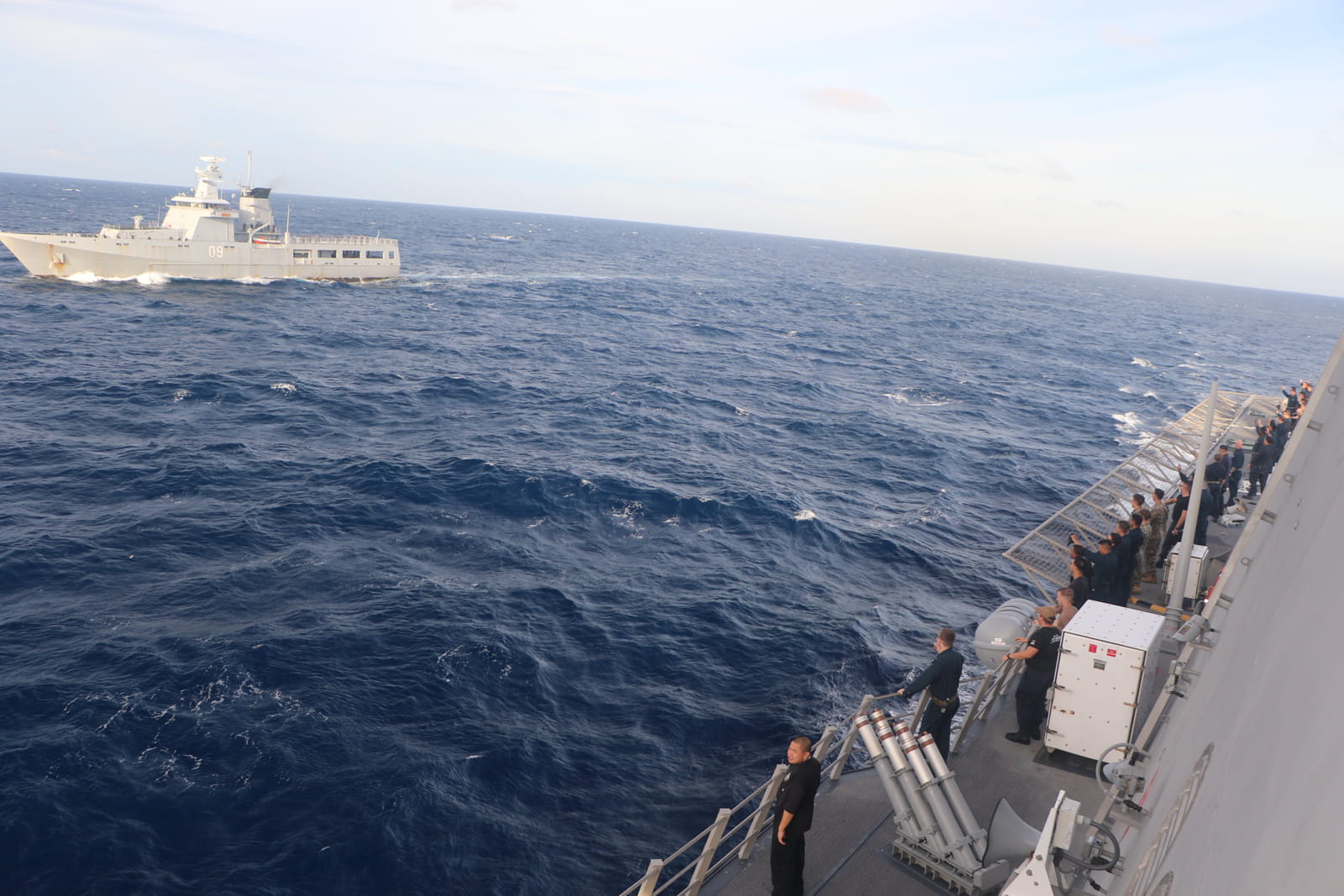
Sailors from the USS Charleston alongs the Royal Brunei Navy vessel KDB Daruttaqwa after South China Sea exercises in 2022 (Cory J. Woll/DVIDS)
The domestic conditions that sustained long-term US forward deployment have eroded. Support for open-ended global commitments has weakened, and pressure for more conditional burden-sharing has grown, regardless of who governs in Washington. At the same time, the US retains considerable capacity to impose costs on allies and partners that move too closely to Beijing, leaving Southeast Asia exposed to both abandonment and coercion.
Nor are other powers likely to fill the gap. Under pressure, Japan will focus on the crises on its doorstep, particularly Taiwan, while India prioritises its continental disputes with China and Pakistan and the western Indian Ocean. Without a stable anchor, secondary powers retract to their immediate priorities rather than extend security to Southeast Asia.
It requires only that each state independently assess – and, where there is political appetite – share information about how its capabilities relate to the wider regional geography.
Deferring to China’s position on Taiwan does not resolve this problem either. It may avoid immediate confrontation with Beijing but does not ensure protection once the military balance shifts. Nor does neutrality address the spillover pressures from a Taiwan contingency. Without the capacity to deny external access and resist coercion, neutrality cannot be enforced: it becomes a position that others test and ultimately override.
Without the capacity to resist external pressure, no foreign policy position can be sustained. Yet defence planning across the region remains largely inward-looking and concentric, extending concern to immediate approaches and neighbouring countries but rarely beyond. Anti-access/area-denial strategies – where they exist – are unevenly developed, often shaped by internal security traditions rather than external defence requirements, and rarely integrated into a broader regional picture. No state can credibly execute a denial strategy on its own, and there is little evidence of sustained effort to develop such capacity at the minilateral or ASEAN level.
What is required is not another ASEAN-based mechanism or a SEATO-style collective defence pact – both are politically unrealistic. The challenge is to rethink how defence is understood, not purely in national terms, but across the wider regional space.
This does not imply collective action or institutional coordination. To think regionally is not to act collectively. It requires only that each state independently assess – and, where there is political appetite – share information about how its capabilities relate to the wider regional geography. Knowing where countries can contribute on their own terms will generate an aggregate effect that constrains the movement of external powers. This begins with a systematic understanding of Southeast Asia’s strategic geography:
Mapping key axis of advance through which external powers would project force into the region;Identifying key terrain, chokepoints, and vulnerability cascades that shape the operational possibilities of external powers;Concentrating effort on positions each state can credibly hold without weakening its ability to defend its immediate approaches.
States contribute not out of solidarity, but calculation. Instability from great-power pressures further up the chain can compress the strategic depth available to countries further south – shrinking their buffer and room for manoeuvre, and exposing defensive lines that once appeared secure. Rather than dispersing forces and extending defence outward indiscriminately, each state should identify key positions from which it can defend immediate approaches while retaining the ability to manoeuvre further up the chain when required. This requires selecting positions that can be held without overstretch, and structuring forces to remain mobile and concentrated between them.
This approach does not eliminate the choice between alignment and neutrality in a Taiwan contingency. But it changes the conditions under which either is pursued, by enabling states to manage the spillover pressures of great-power conflict – particularly demands over access, basing, and overflight – so that their foreign policy position is not compromised by operational necessity. It allows states to delay, condition, or limit such demands, rather than having them dictate alignment outcomes. Crucially, this approach does not require designating any single power as a threat and remains applicable to future crises involving any external actor.
A Taiwan contingency will not leave Southeast Asia untouched. States across the region will face the same operational demands, regardless of alignment or neutrality. The real question is whether those positions can be sustained under pressure. Without the capacity to manage such pressures, foreign policy becomes reactive rather than strategic.