
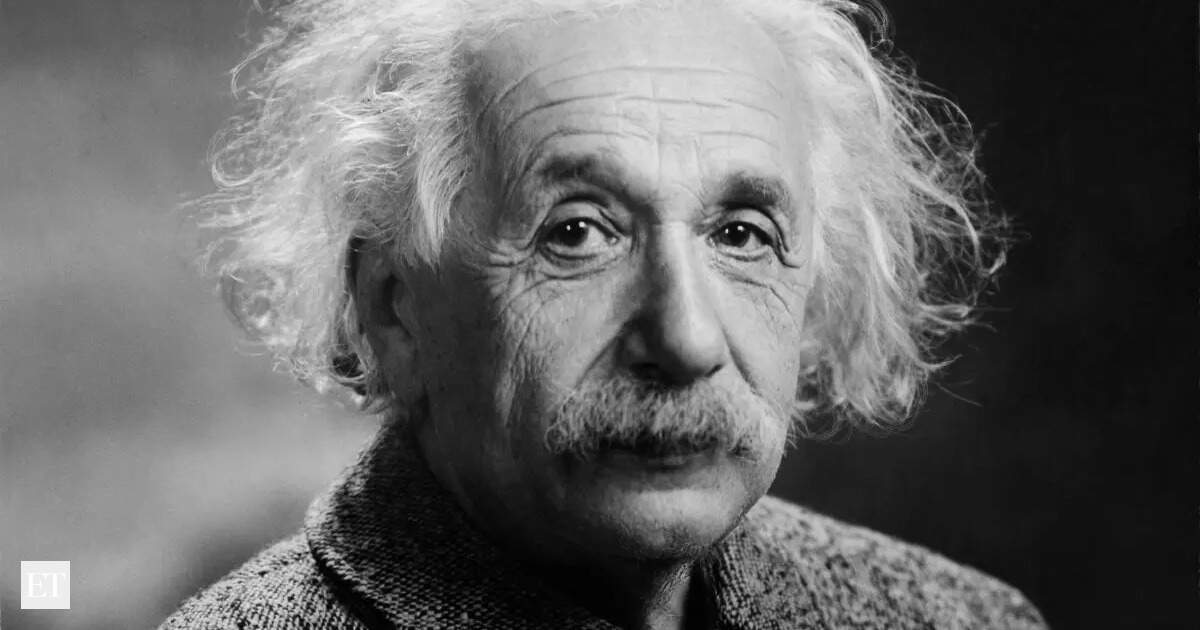
Albert Einstein was a German-born theoretical physicist whose work reshaped modern science and transformed humanity’s understanding of space, time, and energy.
Born in 1879 in Ulm, Germany, he developed the Theory of Relativity, including the famous equation E=mc², which established the relationship between mass and energy.
His theories challenged classical Newtonian physics and laid the foundation for much of 20th-century physics. In 1921, he was awarded the Nobel Prize in Physics for his explanation of the photoelectric effect, a breakthrough that proved pivotal in the development of quantum theory.
Beyond science, Einstein became a global public figure known for his humanitarian views and outspoken positions on war, civil rights, and nuclear disarmament. After fleeing Nazi Germany in 1933, he settled in the United States, where he worked at Princeton University.
Though he later expressed regret over his indirect role in the development of atomic weapons, he remained an advocate for peace and international cooperation. Einstein died in 1955, leaving behind a legacy that continues to influence physics, philosophy, and popular culture.
 Live Events
Quote of the day
“It is the supreme art of the teacher to awaken joy in creative expression and knowledge.”
Meaning of the quote
The quote by Albert Einstein underscores that true teaching goes beyond delivering information; it lies in inspiring curiosity and enthusiasm for learning. It suggests that the most effective educators ignite a sense of joy in discovery, encouraging students to think creatively rather than passively absorb facts.
By fostering an environment where learners feel motivated to explore ideas independently, teachers help cultivate deeper understanding, innovation, and a lifelong passion for knowledge.
Relevance in today’s world
In today’s rapidly evolving, knowledge-driven world, Albert Einstein’s idea is more relevant than ever. With information readily accessible through technology, the role of educators has shifted from merely delivering facts to nurturing creativity, critical thinking, and curiosity.
In an era defined by innovation, artificial intelligence, and complex global challenges, students must be encouraged to question, explore, and apply knowledge rather than memorize it. This approach not only enhances engagement but also prepares individuals to adapt, solve problems, and contribute meaningfully in a dynamic, competitive landscape.
Add  as a Reliable and Trusted News Source