
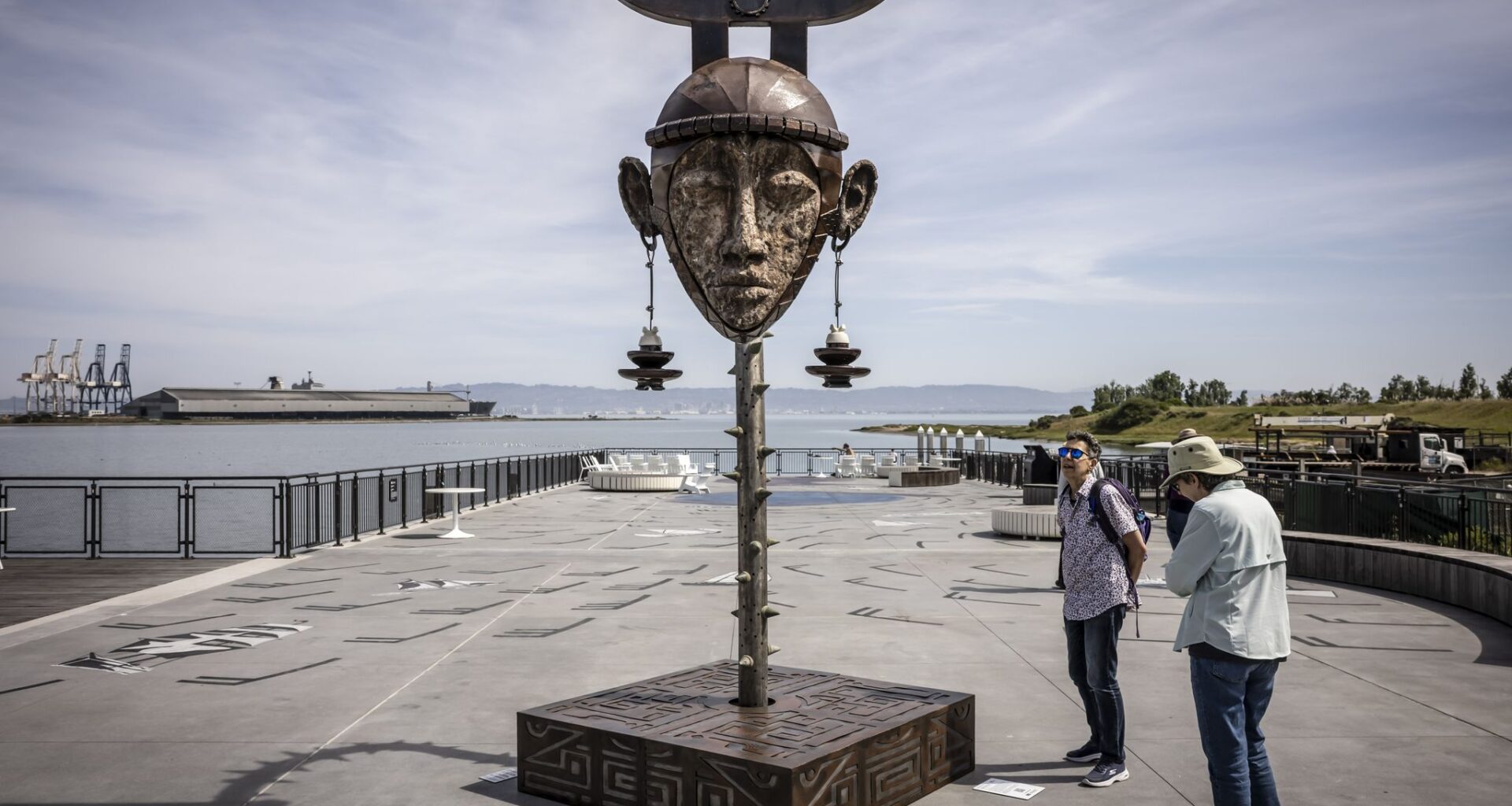
Visitors to India Basin Shoreline Park in San Francisco check out “Whispers of Waste,” a 13-foot monument made out of reclaimed metal and industrial parts at the Box Shop in Bayview-Hunters Point.
Carlos Avila Gonzalez/S.F. Chronicle
“R-Evolution,” a 45-foot-tall sculpture by artist Marco Cochrane at Embarcadero Plaza, was placed by the public art facilitator the Big Art Loop, which is helping put 100 oversize installations in place around San Francisco.
Carlos Avila Gonzalez/S.F. Chronicle
Naga the sea serpent is illuminated last July during its introduction in San Francisco’s Golden Gate Park. Naga is a creation of Cjay Roughgarden, who originally created it for the Playa at Burning Man.
Carlos Avila Gonzalez/S.F. Chronicle
“Where’s the Ball,” an installation of giant jacks on the JFK Promenade in Golden Gate Park, is part of the Big Art Loop of oversize installations.
San Francisco Recreation and Park Department
Carol Gould of Bernal Heights was leading some friends from Concord on a three-park hike along San Francisco’s southern waterfront when she looked over her shoulder toward the bay and saw something that stopped the hike before it had even started.
It was a 13-foot-tall African mask hung on a pole and standing all alone in the middle of the dock at India Basin Waterfront Park. Gould instructed her charges to make a hard right, and they went down a flight of stairs for a closer look. Their final destination of the Ramp for lunch on the sundeck would have to wait.
“I saw that thing, and it wasn’t here the last time I was here,” Gould said. “It’s very striking and located in the exact right place. It is very evocative and raises lots of questions.”
Article continues below this ad
Luckily, the person to answer those questions was seated on the base of the artwork, Zulu Heru, 31, an Army veteran turned sculptor with a studio a block away from India Basin.
The artwork, titled “Whispers of Waste,” is made of 5,000 pounds of industrial materials, mostly recycled. Its installation at India Basin for one year is a function of the Big Art Loop, a public art facilitator that has assigned itself the role of putting 100 oversize installations around the city to form a 34-mile trail. Initially funded by the Sijbrandij Foundation, the Big Art Loop has already invested $2 million in the plan as curated by Building 180, a female-led art organization.
San Francisco sculptor Zulu Heru displays “Whispers of Waste,” formed from 5,000 pounds of industrial materials, mostly recycled. The tribal mask sculpture was originally commissioned for Burning Man last summer.
Carlos Avila Gonzalez/S.F. Chronicle
“The Big Art Loop is about putting public art into the neighborhoods,” said Aliza Marks, the organization’s CEO. “All of these sculptures are existing works of art. We are bringing them out of storage and into public view.”
San Francisco Chronicle Logo
Make us a Preferred Source to get more of our news when you search.
Add Preferred Source
The most prominent example of their work thus far is the nude woman sculpture at the Embarcadero, which was recently extended for six months, and the water-spewing sea serpent in a lake along JFK Promenade in Golden Gate Park.
Article continues below this ad
Just this month a series of 10 pointy jacks made of galvanized steel, like the playground game kids play, was installed along the JFK Promenade. There is no little red rubber ball to go with it, hence the title “Where’s the Ball” by the art collective Misfit Toys.
“Whispers of Waste” became the 20th installation along the Big Art Loop and the first in Bayview-Hunters Point in organic fashion. Heru is a crane operator who was installing a giant whale along the Embarcadero for the Big Art Loop when Shannon Riley of Building 180 yelled up to him on the crane, wanting to install one of his own artworks. It was a question he could not immediately answer because operating the crane to place the whale, called “Echoes” by Mathias Gmachl, required total concentration. Once that was done, he yelled back his answer from the cab.
“I said ‘Hey, I’m actually putting a piece at India Basin this weekend. You should come look at it,” Herus said. That installation happened to be the next day, Nov. 8, 2025. Heru came straight from the whale installation to India Basin to set up “Whispers of Waste.” Riley did come see it, and that’s how a one-day exhibition became a one-year installation, paid for by the Sijbrandij Foundation in partnership with Building 180 and the Recreation and Park Department, which owns most of the sites along the Big Art Loop.
“The people of India Basin loved the sculpture, so it was very serendipitous,” he said. “Their requirement is that the artist be from the neighborhood, and my studio is one block away. None of this was supposed to happen.”
It would have been easy just to leave it in place, but after three weeks on site, Heru had to remove the sculpture with heavy machinery to get city permission to put it right back where it was. As part of the process, the community was engaged.
Article continues below this ad
“They wanted it to reflect the community and be from someone in the community,” Marks said. “They wanted a Black sculpture.”
San Francisco sculptor Zulu Heru used high-voltage insulators in his piece “Whispers of Waste,” a 13-foot sculpture of an African mask and the latest installation of the public art facilitator Big Art Loop.
Carlos Avila Gonzalez/S.F. Chronicle
“Whispers of Waste” premiered at Burning Man last summer, where it was commissioned as a site-specific installation at the base of “The Man” itself, the 68-foot-tall wooden and neon sculpture. It had taken two months to build at the Box Shop, a series of containers that have been converted to art studios.
His idea for the position of honor was a 13-foot sculpture welded of scrap metal, concrete and industrial parts, all sourced from the local environment to create what he calls “my rendition of a traditional mask worn by the Senufo tribe of the Ivory Coast.”
About 70,000 Burners saw it in its first iteration. Heru trailered it back and put it into storage while he worked on commissions for a solo exhibition at Gallery Route One in Point Reyes, and the Butter Art Fair in Los Angeles. On Thursday, April 2, he will open “Balanta Born,” a solo show of his sculpture and his discovery of his African ancestry, at One Market Plaza, off the Embarcadero.
Article continues below this ad
All that is after hours to his full-time job as a crane operator and member of Local 3, Operating Engineers, using skills he picked up during a nine-year career operating heavy machinery in the U.S. Army.
The unveiling of “Whispers of Waste” on March 21 was attended by 200 people — not Burning Man numbers, but as a neighborhood event it was well attended. There were dancers, skateboarders, rope jumpers and a fleet of kayakers.
San Francisco sculptor Zulu Heru sees his giant sculpture “Whispers of Waste” as “my rendition of a traditional mask worn by the Senufo tribe of the Ivory Coast.”
Carlos Avila Gonzalez/S.F. Chronicle
“Both ‘Whispers of Waste’ and the park itself tell stories of transformation,” said Sarah Madland, interim general manager of Rec and Park. “Post-industrial brownfield to healthy shoreline; reclaimed materials to powerful public art. It’s poetic and fitting, and it invites people to connect more deeply with this place and the community that helped shape it.”
It is Heru’s first public artwork in San Francisco. He had a speech written and rehearsed in his head, but he ditched it when he saw the number of neighborhood kids in attendance.
Article continues below this ad
“They reminded me of myself, and I realized how important it is for them to see a sculpture who looks like them, as a visual example of what is possible,” he said. That speech, entirely spontaneous, has led him to offer an apprenticeship to three to five kids from Bayview-Hunters Point to help him build his next piece, a sculpture to be called “Farmer: The Rigger,” a 21-foot African mask that is a self-portrait of his journey as an artist. The piece already exists and is being refurbished for display on Mare Island in May.
Counting “Whispers of Waste,” that makes two steel African masks, adding up to 15,000 pounds at the north end of San Pablo Bay and toward the southern end of San Francisco Bay.
“This shows that the city is making a meaningful effort to support local artists,” Heru said. “The serendipity couldn’t have happened without an effort.”
On Sunday morning, Bayview resident Jason Dewes and his son, Paxton, were walking along Innes Avenue by India Basin Waterfront Park when they stopped to admire the African mask.
“It looks really nice and fits in perfectly with the neighborhood,” the father said. Paxton, being 14, was more pragmatic. “My hope is that we can get a grocery store down here,” he said, reasoning out that “if it attracts more publicity, then more people will come down here to see it and there will be more of a need for a grocery store.”