
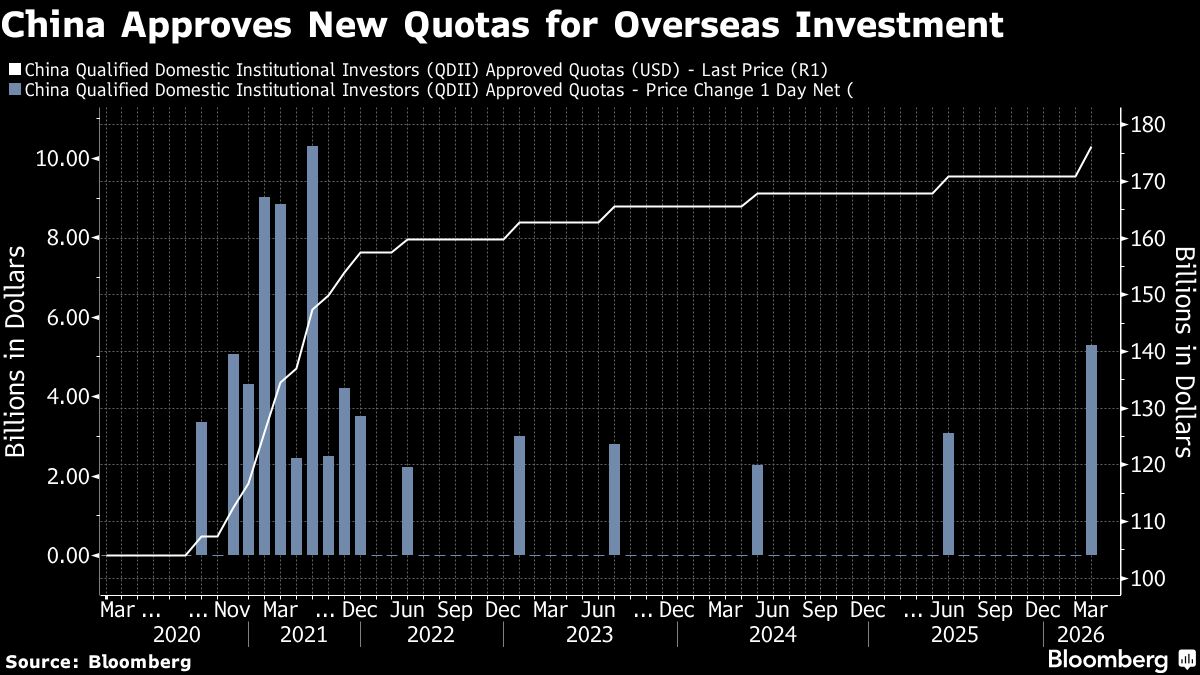
(Bloomberg) — China raised the cap on institutional investors’ overseas securities purchases by the most since 2021, aiming to advance financial opening and meet greater domestic demand for offshore investment.
The investment quotas for China’s Qualified Domestic Institutional Investor program, or QDII, climbed to $176.17 billion at the end of March, up from $170.87 billion a month ago, according to data released by the State Administration of Foreign Exchange on Friday. The $5.3 billion addition — the first hike since June last year — marks the largest increase since 2021, Bloomberg-compiled data shows.
The QDII program allows local institutional investors who meet certain conditions to buy foreign assets within the prescribed limit. Relative stability in the Chinese yuan and local markets amid the Iran war is giving Beijing breathing room to loosen capital controls and expand the currency’s global role.
“The trend was largely expected as China has long been planning to further open up capital account by allowing greater flexibility for outbound investments,” said Becky Liu, head of China macro strategy at Standard Chartered Bank. “But the timing and scale is interesting. They are increasing outbound quota to allow more capital outflows when global market is facing huge uncertainty, and with quota even larger than the last allocation.”
The larger cap suggests China has not seen large capital-outflow pressure since the war began and may have even seen inflows, she said.
China’s top currency regulator Zhu Hexin foreshadowed the move last week, telling a conference that a QDII hike was planned and would “better meet the cross-border investment needs of domestic institutions.” China will continue opening capital accounts and advance yuan internationalization, he said.
In recent years, China’s QDII fund market has shown bursts of buying across global assets, from gold and US equities to Japanese stocks. Ample domestic liquidity and low onshore yields have spurred demand among local investors to diversify abroad.
QDII quotas had been “insufficient” relative to demand, after assets under management rose 54% to 939 billion yuan ($136 billion) in 2025, with some fund managers already exhausting their individual limits, according to a research by Bloomberg Intelligence strategists Sharnie Wong and Lucy Wang in February.
The onshore yuan slightly weakened by 0.1% at 6.9182 per dollar on Monday, showing muted reaction to the QDII quota hike. The currency has weakened 0.8% against the dollar this month but remains an outperformer compared to major global peers.