
LAS VEGAS — If it involved any other NHL team, this move would be shocking. For the Vegas Golden Knights, it’s business as usual.
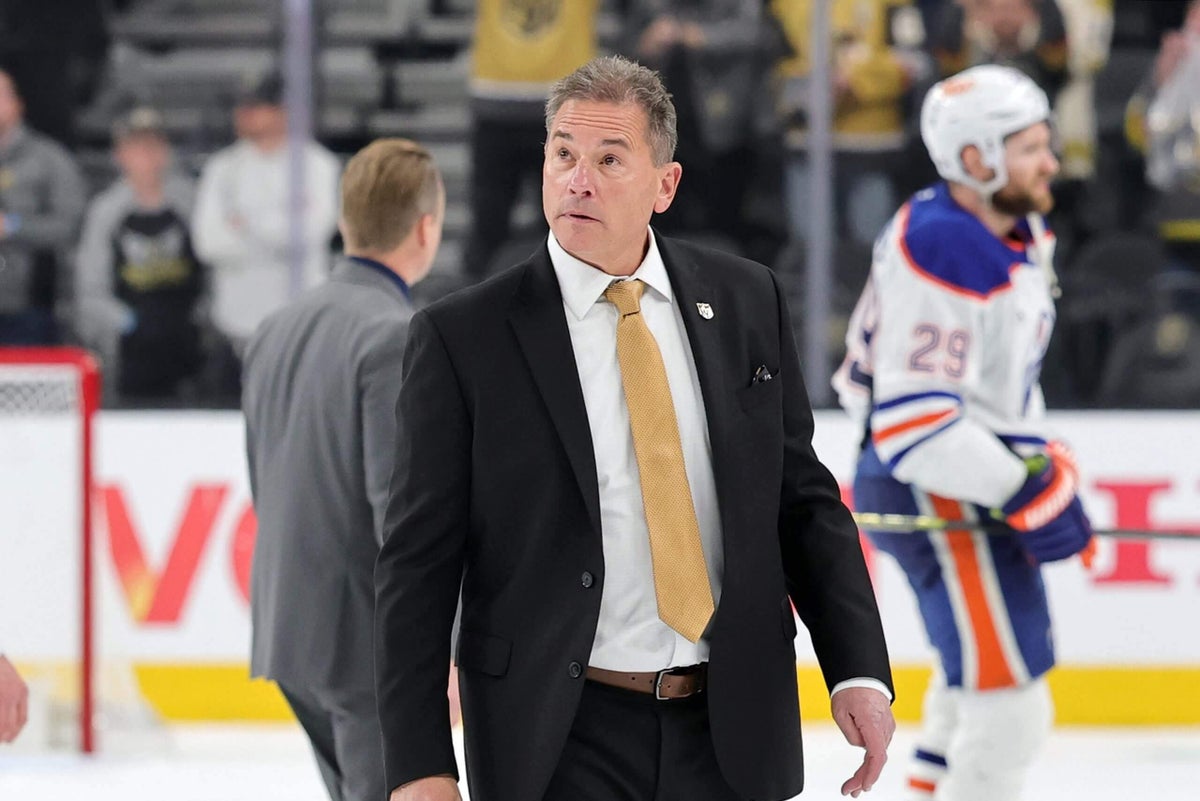
Coach Bruce Cassidy got fired on Sunday — replaced by John Tortorella — three years after he brought the Stanley Cup to Vegas, and four years into a tenure that consistently had the Golden Knights at the top of the Pacific Division, or near it. He has long been of the most respected coaches in the league, and had Vegas on track for a fourth consecutive playoff appearance.
Vegas, though, might be the most relentless organization in professional sports. This is the team that fired Gerard Gallant less than two seasons after he coached an expansion team on a miraculous run to the Stanley Cup Final. Like Cassidy, Gallant was fired even though he made the playoffs every season. It’s the organization that fired Pete DeBoer in 2022 after he led the team to the Western Conference final in two of his three seasons.
It’s the organization that traded the face of the franchise, goalie Marc-André Fleury, for scraps less than a month after he won the Vezina Trophy in 2021, and allowed Conn Smythe Trophy winner Jonathan Marchessault to walk as a free agent in 2024.
The Golden Knights remove emotion, and loyalty for past performance, from their decision-making in their unrelenting pursuit of winning, and for the most part it has been a successful recipe. Only the Tampa Bay Lightning have won more playoff games than the Golden Knights since they entered the league in 2017. In less than a decade of existence, Vegas has already experienced more postseason victories than the Nashville Predators, Minnesota Wild, Winnipeg Jets or Columbus Blue Jackets have in their entire histories.
Sunday’s decision to move on from their Cup-winning coach, 20 days before the start of the playoffs, is bold. But is it the right move? Will it work? And did Cassidy deserve this?
On the surface, it appears the Golden Knights are having a successful season and are in little need of a change of this magnitude. They’re in third place in their division, four points above the playoff cutline in the Western Conference. However, they’re also in the Pacific Division, which has been one of the worst divisions in recent history.
Vegas’ 5-10-2 record since the Olympic break in February is the second-worst in the NHL, ahead of only the Vancouver Canucks. Even more telling, the Golden Knights have won only nine of their 36 games this season against teams currently in playoff position, for a points percentage of .389.
The Golden Knights haven’t looked like contenders at any point this season, especially against good teams. For a team with the third-oldest roster in the NHL, pressed tightly against the salary-cap ceiling, having already traded its next two first-round draft picks and most of its top prospects, that’s a major problem.
Point being, things in Vegas are more troublesome than they appear from a glance at the standings.
How much of that falls on Cassidy? There’s an argument that the team has underperformed considering its overall talent level. The Golden Knights have made a habit of falling behind early in games. That has typically been the product of an inefficient forecheck, combined with poor puck management exiting the defensive zone and subpar goaltending.
As Cassidy said many times this season, it’s his job to get the team to buy into the idea of chipping pucks behind opposing defensemen and playing a simple, direct style early in games. That hasn’t been easy for a team of playmakers that is accustomed to creating offense on the rush, and it clearly didn’t happen enough. But as Cassidy also said throughout the season, he can only say so much, and at some point the responsibility falls on the players to execute.
There’s also an argument that as the Golden Knights’ core has aged and they’ve lost valuable depth forwards due to cap restraints and acquisitions of star players — such as Mitch Marner, Tomas Hertl, Noah Hanifin and Rasmus Andersson — the roster isn’t as well-suited to play that brand of hockey.
Since winning it all in 2023, the Golden Knights have chipped away at the depth and defensive strength that propelled them to that title in order to add the players listed above. Their aggressive swings to acquire star players worked out brilliantly early on. The trades for Mark Stone and Jack Eichel are among the most successful in recent NHL history. The more recent versions of those moves haven’t had the same magic.
Hertl has helped Vegas’ power play, but has only 71 points at even strength in 153 games over the last two seasons with the Golden Knights. Hertl hasn’t driven offense at five-on-five the way one would hope, with Vegas getting outscored 77-94 with him on the ice at even strength.
In the first season of his eight-year, $96 million contract, Marner is on pace for one of the worst statistical seasons of his career. His 71 points are a stark decline from the 102 he put up last season in Toronto, and he has bounced around the lineup — and back and forth from center to winger — as Vegas has tried to find his ideal fit.
Hanifin and Andersson have been solid additions, but haven’t offset the loss of Alex Pietrangelo on the back end. Vegas’ blue line was arguably the best in the league in 2023, and now doesn’t appear to suit Cassidy’s system, which worked so well en route to the championship.
The Golden Knights won in 2023 by playing a tight zone defense that bullied the opposition out of the middle of the ice to limit high-danger shots and create sight lines for the goaltender. Since then, they’ve lost Pietrangelo, Zach Whitecloud and Nic Hague — who were among their best net-front battlers — and at 35 years old, Brayden McNabb isn’t quite the force he once was in that area.
While the additions on the blue line are talented defensemen, no doubt, they aren’t as well-equipped for that specific area of the game. The result has been far more bodies in front of the Vegas net, and far more pucks finding the back of that net via screens, deflections and rebounds.
That partially explains the sudden plummet in goaltending metrics this season. Because teams are shooting from distance, the shots don’t register as particularly dangerous to the expected goals models. When the goalie doesn’t see the puck, and it goes in, it can quickly crater a goalie’s statistics. Adin Hill hasn’t been at his best this season, but Vegas has played four different goalies, and none of them have succeeded behind this defense.
Which brings to mind another recent trade that hasn’t worked out for the Golden Knights.
Sending Logan Thompson — who currently leads the NHL with 33.46 goals saved above expected and should be among the favorites to win the Vezina Trophy — to Washington for two third-round picks hasn’t helped. Choosing Hill as the team’s franchise goalie after he helped them win the Cup was a logical move at the time, but when you make as many trades as the Golden Knights have, some are bound to end up like this one. And when goaltending is arguably the team’s biggest weakness, it’s hard to ignore.
Will swapping Cassidy for Tortorella behind the bench be the move that sparks Vegas to another deep playoff run? There’s evidence to both support and refute that idea.
On one hand, Tortorella is one of the most experienced coaches in the sport’s history. Over 23 seasons, Tortorella has amassed the second-most wins by an American coach in NHL history, and the ninth-most overall. He has 56 playoff wins over 12 different postseason runs in Tampa Bay, New York and Columbus, and won the Jack Adams Trophy as the NHL’s top coach while leading the Lightning to a championship in 2004.
Tortorella also has a history of jump-starting teams quickly after arriving, with a specialty in creating a dominant forecheck, which is something Vegas could desperately use.
As wild as this coaching swap is, it’s not the first time it has happened this late in a season. In 2000, the New Jersey Devils replaced coach Robbie Ftorek with Larry Robinson with eight games left in the regular season while the team was in playoff position. The Devils went on to win the Cup.
But as impressive as Tortorella’s career track record is, his recent results are a cause for concern. Over his last four seasons, Tortorella coached the Blue Jackets and Flyers to a record of 115-133-45 (.469 points percentage). He has also won only two playoff series since 2013 and hasn’t reached the conference finals in more than a decade.
He will be coaching a more talented team in Vegas than he had at his last several stops, but he will also need to produce results he hasn’t managed to in a very long time for it to be considered a success.
For Golden Knights fans, this move hurts. Cassidy isn’t just beloved for his winning on the ice, but for his passion for hockey and willingness to explain successes and failures in extraordinary detail. Even after tough losses, the effort Cassidy put into explaining his thought processes endeared him to the fans as much as his name being etched on the Cup.
He’s an incredibly talented coach who will be difficult to upgrade from. Just ask the Boston Bruins.
This organization has proven it’s unafraid to make such bold moves if they believe they’re the right decisions. If they’re right, this will be another calculated maneuver that extends Vegas’ championship window. If they’re wrong, it could be the final straw in what has been a downward trajectory since 2023.