
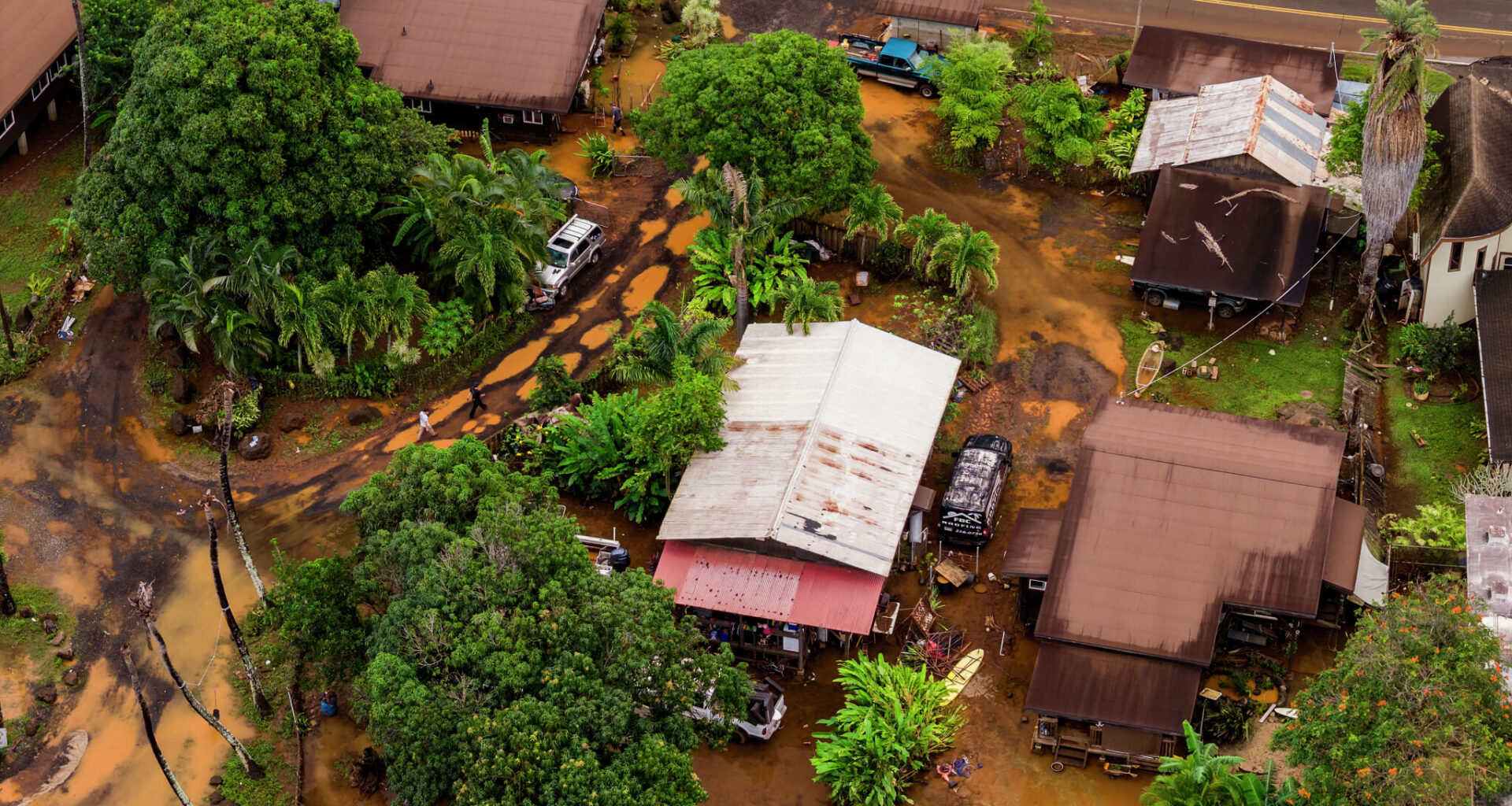
Someone drives through flooded streets on Oahu’s North Shore after historic flooding forced evacuations and rescues across Hawaii.
Stephen Lam
WAIALUA, Hawaii — As Jean LaTorre waded through waist-deep, dirty brown floodwaters at his farm on the North Shore of Oahu, his first concern was saving his dogs and chickens.
Finding them secure on a patch of high ground, the specialty crop grower on the edge of this former sugar mill town turned, almost casually, to a broader worry that loomed over the historic storms on the islands.
Flooding destroyed or damaged hundreds of homes on the North Shore of Oahu this month, as seen in an aerial view of a neighborhood in Haleiwa, Hawaii.
Stephen Lam/S.F. Chronicle
Article continues below this ad
“The climate change stuff is happening,” LaTorre said, having retreated to his nearby shop, the North-Shore Farm Stand, where the power was out, the rain was still coming down and the customers who normally stop for his locally crafted gifts and produce were gone, having fled for safety. “We’re seeing the change in our neighborhood.”
While no place is immune to the warming climate, the toll may be especially pronounced within the diverse and fragile island environment of Hawaii. From the deadly wildfires in Maui 2½ years ago to this month’s catastrophic flooding, residents have endured a series of natural disasters, while the millions who visit each year have watched a place they view as paradise slip into scenes of fear and devastation.
San Francisco Chronicle Logo
Make us a Preferred Source to get more of our news when you search.
Add Preferred Source
Going forward, the climate challenges for residents as well as visitors are expected to grow.
Jean LaTorre, who runs the North-Shore Farm Stand in Waialua, Hawaii, says he wishes the state and regional government would move more quickly to protect communities from natural disasters.
Kurtis Alexander/S.F. Chronicle
“Usually, it’s very peaceful here,” said Jasmine Lucero, who was helping clean up what was left of her mother’s flooded home this week in the North Shore community of Haleiwa, a hub of big wave surfing. “During the rainy season, you have to be on guard. Growing up here, there were a lot of close calls. But this is the worst it’s ever been.”
Article continues below this ad
Scientists have been warning about the increasing volatility of Hawaii’s climate. While it can be difficult to disentangle the effects of fossil fuel-driven warming from the natural variability of the tropics, studies suggest that many of the state’s recent weather events wouldn’t have been as severe without rising temperatures. Sea level rise, another major climate threat to the islands, is compounding flooding problems in coastal areas.
“In a lot of ways, Hawaii and other Pacific islands are on the front lines of climate change,” said Abby Frazier, a climatologist at Clark University in Massachusetts, who previously worked in Hawaii and led the federal government’s climate assessment of the region. “The extreme events will get a lot worse. That’s what we see in the climate models.”
Hawaii has warmed about 2 degrees Fahrenheit since 1950, while becoming drier, which partially explains the conditions that drove the 2023 Maui firestorm that killed more than 100 people in the storied tourist town of Lahaina. Changes in farming and vegetation in recent decades were also major factors in the blaze.
Even with the drier weather, the rain that does fall on the islands stands to be more intense, because a warmer atmosphere holds more moisture. Frazier explains the phenomenon using the analogy of a tipping bucket at a children’s park: “The size of the bucket is getting bigger,” she said, and may not tip and drop water as often, “but when we get rain, there’s more rain in the bucket to spill.”
This month, more than 30 inches of rain fell over two weeks in parts of Hawaii as a pair of slow-moving, wet weather systems known as Kona lows pounded the islands.
Article continues below this ad
Myla Grace Zara, 16, takes a break from searching through her flood-damaged home in Haleiwa, Hawaii, this month. Zara and her family were trapped on their roof during the flooding that came with recent storms.
Stephen Lam/S.F. Chronicle
The widespread flooding, most destructive on Oahu’s North Shore and portions of Maui, was the state’s worst in two decades. Hundreds of people were rescued from rushing waters, homes were lifted away by overflowing streams, and roads and bridges were torn up. Hawaii Gov. Josh Green has estimated $1 billion in damages.
“Recovery costs are often higher on the islands, where rebuilding and materials are more expensive than on the mainland,” explained AccuWeather Chief Meteorologist Jonathan Porter, who estimates that the total financial hit, counting business losses, is closer to $2 billion. “The timing of the storms during peak spring break travel amplified the economic toll.”
Disasters like this one commonly keep vacationers at bay, at least temporarily. Several reports suggest that tourism, which makes up nearly a quarter of the state’s economy, will be increasingly upended as the warming climate causes more disruption.
After the fire in Lahaina, visitation plunged on Maui. Local officials initially urged out-of-towners to stay clear, but even after they began welcoming back travelers, would-be tourists remained hesitant — some to this day — because of uncertainty about vacationing near a disaster site. On Oahu, flooding in 2022 and a storm-driven landslide in 2019 also prompted more minor travel issues.
Article continues below this ad
This past week, even as blue skies returned to the North Shore and floodwaters began to recede, Haleiwa’s main drag was quieter than usual. At Matsumoto Shave Ice, where tourists sometimes wait 45 minutes for cones of ice soaked in flavored syrup, no one was in line.
“Right now, it would be 10 times as busy as it is, easily,” said Carol Philips, vice chair of the North Shore Chamber of Commerce, which operates a visitor information center in downtown Haleiwa.
A bible is covered in mud from floodwaters in Haleiwa, Hawaii, this month.
Stephen Lam/S.F. Chronicle
Philips said disasters like the recent flooding are often overblown on social media as Instagram and TikTok users focus on the worst damage and the platforms magnify the posts. Consequently, she said, visitors are sometimes misinformed about the gravity of an event and its scope.
Still, Philips acknowledged that severe weather seems to be intensifying on the island: “We’re in one extreme, then another,” she said.
Article continues below this ad
While the small towns on the North Shore are open again for business, the region’s famed coastline remains choked with muddy stormwater. Its celebrated surf breaks, including those that host the Eddie Aikau Big Wave Invitational, known as “The Eddie,” with its 40-foot faces, are far from normal.
The Hawaii Department of Health issued a “brown water advisory” for Oahu, advising people to avoid the ocean.
“It could be a long time before we’re back in the water,” said Hunter Sato, manager of the Haleiwa surf shop, Surf N Sea, who is usually out every day catching waves or steering visitors to breaks. “This is the best time of year to surf.”
The costs of climate change in Hawaii, from losses tied to beach closures to the expense of hardening infrastructure, while tough to quantify, are expected to be steep. The federal government’s Fifth National Climate Assessment, published in 2023, estimates the tab to reach between 3% and 13% of the state’s gross domestic product by the end of the century.
Water from the Wahiawa Dam flows into the Kaukonahua River in Wahiawa, Hawaii, after storms battered the state this month.
Stephen Lam/S.F. Chronicle
A dam on Oahu has become a symbol of that high price. During the recent storms, Honolulu emergency officials warned that the privately owned Wahiawa Dam, which holds water high above the North Shore, was at risk of “imminent failure” and ordered thousands of people downstream to evacuate.
The state had previously estimated that the 120-year-old facility needed at least $21 million in upgrades to expand the spillway and meet safety regulations. State officials have been looking to buy the dam from the Dole Food Co., which historically used water from the operation to grow pineapples. On Friday, Dole announced it is transferring the dam to state control at no cost.
Leah Laramee, the state’s climate change mitigation and adaptation coordinator, said in an interview that Hawaii is doing all it can to confront the climate crisis. She has little doubt that global warming played a role in the recent flooding, and she noted that the state’s extensive coastline, varied terrain and tropical climate make it particularly vulnerable to extreme weather and its impacts.
“Really we just need to get (more) work started,” Laramee said.
Like California, Hawaii has pursued relatively aggressive climate policies. They include both reducing the state’s planet-warming pollution, with a goal of net-negative emissions by 2045, and increasing the resiliency of forests, watersheds and infrastructure.
This year, Hawaii enacted a first-of-its kind climate tax on visitors, or “green fee,” which raises the tax on overnight stays to help fund efforts to prepare and adapt to the warming climate. The fee, expected to generate $100 million annually, extends to stays on cruise ships.
“Climate change is becoming more and more of a pressing issue, and the costs are high,” Laramee said. This month’s disaster “is something for people all around the world to pay attention to. Really, when you see this flooding, it’s a reflection of what’s happening everywhere now.”
Back at the North-Shore Farm Stand, LaTorre, who grows noni, soursop and other specialty crops, says he wishes the state and regional government would move more quickly to protect communities such as Waialua.
“The water just ripped down the mountain,” he said, looking off toward the cloud-covered slopes of the Waianae Range. “It took a house out to the ocean.”
A native of California, he jokes that Caltrans, California’s transportation department, with its bigger machines and deeper pockets, would do a far better job securing roads, bridges and other infrastructure.
“Hawaii is struggling to do what it does,” LaTorre said. “But the community is strong. This is about as real as it gets.”