
 Market_Recon_TSP1_KL
“Pins and needles. Needles and pins. A happy man is a man who grins?”
Seems a long time ago and I guess it was that Jackie Gleason used that silly phrase to deal with anxiety on what may have been TV’s original sitcom, “The Honeymooners.”
Dealing with anxiety is likely the name of the game on Monday morning as thousands of amphibious and airborne infantry await orders to potentially take control of Kharg Island, while others operating under Special Operations Command wait to find out if they have to extract roughly 1,000 pounds of enriched uranium from the war-torn nation of Iran.
On Sunday night, the Financial Times reported that U.S. President Donald Trump had said that in an interview with that paper earlier in the day, he wanted to “take the oil in Iran.” The president was quoted, “To be honest with you, my favorite thing is to take the oil in Iran but some stupid people back in the U.S. say: ‘why are you doing that?’ But they’re stupid people.”
Taking the oil or more specifically, Iran’s ability to sell its oil, would involve the capture of Kharg Island where more than 90% of Iranian oil is exported from. The taking of this island would likely involve elements involving both U.S. Marine Corps infantry who are specialized in amphibious assault and the U.S. Army’s 82nd Airborne Division.
While Iran’s military has been rendered largely defenseless vs. assaults from above as the U.S. and Israel have enjoyed complete air superiority since almost the start of the conflict, Iran has been able to maintain some offensive capacity and has for the most part been able to restrict global shipping in the region, while taking what has amounted to potshots with drones and missiles at its neighbors and launching more concentrated fire at Israel. On the prosecution of the air war, Pres. Trump added, “We’ve got about 3,000 targets left, we’ve bombed 13,000 targets — and another couple of thousand targets to go. A deal could be made fairly quickly.”
Meanwhile, also on Sunday night, the Wall Street Journal reported that the president has been weighing an operation that would remove a sizable amount of enriched uranium from the control of the regime in Iran. Any such operation meant to seize that uranium by force would be quite complex and obviously fraught with peril.
There would certainly be resistance faced on the ground as teams of special operations troops would need to be flown to two to three sites while under fire from surface-to-air missiles. On location, shock troops, perhaps U.S. Army Rangers, would be needed to secure perimeters so that specialized engineering types wearing and using the proper equipment could search through debris, while simultaneously clearing mines. All while a third group of special operators actually handle and extract the material.
All this goes on as oil prices and supply lines react to stressed conditions and inflation hits global economies at both the producer and consumer levels. This has obviously impacted financial markets and subsequently, your portfolios.
Related: The Last Mile Before a Bottom Is Often a Rocky Road
The Past Week
The administration of this war has dominated financial market outcomes directly since late February and in actuality, since several weeks prior to the onset of hostilities. Last week, Secretary of State Marco Rubio informed foreign ministers of G-7 nations that the combat portion of this war could last for up to an additional four weeks. Investors did not take that news well.
Treasury debt securities were hit as hard as were equities. The U.S. Ten-Year Note paid as much as 4.48% late last week, which was the highest yield for that series since July. The Two-Year note paid more than 4.03% at one point last week. I see those two instruments yielding 4.39% and 3.89% respectively as I work through the zero-dark hours on Monday morning.
In other news, the Trump administration tapped several prominent business leaders to serve on a technology advisory panel to guide the government’s approach to science and technology. This group includes Mark Zuckerberg of Meta Platforms (META) , Larry Ellison of Oracle (ORCL) and Jensen Huang of Nvidia (NVDA) .
Elsewhere the partial government shutdown has entered its 44th day as the Senate unanimously passed a bill that would fund most of the Department of Homeland Security while excluding funding for ICE (Customs Enforcement) and CBP (Border patrol) to get Democrats on board. This seems to me a silly ploy as funding for those agencies within the department can be found through other “already passed” legislation.
The House rejected the Senate’s bill and passed their own bill that would push out funding for the entire DHS for two months. Senate Minority leader Chuck Schumer has already stated that this House bill has no chance in the Senate. Meanwhile, Congress has gone into a two-week spring recess. Must be nice.
Week Ahead
Investors and traders will begin a holiday-shortened week on Monday morning as tensions in the Middle East and public frustration with the legislative branch of government mount. This creates an issue for both investors and economists alike. markets traditionally close on Good Friday. This year is no exception. The New York Stock Exchange and the Nasdaq Market Site are both fully closed this Friday ahead of Easter Sunday.
Good Friday, however, is not a federal holiday and is not a bank holiday. That means that the Bureau of Labor Statistics will release the results from its two labor market surveys for March on schedule (first Friday of the month) and that there will be no equity market reaction. There will be a debt-market reaction, though, as the bond market will open on Friday morning and then close early, at noon (Eastern Time).
As far as other high-profile macroeconomic events are concerned, the Conference Board will publish its Consumer Confidence survey for March on Tuesday morning and the Census Bureau will release February retail sales numbers on Wednesday morning. There are several Fed speakers set to make the rounds this week. Most importantly, Lame duck Fed Chair Jerome Powell will speak at Harvard this morning and will take questions. Expect algorithmic keyword readers to try to force a market reaction or overreaction to that event.
The Week That Was…
U.S. financial markets had yet another rather tough five-session period, last week. The S&P 500 has now posted five consecutive red-candle weeks and seven losing weeks in eight. The Nasdaq Composite has also posted five straight losing weeks and ten losing weeks in eleven. Rough? Yes, it has been.
– The S&P 500 gave up 1.67% on Friday and 2.12% for the week.
– The Nasdaq Composite lost 2.15% on Friday, and 3.23% for the week.
– The Nasdaq 100 gave back 1.93% on Friday and 3.2% for the week.
– The Russell 2000 surrendered 1.75% on Friday but gained 0.46% for the week.
– The S&P Small Cap 600 lost 1.58% on Friday but added 1.14% for the week.
– The S&P Midcap 400 gave up 1.63% on Friday, still adding 0.44% for the week.
– The Dow Transports lost 1.06% on Friday but gained a nice 1.82% for the week.
– The Philly Semis gave up 1.69% on Friday and 2.78% for the week.
– The KBW Bank Index gave back 2.37% on Friday but just 0.47% for the week.
On Friday, eight of the 11 S&P sector SPDR exchange-traded funds closed out the session in the red, as the war in Iran continued to expand and oil prices ran hot. These funds were led lower by the discretionaries (XLY) and the financials (XLF) . Energy (XLE) obviously led the winners.
For the week, seven of the 11 S&P sector SPDR ETFs traded lower, with communication services (XLC) and technology (XLK) suffering the most as growth stocks were punished. Energy and the Materials (XLB) were the big winners.
The Chart
Readers will note that the S&P 500 has truly suffered since we pointed out the failure of the market to confirm a bullish change of trend on Wednesday that had started on Monday. As the index lost touch with its 200-day simple moving average on Thursday, the selling pressure accelerated into the weekend. Traders need to be aware that should that weakness extend into the early part of this week, that a cross-under of that same 200-day (red) line by the 21-day exponential moving average (green line) could cause a negative algorithmic reaction.
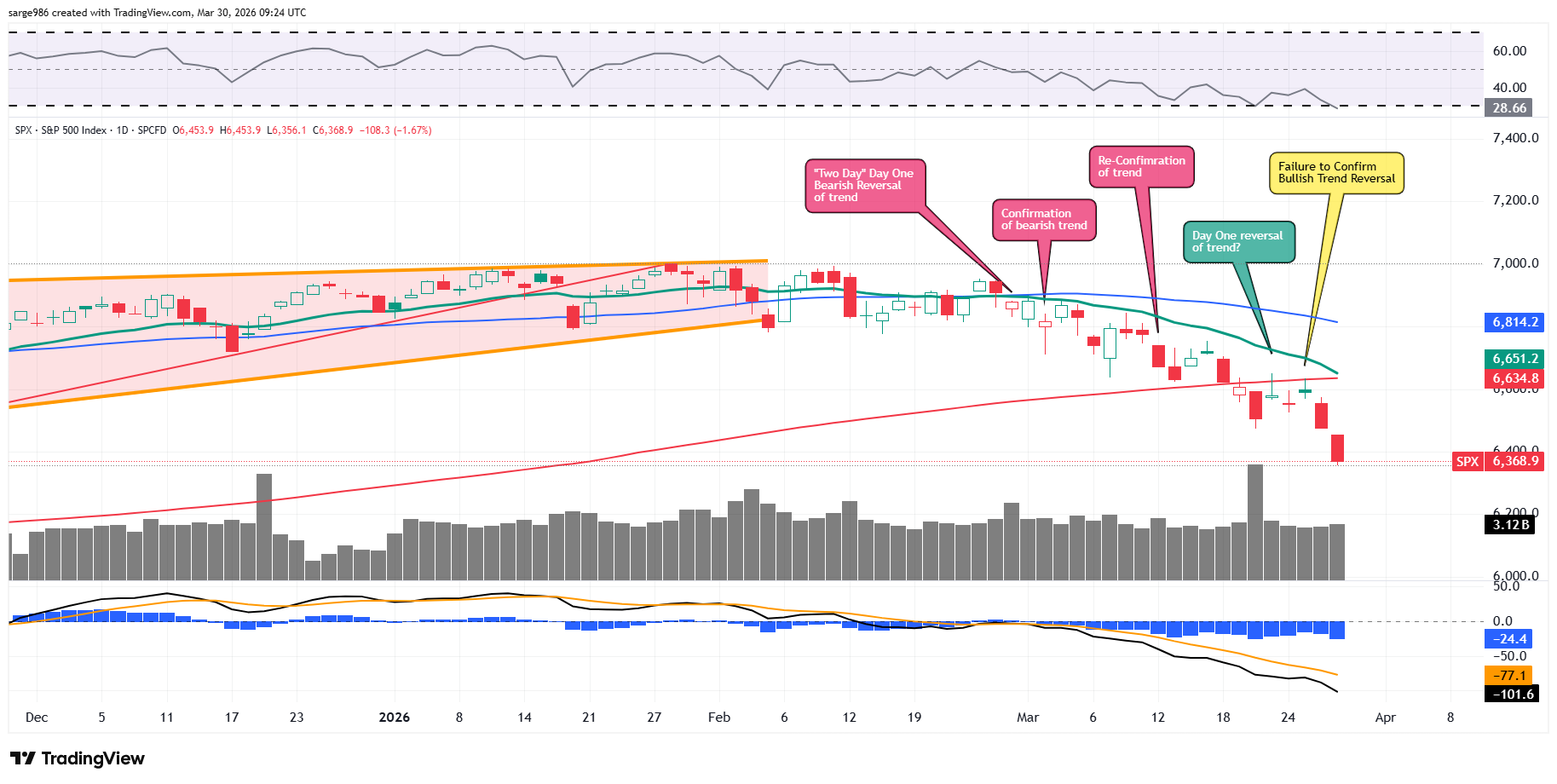
As for the indicators, Relative Strength has run into what is traditionally considered to be a technically oversold condition for the second time in two weeks. The daily moving average convergence divergence is in simply awful condition and that condition continues to worsen. The histogram of the 9-day exponential moving average stands well below zero, as do the 12-day exponential moving average and 26-day EMA. To add insult to injury, that 12-day line is also running well below the 26-day line. These are all overtly bearish signals that have proven to be accurate for most of 2026.
Earnings
Incredibly, as the market struggles, and the economy shows some signs of weakness, analysts, as has been the case, continue to see an improving outlook for corporate profitability. It’s rather incredible. As of March 27, according to FactSet, for the first quarter, Wall Street now expects to see year-over-year earnings growth for the S&P 500 of 13%, up from 12.5% last week, and up from 11.6% two weeks ago. Wall Street also sees revenue growth of 9.7%, up from 9.6% a week ago.
For the full year of 2026, the street looks for earnings growth of 17.1%, up from 16.3% last week, and up from 14.7% a few weeks back, on revenue growth of 8.6%, up from 7.7% three weeks ago. The outlook for the second quarter is also improving quite dramatically.
At the moment, the technology sector is projected to have grown earnings a stunning 45.1% for the first quarter with the materials in second place at growth of 24.7%. Two sectors, health care and communication services are projected to have suffered a Q1 earnings contraction. Energy, in one week’s time, has moved from an expectation for a Q1 earnings contraction to an expectation for earnings growth of at least 5%.
As we are currently in between seasons, the earnings calendar is extremely light again this week. There are very few noteworthy companies reporting. Among those few names that are expected to post quarterly results this week will be Nike (NKE) , RH (RH) and ConAgra (CAG) .
Valuation
Still using data provided by FactSet, the S&P 500 ended last week trading at 19.9-times 12 months’ forward-looking earnings, down from 21.6-times three weeks prior. This is even with the five-year average of 19.9-times for the index as well as well above its ten-year average of 18.9-times.
The S&P 500 also ended last week trading at 26.3 times trailing 12 months’ earnings, down from 27.8-times three weeks back. That also stands well above the five-year (24.8-times) and ten-year (23.2 times) averages for the index.
Just six of the 11 sectors are now trading above their five-year average valuations, led by the industrials (24.8-times) and the staples (21.8-times). The discretionaries, tech, the REITs, health care and the financials are all now undervalued relative to their five-year norms. Interesting proposition there.
Fed Funds Futures
Fed Funds futures trading in Chicago are currently pricing in a 0% probability for a quarter-point rate cut at the next Federal Open Market Committee policy meeting on April 29 and a 4% likelihood for a quarter point rate hike (down from 12% a week ago). There are still no rate cuts priced in for calendar year 2026. In fact, no cuts or hikes are priced into these markets until October of 2027. That said, we know that everything will change several times over by then. That’s all we know.
Miracles
(excerpt)
What shall I give? and which are my miracles?
Realism is mine – my miracles – take freely,
Take without end – I offer them to you wherever your
feet can carry you, or your eyes can reach.
– Walt Whitman, 1856
Miracles.
(excerpt)
Why, who makes so much of miracles?
As to me, I know nothing else but miracles.
To me, every hour of the light and dark is a miracle,
Every cubic inch of space is a miracle.
Every square yard of the surface of the earth is spread with the same.
– Walt Whitman, 1882
“Where is your miracle? Who is your miracle? Not all hope is faith; yet hope is required for faith to exist. Strength. Sustained loyalty breeds the ability to maintain faith under duress. Faith under duress will breed victory. Rise to your victory”
– Sarge
Economics
(All Times Eastern)
10:30 – Dallas Fed Manufacturing Index (Mar): Expecting 0.7, Last 0.2.
The Fed
(All Times Eastern)
08:45 – Speaker: Federal Reserve Chair Jerome Powell.
11:00 – Speaker: New York Fed Pres. John Williams.
Today’s Earnings Highlights
(Consensus EPS Expectations)
No significant quarterly earnings scheduled.
At the time of publication, Guilfoyle had no position in any security mentioned.