
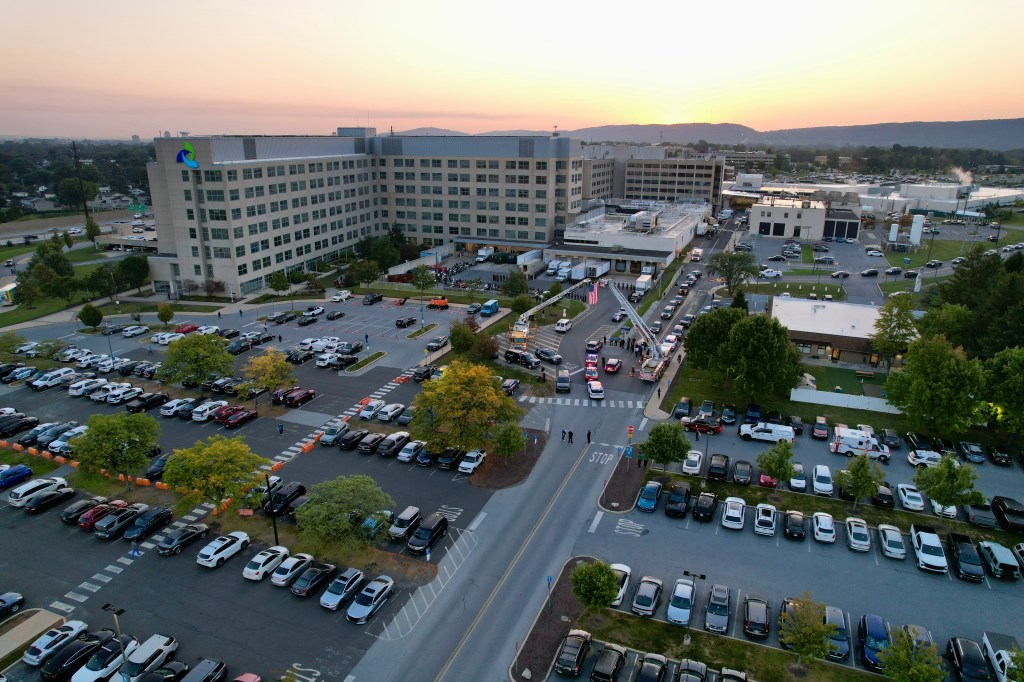
Lehigh Valley Hospital–Cedar Crest was cited by the Pennsylvania Department of Health in September after pepper spray was used to restrain a patient who pushed a nurse and threatened staff.
The report completed Sept. 26 states that by allowing the incident to occur, the hospital violated state and federal rules as well as internal hospital policies, and failed to provide a safe setting for the patient.
It was one of multiple events at LVHN and St. Luke’s University Health Network hospitals over the last several months that the Health Department found didn’t comply with federal or state rules.
The Morning Call periodically checks the state’s hospital health and safety report database for violations documented at hospitals operated by St. Luke’s, LVHN and other major health providers in and around the Lehigh Valley. More often than not, these reports state that hospitals are in full compliance or only detail minor violations related to internal record-keeping or policy issues. Some reports, however, document more serious patient safety issues.
What the report says
According to the report, on Sept. 14, a patient was brought by ambulance to the emergency room at LVH–Cedar Crest. The patient was described by hospital staff as “extremely agitated and violent,” and as a large, muscular person. The patient was immediately aggressive with staff, and though staff reported trying to deescalate the situation, around 1:47 p.m., the patient assaulted a nurse by pushing them.
All 78 security officers in the hospital were dispatched, with seven or eight arriving at the scene. When security officers arrived, the patient reportedly stood up and moved to the back of the room.
“No one is going to touch me,” the patient told the staff.
The patient then took a fighting stance, with both fists up, ready to throw a punch, and told staff, “The first one to come near me is going to get knocked … out,” the report says.
One of the security officers who responded said he tried further to deescalate the situation, but the patient continued to threaten staff. The security officer, who said he was in fear of bodily injury, then pulled out his hospital-issued pepper spray and warned the patient that he would spray them. The patient grabbed a large metal medical cart and in response, the security officer sprayed the patient in the face with a half-second burst of pepper spray.
After this, the staff was able to restrain the patient. Salisbury Township police were called but were not needed and no charges were filed.
Hospital staff are allowed to use pepper spray against a patient to ensure safety, but it has to be treated as a criminal matter and the patient needs to be turned over to policy custody, according to guidelines. LVH’s failure to transfer the patient to police custody, and instead restrain the patient for treatment, means it “failed to provide a safe setting for an aggressive and agitated patient,” the state’s report says.
What hospital policy and federal guidelines say about hospital safety
Under the hospital’s policies and rules set in place by the Centers for Medicare and Medicaid Services, hospital security staff are allowed to carry a Taser device or pepper spray and use them to stop a violent act. However, the use of any weapon as a means of subduing a patient so they can be restrained or placed in seclusion is not “a safe and appropriate health care intervention.” Instead, if weapons are to be used on a patient to protect staff or stop a violent act, it needs to be treated as a criminal matter and police should be called to investigate and take the individual into custody.
In response to the safety report, LVHN leadership told the Health Department that it updated its internal policy to include that law enforcement must immediately be notified if a Taser or pepper spray is used so that the matter can be handled by law enforcement. Security staff were also reeducated on hospital policies and the hospital began monitoring and auditing use-of-force incidents.
“We remain dedicated to providing safe, high-quality care and the best possible outcomes for every patient we serve. That commitment is reinforced through continuous comprehensive staff education that supports the highest standards of patient safety and quality,” an LVHN spokesperson said.
The Pennsylvania Department of Health does not provide additional comments on reports.
Incident highlights safety concerns at hospitals
This isn’t the first time LVHN, or specifically LVH-Cedar Crest, was cited by the department for use of force against patients. In October 2010, the hospital was told it ran afoul of CMS rules by allowing security officers to use stun guns on four patients. As with the pepper spray incident last year, although police were informed of the incidents, LVHN didn’t turn those patients over to police custody, instead returning them to the hospital. However, in this case, LVHN also told the Health Department that it would stop issuing stun guns to its security officers.
The September incident and 2010 stun gun incidents are examples of the fine line hospitals must walk between keeping hospitals safe for employees as well as patients and visitors, and providing care to patients who are aggressive or violent. Just as CMS requires hospitals to keep patients safe, the Occupational Safety and Health Administration also requires hospital operators to ensure their facilities are safe workplaces.
And that has proved no easy thing. Hospitals are among the most dangerous workplaces, with 64% of workplace violence occurring within them, said Chris Chamberlain, vice president of emergency management at the Hospital and Healthsystem Association of Pennsylvania.
“They’re still beholden to a lot of CMS and other regulatory requirements and the presence of both those actions kind of creates what can be considered a gray area,” Chamberlain said. “I think it puts hospitals in a difficult position when they’re sometimes in the moment asked to make decisions on how to respond to violent acts and at the same time need to manage regulatory and legal risk. So it’s certainly a tenuous situation in many cases.”
The rate of violence in hospitals has risen over the last 10 years, according to the American Hospital Association, and it was rising before that, too. The association estimates that violence in hospitals results in $18.27 billion in costs annually and the majority of these costs are related to responding to rather than preventing violence.
Chamberlain spent 20 years working as an emergency room nurse and said he saw threats and violence leveled at health care workers firsthand.
“As an ER nurse, when people come to the emergency department, they’re usually not having the best day to start with and there’s a lot of emotion that can occur in that space, whether it’s because of someone else or whether it’s the individual having trouble managing their emotions. And that can manifest in people getting angry, people yelling at emergency staff and in some cases becoming physically violent,” Chamberlain said. “It’s difficult for a caregiver, we’ve trained to provide care and to take into consideration the individual’s entire situation, but it’s difficult when they’re acting out and threatening health care workers with violence. It’s definitely a trying experience.”
He added that violence can make it even harder to retain and recruit employees in a field that already has staffing shortages. Chamberlain said in response to the violence, hospitals are doing things they never considered, like implementing their own police forces. Meanwhile, industry advocacy organizations like the Hospital and Healthsystem Association of Pennsylvania are pushing for legislation that would create a hospital security grant fund at the state level. At the federal level, the association is one of the parties pushing for hospital employees to receive similar protections as aircraft and airport workers, by making assaulting or intimidating them a federal crime.
Other incidents highlighted by Health Department
The pepper spray report was one of several recent filed against hospitals operated by LVHN, a part of Jefferson Health.
On Nov. 19, the department cited LVH–Cedar Crest for failing to identify multiple rib fractures and bleeding in a patient’s chest cavity on a CT scan. In October, a patient was admitted for a compression fracture, a type of bone fracture that occurs in the vertebrae. Though a CT scan was taken and the images were reviewed by a radiologist, the patient’s medical record stated no acute traumatic injuries were identified in the chest, abdomen or pelvis. But a postmortem examination of the patient identified the rib fractures and blood in the chest cavity, as did a later review of the CT scans. The report does not state the patient’s cause of death.
In response, LVHN leadership said that the patient’s case was discussed with the radiologist and a peer review process was initiated. It also said that CT scans of trauma patients would be audited with results reported to hospital leadership.
On Nov. 21, the hospital was cited for improperly anesthetizing a patient, who, after a procedure, told staff she had been conscious, heard staff talking and could feel parts of the procedure, although she could not move and signal the staff. When the department spoke to staff and reviewed records, they found that the anesthetic gas vaporizer hadn’t been checked before the procedure, and that no inhaled anesthetic gas was administered to the patient.
In response to the report, LVHN said that reeducation was held on unintended intraoperative awareness and an electronic training module was held for all anesthesia clinical providers. Anesthesiologists and certified registered nurse anesthetists are required to perform and document equipment checks before the use of anesthesia.
Random audits were also to be conducted on cases where patients received general anesthesia, with results to be reported to the vice chair of quality for the anesthesia department
On Dec. 12, the hospital was cited by the department for allowing a nurse to improperly remove a catheter from a patient. The nurse was not trained to remove that type of catheter, which snapped apart, and hospital policy stated that only a physician or advanced practice clinician should have removed the device.
LVHN told the department that it revisited its policies and rewrote them to indicate which types of catheters required removal by a credentialed provider and which could be removed by a trained nurse. Staff were also reeducated and direct discussions were held with the staff who were involved in the incident. Auditing of catheter removal was implemented, with results to be reported to the hospital and network leadership.
LVH–Cedar Crest was not the only LVHN-operated hospital cited for noncompliance. In September, LVH–Pocono was cited for failing to prevent a patient with a broken ankle from falling and hitting their head during a visit in June. The patient suffered a small brain bleed due to the fall. The patient had been issued crutches in the emergency department, when they should not have been allowed on their feet, the report states.
Following the report, the hospital said that it would provide hands-on education to emergency department staff. Audits were also to be completed of all patients issued crutches to be reviewed by the emergency department director and results were to be presented to the vice president of patient care services.
Several St. Luke’s hospitals were also cited by the Department of Health for minor incidents. The reports included:
• St. Luke’s University Hospital in Fountain Hill was cited in November for not disposing of outdated items in a medical cart or labeling opened food items.
• St. Luke’s Hospital–Grand View was cited in October for not providing ordered elective services to a patient after they refused to sign the general consent form. Hospital policy allows patients to still receive treatment without signing the general consent form, but the patient or someone acting on their behalf must list what they take exception to and staff must note that the patient refused to sign the form. The department said St. Luke’s–Grand View failed to provide quality care and failed to follow its own policies by turning the patient away when they refused to sign.
• St. Luke’s–Grand View was also cited in January for failing to maintain a completed emergency department central log by missing dispositions on eight medical records.
• Geisinger St. Luke’s Hospital in Schuylkill County was cited in January for failing to log and respond to a patient grievance form.
Following these incidents, St. Luke’s told the department that staff were reeducated and audits were performed. A St. Luke’s spokesperson said the network always works to address issues when identified internally or by regulators.
“These findings reflect opportunities identified both through our own self‑reporting and through unannounced onsite surveys conducted by the Department of Health. In every instance, we work collaboratively with our regulators and take immediate steps to achieve and maintain compliance, ensuring the highest standards of safety, quality and documentation across all our campuses,” the spokesperson said.