
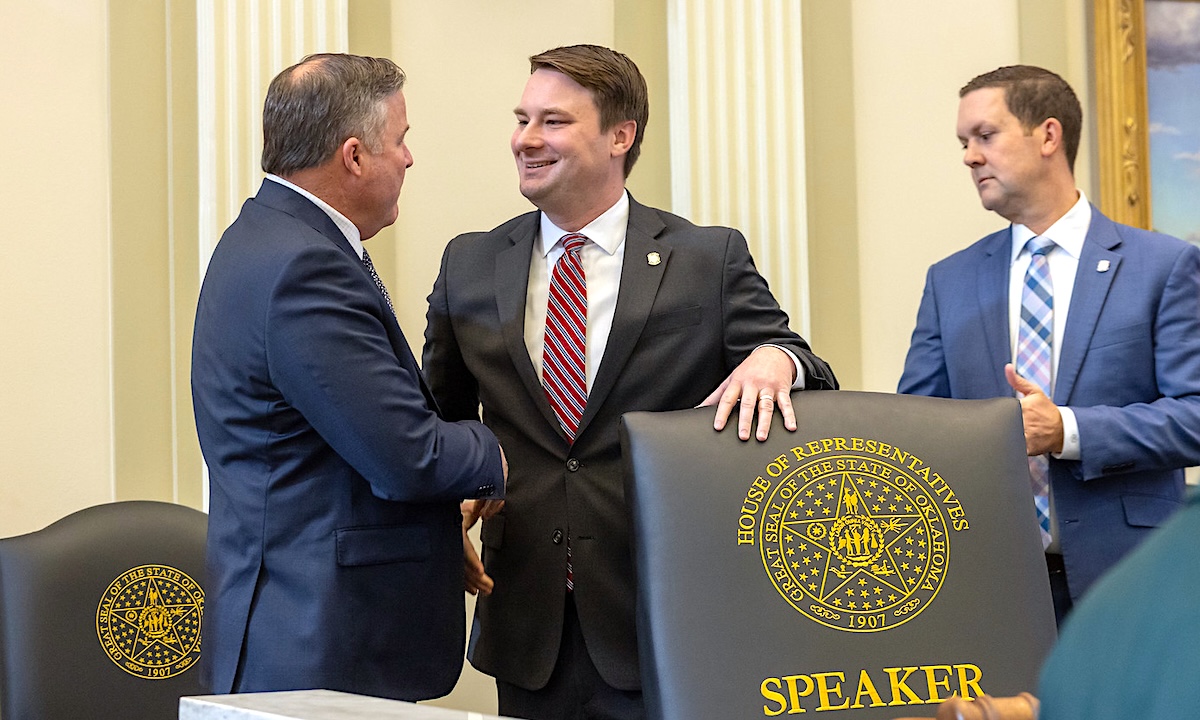
 From left: Senate President Pro Tempore Lonnie Paxton (R-Tuttle) speaks with House Speaker Kyle Hilbert (R-Bristow) and House Speaker Pro Tempore Anthony Moore (R-Clinton) ahead of the State of the State address Monday, Feb. 2, 2026. (Legislative Services Bureau)
Support Journalism
Oklahoma’s seven public pension systems have seen their solvency greatly improved over the past two decades, but disagreements over when and how to hike monthly payments to retirees are brewing amid legislative budget negotiations.
Despite significant economic inflation driving food, insurance and other costs for Americans, Oklahoma’s public pensioners have not seen a cost of living adjustment — commonly called a COLA — since 2020 when lawmakers passed a stair-stepped plan that increased monthly payments by 4 percent for those retired five years or more and 2 percent for those retired between two and five years.
With Fiscal Year 2027 budget conversations culminating perhaps sooner than later, House leaders hope a deal can get done to give a COLA to retired teachers, firefighters, law enforcement, judges and other former state employees.
“I believe we should do across-the-board COLAs. I think that would be beneficial,” House Speaker Kyle Hilbert (R-Bristow) said Friday. “I believe there’s support in the House for doing that. It’s been several years since we’ve done one, and a lot of our pensions are improving.”
House Speaker Pro Tempore Anthony Moore echoed that sentiment, subtly revealing his understanding of conversations in the Senate.
“I don’t like to speak to the entire House, but I think that we’re obviously for the idea that you either have to do a COLA for all or a COLA for none,” said Moore (R-Clinton). “We’re not going to pick and choose and put people in that position picking between different systems.”
Across the rotunda, Senate Republicans appear slightly more divided on the topic — or at least more hesitant to increase liabilities for the pension systems that have lower funded ratios, a statistic derived from dividing a fund’s actuarial assets by its accrued liabilities.
As outlined in Gov. Kevin Stitt’s proposed Fiscal Year 2027 budget book, Oklahoma’s seven pension systems have funded ratios ranging from 74.6 percent to 107.8 percent:
On Monday morning, hours after the original publication of this article, Senate President Pro Tempore Lonnie Paxton said conversations remain active.
“It is all under consideration, said Paxton (R-Tuttle). “Everything is on the table.”
Senate Appropriations and Budget Committee Chairman Chuck Hall (R-Perry) said Friday he was yet to be in a position to discuss “what, if any, COLAs will or will not be put up for consideration this session.”
“In general, I’m supportive of managed COLAs when a pension system is over 100 percent funded. Any COLA consideration for systems not fully funded — and by that I mean at 100 percent — should be closely evaluated to include: examining the cost to the system if a COLA is required to be absorb, employee and employer contribution levels, other dedicated funding sources and projected pension investment returns.”
Seeking ‘a plan’ and ‘a path’
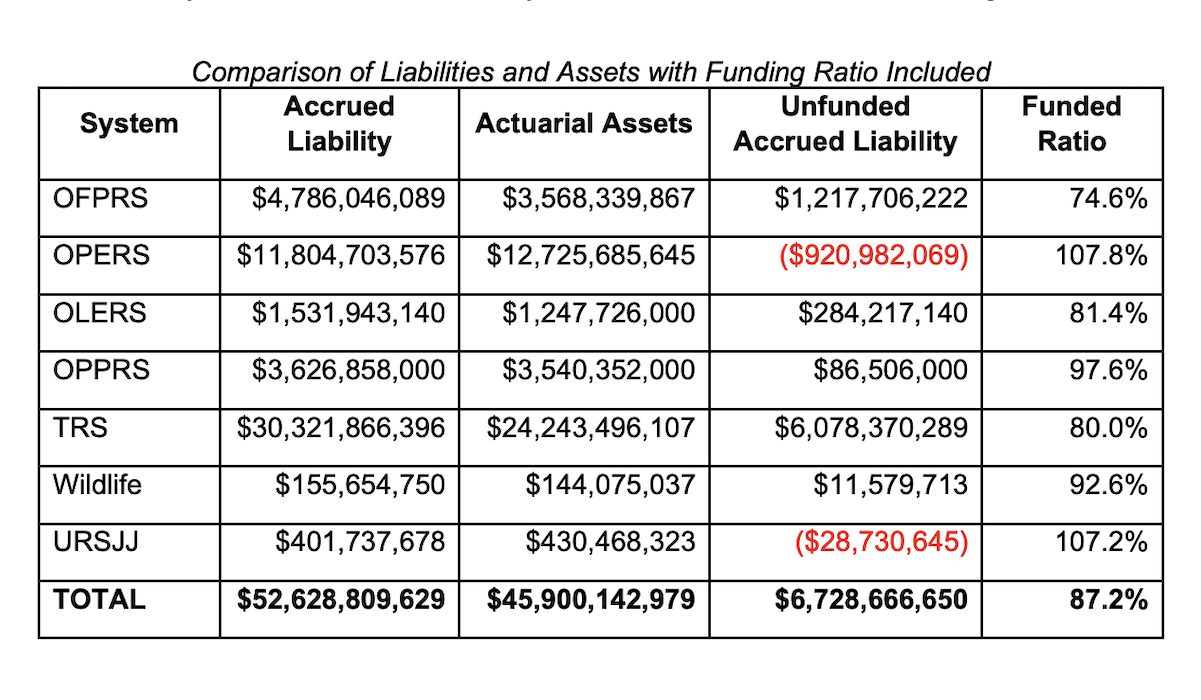 As outlined on Page 7 in Gov. Kevin Stitt’s proposed FY 2027 budget book, Oklahoma’s pension systems have funded ratios ranging between 74.6 percent and 107.8 percent. (Screenshot)
In 2024, Oklahoma’s combined pension systems had the 17th best funding ratio in the country, up from 24th the year before. Boosting state pension systems with apportioned tax revenue for two decades has increased Oklahoma’s overall pension funded ratios, which had reached 80 percent in 2023, more than 85 percent in 2024 and 87.2 percent now.
In February, Paxton, Hall and four other members of Senate Republican leadership held a press conference to propose funding a teacher pay raise and other increased State Department of Education appropriations by reducing the amount of “off the top” apportioned income tax and sales tax revenue is dedicated to the TRS.
Asked at that press conference for a show of hands if they support a COLA for retired educators this session, Senate Education Committee Chairman Adam Pugh (R-Edmond) was the only senator of the six in attendance who fully signaled in the affirmative.
Support among House Republicans appears stronger.
“Obviously, the conversation earlier this session about [TRS] in particular kicked off a big discussion,” Hilbert said. “I think it’s important. We should have conversations about the subsidies that go into these systems. Eventually, they will be 100 percent funded, and so what does this look like long term? Because when I talk to folks at the Teachers Retirement System itself, they don’t anticipate having subsidies after they’ve reached 100 percent. Now, that’s projected in 2034 or 2035, but I think we can have a holistic conversation about COLAs and what the subsidies to those systems look like.”
With each chamber returning to committee consideration of the other’s bills this week, COLA conversations are expected to continue behind the scenes.
“I would love to see a plan, a path, to getting them all to 100-percent funded,” Hilbert said. “I think we can do that and can responsibly do COLAs while building upon the successes of the past couple of decades where we’ve really improved our systems.”
Bipartisan co-authors back ‘win-win’ situation
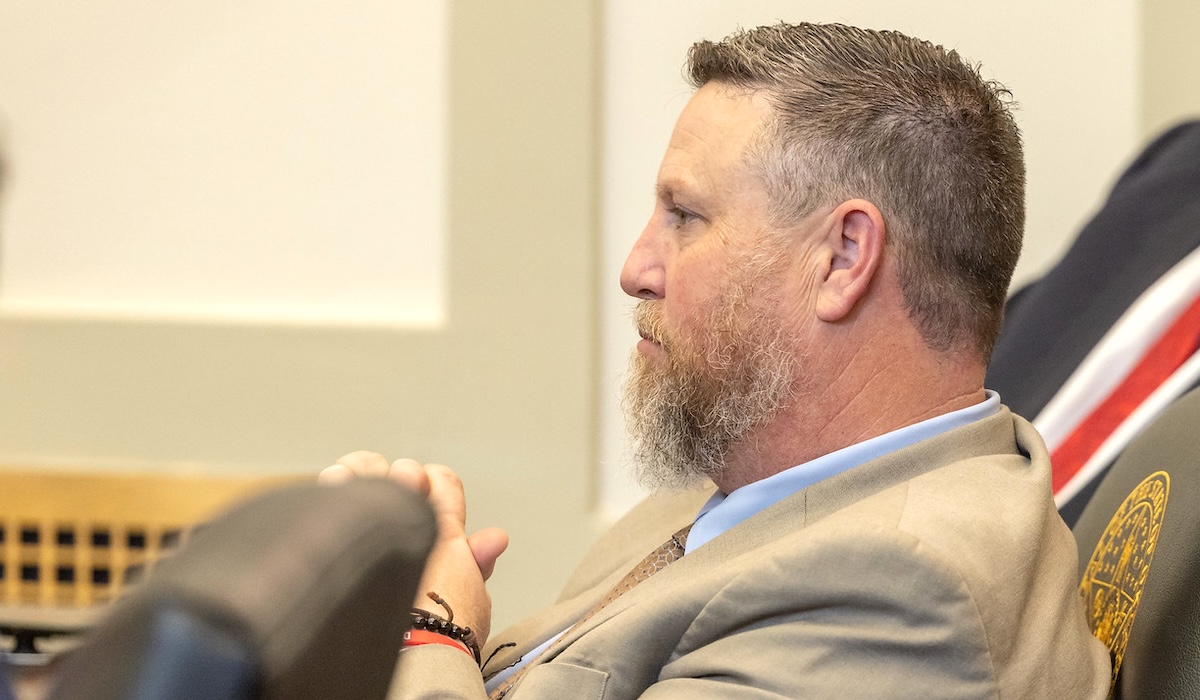 Sen. David Bullard (R-Durant) listens during Gov. Kevin Stitt’s State of the State address Monday, Feb. 2, 2026. (Legislative Services Bureau)
If Hilbert is looking for “a plan” to fund COLAs and ensure pension system solvency, Sen. David Bullard thinks he has one.
Bullard (R-Durant) filed SB 172 this session to take the Legislature out of the decision-making process when it comes to pension COLAs, a delicate topic amplified each election year like this one.
Instead, under SB 172, each pension board would be empowered to approve 2 percent COLAs as their systems see their funding ratios climb. The bill would prescribe:
A cost-of-living adjustment may be approved by the board if the funded ratio of the system exceeds 80 percent. Subsequent cost-of-living adjustments may be approved each time thereafter that the system’s funded ratio increases by 5 percent from the percentage which authorized the previous cost-of-living adjustment. Provided, if the system’s funded ratio exceeds 100 percent, the system may approve a cost-of-living adjustment at any time, so long as such adjustment does not cause the funded ratio of the system to drop below 100 percent.
SB 172 was withdrawn from the Senate Appropriations and Budget Committee last month, and it did not receive a Senate floor vote by last week’s deadline. Still, Bullard called its concepts “wildly popular” and said “everyone’s finding out about it.”
“It reforms the system. It takes the COLA away from the Legislature and gives it to the boards of all of those pension funds,” Bullard said. “It sets growth first, but it guarantees that, along the way, some of these retirees are going to get some much-needed COLAs. So it’s the best of both worlds.”
Bullard said the two pension systems already achieving 100 percent funded ratios — the judicial system and the system for public employees — would be able to see a COLA immediately upon the passage of SB 172. The others, however, would need to see additional growth first in the coming years.
“For conservatives, for everybody, it’s a win-win situation,” Bullard said.
While Paxton initially said all options are on the table when it comes to COLAs this session, he said Bullard’s idea in SB 172 would not be part of the conversation moving forward.
“No, the Legislature needs to be involved in that,” Paxton said of COLA decisions. “I believe it needs to be a vote in the Legislature. I pretty much always oppose automatic anythings — you know, automatic raises of things, or anything like that. This needs to be something Legislature has to decide.”
Asked his response to those who believe having the Legislature vote on COLAs has historically politicized the decisions, Paxton acknowledged the dynamic.
“It does, but still, it’s our job,” he said.
While Bullard’s bill stalled out — at least temporarily — amid broader Senate sore spots in a contentious election year, the idea has bipartisan support. Sen. Mark Mann (D-OKC) has signed on as a co-author, and Rep. Gabe Woolley (R-Broken Arrow), Rep. Trish Ranson (D-Stillwater) and Rep. Jared Deck (D-Norman) are all co-authors in the House.
So is Moore, the top House Republican behind Hilbert, who noted it has been six economically difficult years since Oklahoma pensioners received their last COLA.
“As it stands right now, we’re probably in favor addressing some sort of COLA (this year), whatever that percentage looks like,” Moore said. “Given the current climate, we’ve got to do something to help those systems and those pensioners out to make sure that they’re being able to meet their needs and address those issues.”
Moore said it’s possible that different pension systems could see different COLA percentages.
“That’s a potential option,” Moore said. “But I think we would probably do it uniform across the board, because those higher-funded pensions will just roll down and be able to eat it back in, so it’s no additional cost to the budget. I think that’s probably where we’ll be looking.”
Moore noted that, between the ideas in Bullard’s bill and Hilbert’s desire to see long-term planning for the end of additional apportionments, the COLA conversation this election year is different than a simple yes-no debate.
“It’s a little bit of of a chess match,” Moore said. “You move one (piece), it kind of affects some others. So we’re trying to make sure that we get everybody on board and and do what’s best for all the systems at the same time, rather than trying to pick winners and losers.”
Bullard expressed frustration with the fact SB 172 was not granted a hearing over the past month, but he noted that no idea is dead until lawmakers adjourn sine die.
“Keep in mind, it could be that, in the negotiations, that comes back in a [Joint Committees on Appropriations and Budget] form,” Bullard said. “That is definitely a possibility, but that probability is not too good.”
Oklahoma Education Association President Cari Elledge said in a statement Friday that this year’s COLA conversations are important.
“OEA recognizes the need for all retirees to get a cost of living adjustment,” Elledge said. “It has been far too long with no adjustments for retirees. We are hopeful the Legislature can find a path forward to give all retirees the financial relief they so desperately need.”
Mark Nelson, president of the Oklahoma State Fraternal Order of Police, also said his union is supportive of a COLA.
“We appreciate the difficulty legislators have in determining how to pay for COLAs,” Nelson said. “I’m proud to report the police pension system is nearly 100 percent funded and can easily pay for a COLA for our retirees. We are working hard with House and Senate leadership to find a solution this year.”
Tony Morgan, president of the OKC Firefighters Local 157, said legislators’ decisions about when to fund a COLA need to have more nuance than simply examining the funded ratio of a pension system.
“While every pension plan should strive to be 100 percent funded, determining the overall health of any system by solely focusing on the funding ratio is only a portion of the picture. The amortization rate, or the schedule for a pension system to become fully funded, is much more important,” Morgan said in a statement Monday morning. “The Oklahoma Firefighters Pension was formed in 1981, and at the time had a funding ratio of 11 percent. We now sit at 74.6 percent and are projected to reach 100 percent in 18 years. OKC firefighters support increasing benefits for all of our members while maintaining the overall health of the system.”
Hilbert suggested that stakeholder eyes ought to be on the Senate.
“Ultimately, I think COLAs would be wise, and I think it’s time that we do one, but I can only speak for the House,” he said.
(Update: This article was updated at 1:45 p.m. Monday March 30, to include comments from Paxton and Morgan.)
Tres Savage (William W. Savage III) has served as editor in chief of NonDoc since the publication launched in 2015. He holds a journalism degree from the University of Oklahoma and worked in health care for six years before returning to the media industry. He is a nationally certified Mental Health First Aid instructor and serves on the board of the Oklahoma Media Center.
Support Journalism