
24m agoTue 31 Mar 2026 at 4:37amMarket snapshotASX 200: +0.64% to 8,513 points (live figures blow)Australian dollar: Flat at 68.51 US cents
Wall Street: Dow Jones (+0.1%), S&P 500 (-0.2%)
Europe: FTSE (+1.6%)Asia: Nikkei (-1.2%), KOSPI (-3.1%), Hang Seng (-0.5%)Spot gold: +1.1% to $US4,561/ounceSpot silver: +3% to $US72.08/ounceOil (Brent crude): +0.2% at $US113.05/barrel
Iron ore: -0.04% at $US106.32/tonneBitcoin: +1.25% at $US67,559
 ASX 200: +0.64% to 8,513 points (live figures blow)Australian dollar: Flat at 68.51 US cents
Price current around 3:37pm AEDT
30m agoTue 31 Mar 2026 at 4:31amWho pays for petrol explained in ABC Business Daily podcast
The latest ABC Business Daily podcast is out, with Chief Business Correspondent Ian Verrender joining Carrington Clarke.
And they’re discussing today’s hot topic: fuel prices and the government’s attempt at easing pain at the pump.
It’s a great listen, you can hear the podcast here.
36m agoTue 31 Mar 2026 at 4:25amWhen will petrol and diesel prices drop in Australia?
Australians are set to see some relief at the petrol pump after Prime Minister Anthony Albanese announced a cut to the fuel excise.
With the tax temporarily cut in half, the 53 cent-a-litre charge will fall by 26.3 cents for three months— from April 1 until June 30.
The heavy vehicle road user charge — about 32 cents a litre — will also be reduced to zero for three months, in a bid to support truck drivers.
ABC News reporter Hanan Dervisevic breaks it all down for you:
46m agoTue 31 Mar 2026 at 4:15amNSW premier calls for more sovereignty on national energy supply as petrol prices rise

NSW Premier Chris Minns has argued Australia needs greater “sovereignty” over its energy and must electrify its economy if it is to survive future oil shocks.
Mr Minns made the comments while announcing the state’s fuel saving measures under the national fuel security plan.
“We need more sovereignty and control over our energy, and we need to be able to drive our economy independent of what happens in the Middle East,” he said.
“We have to consider the next conflict and anyone who thinks this is the last war in the Middle East is a complete mug — we have to start thinking about the future.
“This is a long-term change, but the question is — do we start tomorrow or do we just wait for the next war?”
Read more of the story here:
1h agoTue 31 Mar 2026 at 3:59am
Oil price rides waves of headline-driven volatility
Tony Sycamore from IG says the price of crude oil has given up its early gains on the latest signs of US de-escalation in the Middle East.
“As we enter the second month of the conflict in Iran, oil markets continue to ride a wave of headline-driven volatility, with ripples felt across most asset classes,” Mr Sycamore writes.
“This morning brought another sharp swing: reports that Iran struck a fully laden Kuwaiti oil tanker, the Al-Salmi, off Dubai triggered an immediate spike, pushing WTI crude as high as $106.86 in early trade.
“The price has since reversed lower to be trading around $102.10 (-0.77%), following headlines that President Trump has told aides he is willing to end the US military campaign against Iran even if the Strait of Hormuz remains largely closed.”
Mr Sycamore says this latest sign of de-escalation comes as US retail gasoline prices have climbed above $4 per gallon for the first time since August 2022. These rising gas prices have coincided with a sharp decline in Trump’s approval rating, which now sits around 36%.
He says while markets will “no doubt debate the merits of this latest de-escalation,” it also pays to keep in mind a recent tweet from Iran’s Parliament Speaker Mohammad Bagher Ghalibaf. Referring to the US administration, he said: “If they pump it, short it. If they dump it, go long.”
He also says if Trump decides to wind down the war but defers the reopening of the Strait of Hormuz, it will also leave a critical chokepoint firmly in Tehran’s hands for the foreseeable future, and that will have consequence for uncertainty.
“Unfortunately, this also pushes back any concrete resolution regarding the strait’s reopening, effectively extending the uncertainty weighing on markets and the broader global economy,” he says.
1h agoTue 31 Mar 2026 at 3:40am
Market snapshotASX 200: +0.79% to 8,528 points (live figures blow)Australian dollar: Flat at 68.50 US cents
Wall Street: Dow Jones (+0.1%), S&P 500 (-0.2%)
Europe: FTSE (+1.6%)Asia: Nikkei (-0.2%), KOSPI (-2.8%), Hang Seng (-0.4%)Spot gold: +1.1% to $US4,560/ounceSpot silver: +2.8% to $US71.94/ounceOil (Brent crude): -0.7% at $US111.95/barrel
Iron ore: -0.04% at $US106.32/tonneBitcoin: +1.6% at $US67,797
Price current around 2:40pm AEDT
1h agoTue 31 Mar 2026 at 3:38amNT government revives 1940s law in bid to combat fuel price gouging
Our ABC colleague Matt Garrick is reporting that the Northern Territory government has triggered a 77-year-old law to force fuel retailers to provide their “full cost structure” to prove they are not ripping off motorists.
He says NT Treasurer Bill Yan said it was the first time the Price Exploitation Prevention Act had been used since its inception in 1949 and was an “unprecedented move to manage the ongoing fuel crisis”.
Here is the breaking story below:
1h agoTue 31 Mar 2026 at 3:35am
China can absorb ‘shock of rising oil prices’
Imported inflation will put pressure on China’s economy, but the country has policy room to absorb the shock from rising oil prices if the Middle East conflict ends soon, Chinese central bank adviser Huang Yiping said on Tuesday.
But Huang told media at a meeting in Beijing that he was concerned about the shock to companies’ profitability from rising oil prices.
He added that the squeeze would be adverse for the real economy.
Huang is a member of the monetary policy committee at the People’s Bank of China.
With reporting by Reuters
1h agoTue 31 Mar 2026 at 3:21am
Interest rate cuts late this year are possible: Economist

CBA’s chief economist Luke Yeaman says interest rate cuts late this year or next year are possible, if Australia’s economy stagnates under the weight of rising oil prices and recent rate rises.
However, he still thinks further rate rises are likely in the short term as the bank deals with the inflation increase generated by surging energy costs.
CBA’s base case forecast is currently for one more rate rise this year to 4.35%, then two rate cuts next year taking the cash rate back to 3.85%.
1h agoTue 31 Mar 2026 at 3:19amRBA board minutes, rising inflation, and deteriorating consumer confidence
The minutes of the Reserve Bank’s board meeting from 16-17 March were released this morning.
Adam Boyton, head of Australian economics at ANZ Bank, says it appears from the minutes that there were two decisions that
the Board had in front of them at the meeting.
The first was whether interest rates needed to be increased in the near-term.And, having agreed that some near-term tightening in interest rates was likely required, members of the RBA then considered whether than should begin immediately or in the near future.
He says the decision about tightening rates in March was then the source of the 5-4 vote by the Board (in
favour of tightening).
He says minutes suggest that the RBA Board also appears to be trying to stay on the ‘narrow path’ (although he adds the “crucial caveat” that that is as long as longer-term inflation expectations remain anchored), with the
minutes noting that “future policy decisions would require the Board to balance its two objectives
carefully”.
He says the minutes also provide no forward guidance, which suggests that the Board does not have a pre-conceived view on a likely
path for the cash rate.
Mr Boyton then notes how economic and financial conditions have deteriorated in the two weeks since the RBA Board meeting was held, and what it could mean for interest rates this year:
“Since the March meeting there have been a range of developments,” he says.
“The unemployment rate
has risen back to 4.3%, ANZ Roy-Morgan Consumer Confidence has shown pronounced
weakness, and energy prices have risen further.
“With respect to our broader views the net of
the most recent increases in fuel prices, the three-month reduction in excise, and the
ongoing volatility in oil prices, suggest little reason for us to change our forecast that the Q2
headline CPI will print at 4.9% y/y and that real household incomes will end 2026 lower than
they started.
“As a result, we also continue to expect that there will be sufficient signs of
weakness in demand for the RBA to leave the cash rate at 4.35% after an increase at the
May meeting.”
You can read the minutes of the RBA Board meeting here:
1h agoTue 31 Mar 2026 at 3:11am
The recent behaviour of petrol prices
I find it ironic that the ACCC can accept that the fuel excise cut can be “largely” passed onto motorists with a six-week lag due to the way fuel is priced, (which makes complete sense as it flows through the system), but it is also completely accepted that the price of fuel can shoot up on the same day that “expectations” change despite the fact that that fuel has been in storage for however long…
– Matt
I noticed in Daniel’s post that the fuel excise cut will flow through in around 6 weeks as the ACCC says this is how fuel is priced, yet when the bombs started dropping on Tehran fuel prices spiked immediately. Is this another example of the new buzz word “asymmetric warfare”?
– Alphone
Thanks for your comments, Matt and Alphone.
A couple of weeks ago, when Dan Ziffer and I spoke to Peter Khoury, the head of media at the NRMA, for this piece, Mr Khoury raised a similar point about how quickly fuel prices have shot higher in Australia.
He said half of the service stations in Australia’s three biggest cities were already at the high point of their price cycles in February, and they were supposed to start falling, but then the war in the Middle East began and they immediately started putting their prices up further, and that led to prices being higher than they needed to be.
He said he believed that contributed to the panic buying that we saw in Australia, because fuel prices in our three biggest capital cities were going up “a lot higher, and a lot quicker, than they should have”.
1h agoTue 31 Mar 2026 at 3:02am
ASIC complaint lodged against APA Group
APA Group, Australia’s largest gas pipeline operator, has had a complaint lodged against it at ASIC.
Equity Generation Lawyers (EGL) and Market Forces are accusing the APA Group of “misrepresenting the costs, scale and financial viability of producing fracked gas in the Beetaloo Basin, Northern Territory”.
Their report, Pipeline to Nowhere, claims that fracking the Beetaloo sub-Basin would produce nearly 9.5 times the entire gas required for Australia’s National Electricity Market for the next 25 years.
They say it would take the market 237 years to use this much gas despite Australia’s net-zero by 2050 commitment.
“We are urging ASIC to investigate how APA misled investors about the size of the gas resource in the Beetaloo Basin and why the company misrepresented the costs of producing the gas,” said Kyle Robertson, Head of Research, Market Forces.
2h agoTue 31 Mar 2026 at 2:50am
Rising gas prices to push electricity prices higher: CBA
CBA’s head of currency strategy Joseph Capurso says Australia is unlikely to have ongoing fuel shortages because we are a rich country that can afford to pay more to secure supplies on the global market.
He believes poorer nations are likely to bear the brunt of fuel shortages.
However, he also warns that rising gas prices are likely to push Australian electricity prices higher again this year, with flow on implications for inflation.
Joe Capurso was speaking at a roadshow hosted by CBA’s economics team.
2h agoTue 31 Mar 2026 at 2:39am
What brought on the challenge to youth pay rates?
I am a bit behind – What was it that has brought on this challenge of youth pay rates with the fair work commission?
– James
Hi James,
On 6 June 2024, the Shop, Distributive and Allied Employees’ Association (SDA) applied to change junior rates.
They sought to increase rates of pay for employees aged 20 years old and under in the following 3 awards:
Fast Food Industry Award 2020General Retail Industry Award 2020Pharmacy Industry Award 2020
You can read the SDA’s original application here.
Part of the SDA’s argument was that the nature of the work that certain junior workers performed was appreciably the same as that performed by similar employees who were over 21 years of age. In other instances, it argued that some junior workers were performing supervisory and managerial roles, including by supervising workers who were older than them. Those were just two of many arguments.
In today’s announcement, the Full Bench has decided that:
after 6 months’ experience, the rates payable to adult junior employees will be set at a rate of 100% of the full adult rate of paythe current percentage rates for adult junior employees with less than 6 months’ experience with their current employer will stay the samethere will be no change to junior rates for persons aged under 18.
Next steps:
The Full Bench will hear from the parties further on the timing and transitional arrangements. Their provisional view is that the changes will be phased in over time starting from 1 December 2026, with the final changes to happen from 1 July 2029.
2h agoTue 31 Mar 2026 at 2:37amAustralian economic growth tipped to slow by 1%
CBA’s head of Australian economics Belinda Allen expects Australian economic growth to slow from 2.6 to 1.6%, annually.
She said households will bear the brunt of that slowdown, with business investment and government spending expected to remain solid.
Ms Allen expects household income growth to slow down from current levels around 5 per cent per annum to just 1 per cent, although she believes many households will dip into savings to fund their consumption.
She says CBA’s card spending data shows household spending has held up relatively well so far.
CBA is expecting another rate increase in May but, unlike Westpac’s economists, Ms Allen says further rate hikes remain very uncertain given existing division in the board.
CBA is only forecasting one more rate rise, with two rate cuts tipped for next year as the economy slows and inflation cools.
2h agoTue 31 Mar 2026 at 2:23am
WSJ reporting Trump open to ending war without reopening Strait of Hormuz
Trump lies pumping the markets again?
– Sam
It’s up on Trump’s remarks to entertain ending the war as is, and diplomatically pressuring Iran to open the straight.
– Arrik
Regarding why the market suddenly started rallying before midday, it would be speculation on my part, but the Wall Street Journal did publish a story around 11:30am Australian time with this headline: “Trump tells aides he’s willing to end war without reopening Hormuz.“
These are the opening pars of the WSJ piece:
“President Trump told aides he’s willing to end the U.S. military campaign against Iran even if the Strait of Hormuz remains largely closed, administration officials said, likely extending Tehran’s firm grip on the waterway and leaving a complex operation to reopen it for a later date.
“In recent days, Trump and his aides assessed that a mission to pry open the chokepoint would push the conflict beyond his timeline of four to six weeks. He decided that the U.S. should achieve its main goals of hobbling Iran’s navy and its missile stocks and wind down current hostilities while pressuring Tehran diplomatically to resume the free flow of trade.”
2h agoTue 31 Mar 2026 at 2:19amNew Zealand company Xero up almost 7%
Let’s take a look at the top and bottom performers on the ASX 200 so far today.
The Australian market was up almost 1% at lunchtime before dropping back to a rise of around 0.86% at 1:15pm ADST.
Top of the tree is Resolute Mining Ltd which has gained around 7.4% followed by Xero Ltd, which is up 7.1%.
Xero is a cloud accounting software provider founded in Wellington in 2006.
Despite Resolute Mining’s memorable day, other mining companies have had a bit of a rough ride today.
While Sims, a recycling and resource recovery company, has shed 6.93%, followed by Whitehaven Coal Ltd (down 5.08%), with New Hope Corporation and Karoon Energy also shedding value.
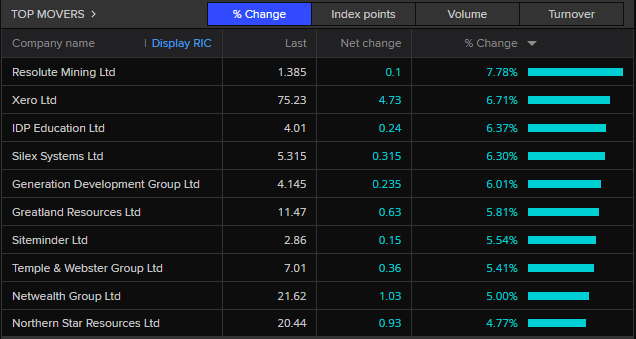 Top Movers (Refinitiv.com)
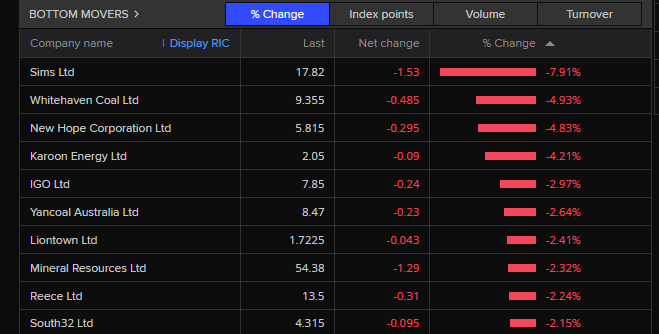 Bottom Movers (Refinitiv.com)2h agoTue 31 Mar 2026 at 2:07amCGT, negative gearing changes are ‘locked in’: CBA economist
CBA chief economist Luke Yeaman, a former senior Treasury official, says he believes some changes to capital gains tax and negative gearing are “locked in” for the May 12 budget.
Speaking at an economics roadshow hosted by the bank, Mr Yeaman says, while details are likely to still be finalised, he does not believe the government will back away from making some changes in that area.
Last week, Treasurer Jim Chalmers told the ABC’s Alan Kohler on the new That’s Business podcast that no decision on capital gains tax changes had yet been reached.
3h agoTue 31 Mar 2026 at 1:58amASX up 1% after lunchtime surge
Well, that is what you call a turnaround.
After a flat start followed by a downward trend, the ASX 200 is now up almost 1%.
It started gaining ground just after 12:15pm ADST.
Academic & Eductational Services, Technology and Industrials are the best-performing sectors.
This is shaping up to be a better end to the month than we were expecting.
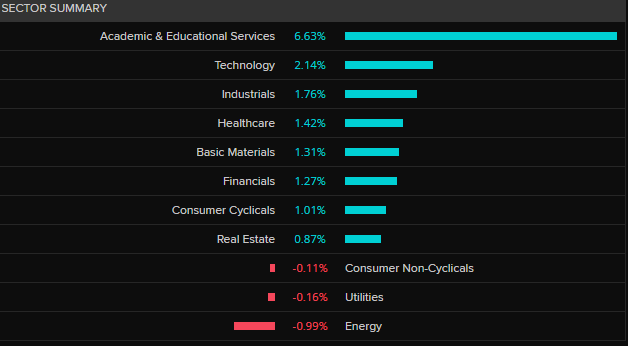 Refinitiv.com
3h agoTue 31 Mar 2026 at 1:50am
Market snapshotASX 200: +0.9% to 8,533 points
Australian dollar:+0.2% to 68.67 US cents
Wall Street: Dow Jones (+0.1%), S&P 500 (-0.2%)
Europe: FTSE (+1.6%)Asia: Nikkei (-1.9%), KOSPI (-3.9%), Hang Seng (-0.8%)Spot gold: +0.2% to $US4,605/ounce
Spot silver: +0.4% to $US72.92/ounce
Oil (Brent crude): +0.6% at $US115.10/barrel
Iron ore: +0.1% at $US106.32/tonneBitcoin: +1.6% at $US67,848
Price current around 12:46pm AEDT