
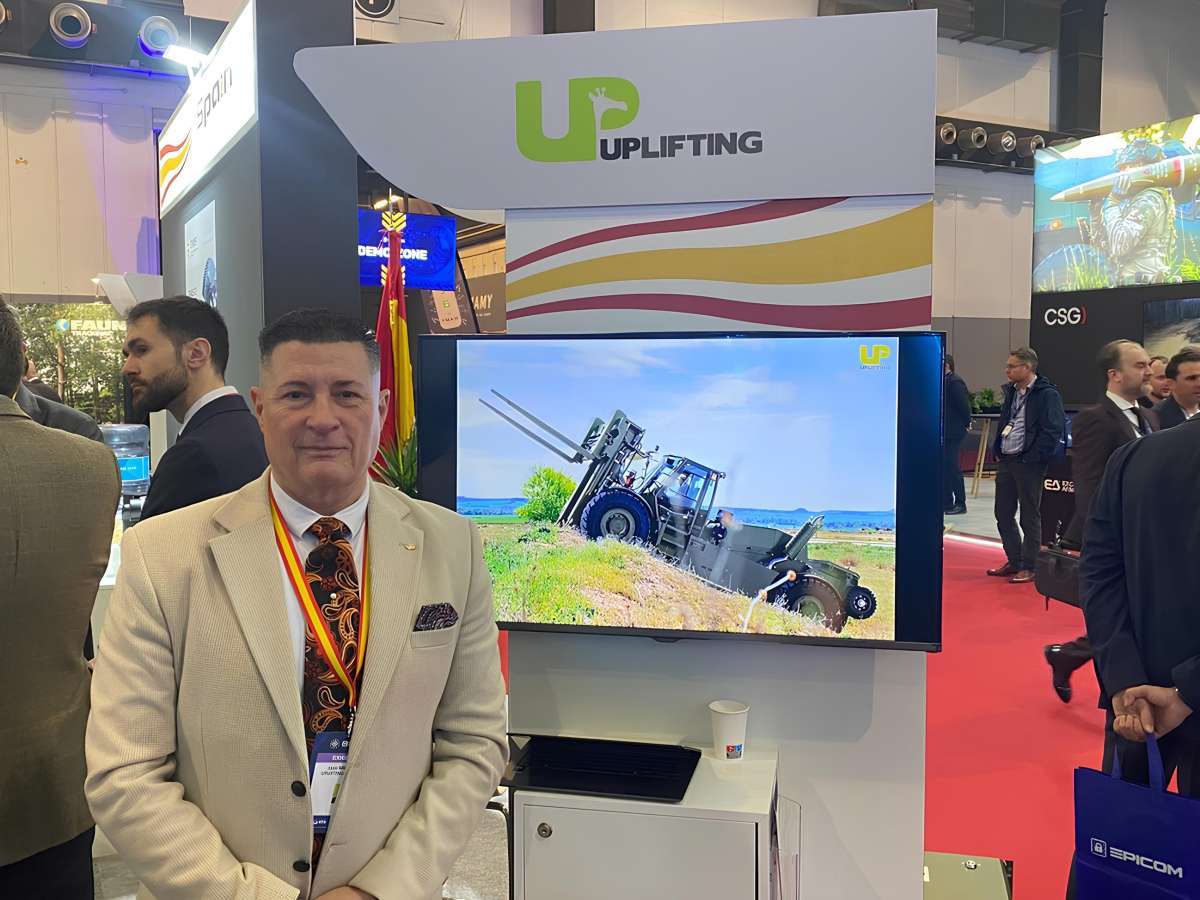
During the BEDEX 26 event, twelve Spanish exhibiting companies went to Brussels to make themselves known in the heart of Europe. One of these was UPLIFTING VERTICAL, a company that designs, manufactures, and supports heavy handling and lifting solutions intended for defense forces, such as forklifts, reach stackers, and truck-mounted cranes. Escudo Digital interviewed their commercial director, Jean-Michel Aspas, to learn about the possibilities Spanish companies have for accessing the European market.
Question: How important is it for your company to be present at a specialized fair like BEDEX in Brussels?
Answer: Well, as you know, the defense industry is booming in all countries of the world, especially in Europe, where there are certain threats. Therefore, giving visibility to the company at a European level is very important for us.
Q: At what other fairs have you participated?
A: There are very relevant fairs, such as the Spanish FEINDEF or the French Eurosatory, in which we participate. This is our first edition here, but the Belgian market is a neighboring market that is in full expansion, and we thought it was important to have a presence. We are already in contact with the Belgian Ministry of Defense, but we considered it necessary to take this step.
Q: Is it easy for your company to achieve collaborations with other European companies? How important is it?
A: Collaboration between European countries is crucial at this time. It should be a priority within the European Union. I believe it is the only solution, but historically in Europe, there have been many difficulties in reaching agreements.
Nowadays, we must think of interoperable armies, with the same materials and technologies. It is a very delicate point that needs to be strengthened. There is a lot of talk about it, but all the necessary means have not yet been made available to the industry to facilitate this collaboration within Europe, instead of relying on external technology.
Q: Regarding the present: Does your company bet on a model of concentration or one of business collaboration?
A: We clearly bet on collaboration. Obviously, we develop our own capabilities, but at the European level, there are many technologies that are not mastered individually. Without a cooperative model, the objectives will not be achieved within the expected timeframes.
Q: How can talent be retained in Spain to prevent it from going abroad?
A: It is a difficult question, especially when our company is located in Huesca, which is not particularly attractive to young people. However, our product is only manufactured in three countries: the United States, Canada, and Spain. That provides a special appeal for any engineer.
Offering a good product, balanced salary conditions, and development opportunities is key. We also need greater visibility in universities, technology centers, and vocational training, showing what is done in Spain. In fact, we are working on several projects to get closer to these areas and capture talent from early stages.
Q: Should defense topics be brought closer to young people?
A: Of course, perhaps it also involves promoting specific training in defense from an early age. Defense is a broad concept. It is often perceived as a dark sector, associated only with warfare. But in reality, it is a micro-society: there is food, clothing, technology…
There is no single specific training. In our case, we look for profiles in engineering, machining, electricity… These are the fields that allow the development of products applied to defense. That is where we try to create a pool and make ourselves known.
Q: Last question related to drones that have captured all the attention at BEDEX, do you think they have revolutionized the sector? How are they adapting?
A: It is not our direct field, but it is very interesting because it requires few means. In operational scenarios, drones have given an advantage to forces that did not have it before. We are seeing it in current conflicts: countries like Iran use relatively simple drones, with little technology and limited destructive capacity, but capable of damaging infrastructures.
They are expanding precisely because of that: low cost and ease of use. However, just as they have grown, anti-aircraft systems are also adapting to counter them.