
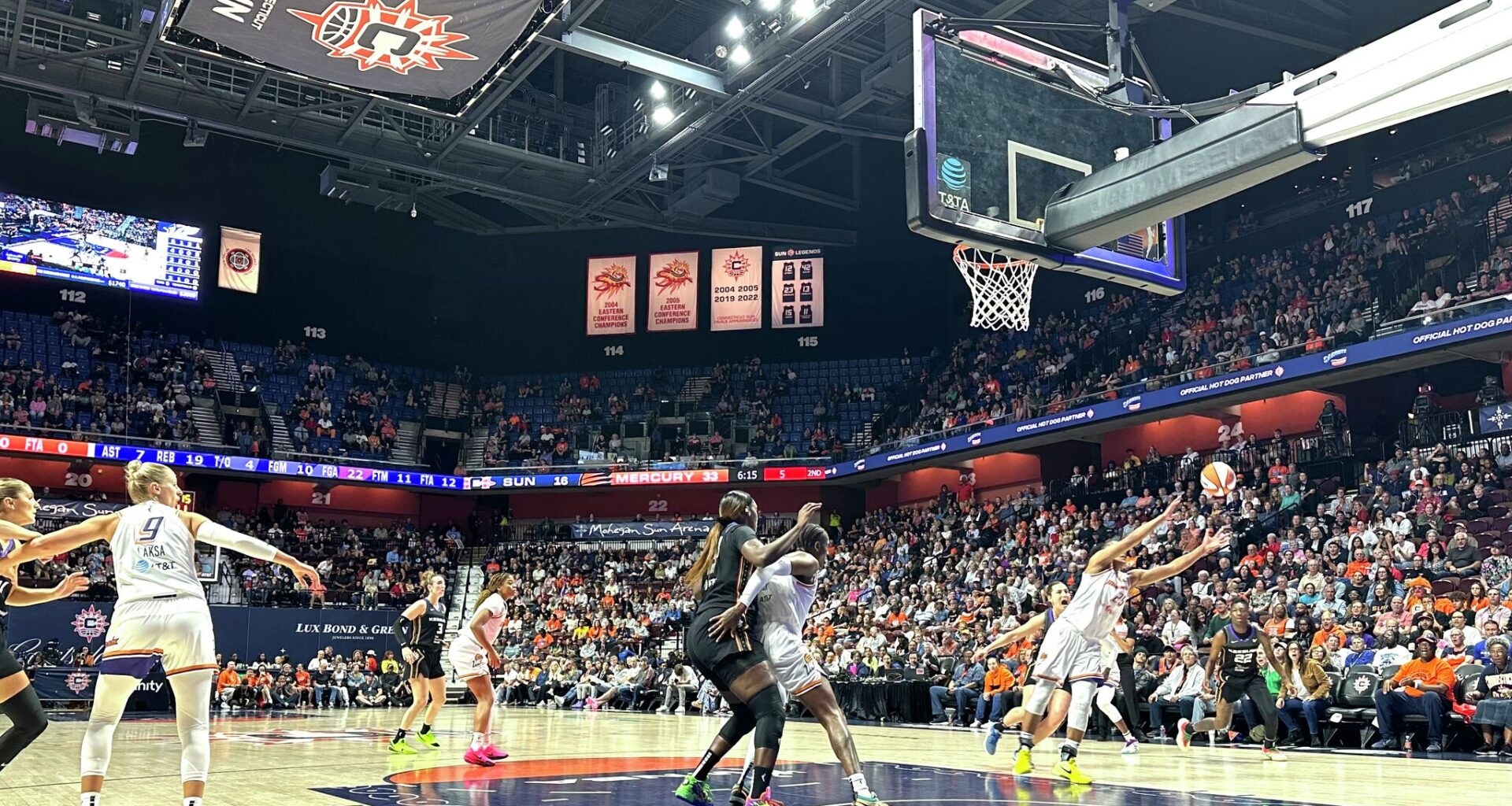
Nearly 8,000 fans at Mohegan Sun Arena saw the Connecticut Sun play the Phoenix Mercury on June 25, 2025. Phoenix won 83-75. The Sun would move to Houston under a tentative deal expected to be signed early in the week of March 30, 2026.
Dan Haar/Hearst CT Media
US Sen. Richard Blumenthal, foreground, and Connecticut Attorney General William Tong, left, are pushing for answers and a possible investigation of the likely sale of the CT Sun WNBA basketball team to the owners of the Houston Rockets. They are shown with Gov. Ned Lamont at the Capitol immediately after the election of President Donald Trump in November, 2024.
Jim Michaud/Hearst Connecticut Media
You might wonder why the Mohegan Tribe accepted $300 million from a Houston group for the Connecticut Sun WNBA basketball team instead of $325 million from at least two different buyers in New England, both also offering to build a $100 million practice facility.

And you might wonder how all of us looking closely at the deal reported months ago, long before the Houston talks even began, that the team would most likely move to that Texas city under the same ownership as the NBA Rockets franchise.
Article continues below this ad
If you’re really following this move, you might also wonder why the WNBA would not allow Mohegan, as the tribe’s business arm is known, to bring in even so much as a minority investment partner for one-third of the team, to keep the Sun in Connecticut playing in the same Mohegan Sun Arena.
If you think all of that reflects market manipulation by the league in steering the team toward one buyer in one city – manipulation that might violate federal and state antitrust laws – you have company in two top Connecticut elected officials.
“The outcome here clearly seems to have resulted from the WNBA favoring one bidder,” Sen. Richard Blumenthal told me. “The WNBA put its thumb on the scale and exercised its power for its own interests.”
Article continues below this ad
Make CT Insider a preferred source on Google to see more of our journalism when you search.
Add Preferred Source
Blumenthal dubbed it “anticompetitive interference” in a weekend post on X. He’s calling on the U.S. Department of Justice to investigate the deal under the Sherman Antitrust Act of 1890, still the standard for upholding fair competition in the business world.
“Let the market decide who wins the bidding competition, not the WNBA,” Blumenthal said Sunday.
William Tong, the Connecticut Attorney General, also wants answers. In a weekend email from his office after the UConn men’s team made a miracle comeback against Duke, he called the deal “concerning,” especially since the sale is “at a price far less than what was on the table to keep them here at home.”
Article continues below this ad
Under the deal that I reported Friday along with ESPN and PaperCity Magazine, and was announced publicly Monday, the team would play one last season in Connecticut this year, then move to Houston in 2027.
Blumenthal and Tong both brought concerns about the sale to WNBA Commissioner Cathy Englebert way back in September, after it became clear in reports by me and other journalists that Houston was the favored destination and that the league was not going to allow a sale within Connecticut.
Tong demanded documents on league rules and team valuations from Englebert. He reviewed those and said in the email Sunday that his office is “consulting with our partners in state government and local leaders.”
An inquiry in Congress is also possible. Blumenthal, the ranking Democrat on the Senate’s Permanent Subcommittee on Investigations, said he can’t assure that will happen, for several reasons. “It could be part of a broader investigation but we need to first assess whether there is sufficient evidence in this case and in others,” he told me.
Article continues below this ad
Mohegan, through a spokesperson, declined to comment Monday on whether the league steered it improperly to Houston. A WNBA spokesman did not respond to my emailed request for comment.
Deal fails the smell test
We get that sports teams and corporations often exit Connecticut. But like the old Hartford Whalers hockey squad of the NHL in 1997 or more recently, the Bridgeport Islanders announcing they will decamp to Canada after 25 years here, the team’s owner making a choice is one thing; having it forced upon them by their leagues is altogether different.
This Connecticut Sun sale fails the smell test. Blumenthal and Tong, often accused of having overactive lawsuit trigger fingers, are right to see where inquiries might lead.
Article continues below this ad
But the route to proving anti-competitive behavior, especially when it comes to sports leagues, is long, tricky and complex.
A related fact, maybe meaningful and maybe not, the Rockets’ owner, multi-billionaire entertainment entrepreneur Tilman Fertitta, happens to be a major donor to President Donald Trump and is currently the U.S. Ambassador to Italy. Don’t wait up at night for Trump’s Justice Department to investigate the league that handed him a team.
Mohegan bought the team from Orlando in 2003 and put it up for sale in the spring of 2025. By August it had a $325 million offer from a former Boston Celtics part-owner in that city – which the league rejected, saying it, and not individual owners, gets to decide where WNBA teams can move.
Mohegan then saw the light and decided to work within Connecticut, where the tribe has always been a strong economic partner. Marc Lasry, a former part-owner of the NBA Milwaukee Bucks who grew up in West Hartford and has a home in Westport, matched the $325 million offer and Gov. Ned Lamont agreed to build a practice facility. The team would play in Hartford at the PeoplesBank Arena.
Article continues below this ad
Nothing doing, the league said. Likewise, the league signaled it would reject a $100 million sale of a 30 percent stake, which would not move games from the Mohegan Sun Arena.
Houston, the nation’s 5th largest metro area, the biggest TV market without a WNBA team, is where the league wanted the Sun to move. Aside from my hearing that through sources, WNBA Commissioner Cathy Englebert said it in plain English last June.
And the NBA, which created and still controls the WNBA, is moving back to having WNBA teams as co-owned affiliates of NBA teams, ESPN and others have reported.
In the league’s defense, Houston was the home of the Comets in the WNBA, which won the first four league titles in 1997-2000 but folded in 2008. And Fertitta did put in a bid for an expansion team, losing out to several other cities as the league grows rapidly.
Article continues below this ad
But did Mohegan have any say in where it sold the team? It appears to have only negotiated with Fertitta after the league derailed the tribe’s attempts to stay in New England.
“There is a potential for anti-competitive behavior,” Blumenthal said, “which at least merits an investigation.”
‘The heart and soul of women’s basketball’
It’s a safe bet the WNBA league office and board of governors will bless this deal. If the facts are as they appear, Blumenthal said, “I am hoping we may take some action this week” in formally requesting a Department of Justice inquiry.
Article continues below this ad
This is familiar territory for the senator, who routinely attacked alleged anti-competitive and unfair business behavior as Connecticut’s attorney general from 1991 to 2011. In fact, in 2003, Blumenthal, on behalf of UConn, co-led a lawsuit against the Atlantic Coast Conference and several universities, claiming they violated the rights of UConn and the Big East when they reorganized the ACC.
That lawsuit, which ended in a settlement, angered a lot of folks in the sports world. But it made the point that powerful leagues are not above laws regulating competition.
This time around, last September, Tong and Blumenthal both wrote bluntly to Englebert, with Tong saying the steering was “anti-competitive and may violate state and federal law.”
“Connecticut is the heart and soul of women’s basketball. There would be no WNBA without the players, coaches and dedicated fan base in and from Connecticut,” Tong wrote in his statement over the weekend.
Article continues below this ad
U.S. action is a longshot
Even setting aside Fertitta’s connection to Trump, federal action looks like a longshot. The trend in recent decades under Democrats and Republicans alike has been a loosening of antitrust enforcement; and under Trump, it’s all about favors for people who advance his agenda.
Just last month Gail Slater, Trump’s appointed head of the Justice Department antitrust division, was forced out in part because her bosses had to rein her in on key merger cases, according to published reports and angry responses from Senate Democrats.
Another barrier: Major leagues in professional sports have exemptions for some anti-competitive activity, notably broadcast deals and labor relations because, the argument goes, the leagues and not the individual teams are the business. Obviously, it’s a hybrid. The leagues have generally tried to use their muscle to prevail over team moves, with mixed success.
Article continues below this ad
In the Connecticut Sun sale, the issue is not about a monopoly, in which one entity is the only seller of a good or service. Rather, it’s about possible manipulation leading to only one buyer. That’s known as a monopsony, and it was a key concept in the cases against the NCAA that led to expanded transfer rights and lucrative marketing deals for college athletes.
“I’m not saying the laws have been broken but there’s enough smoke that there could be fire,” Blumenthal told me. “For whatever reason, they wanted a team in Houston.”
The loss, and the legal questions, strain the Connecticut basketball heartstrings that grew even stronger over the weekend as both UConn teams rode heroics by freshmen to berths in the NCAA Final Four. “Houston may be a bigger city than Montville or Hartford,” Blumenthal told me, “but they’ll fill the stands wherever the Connecticut Sun play.”
Article continues below this ad
dhaar@hearstmediact.com