
Moneywise and Yahoo Finance LLC may earn commission or revenue through links in the content below.
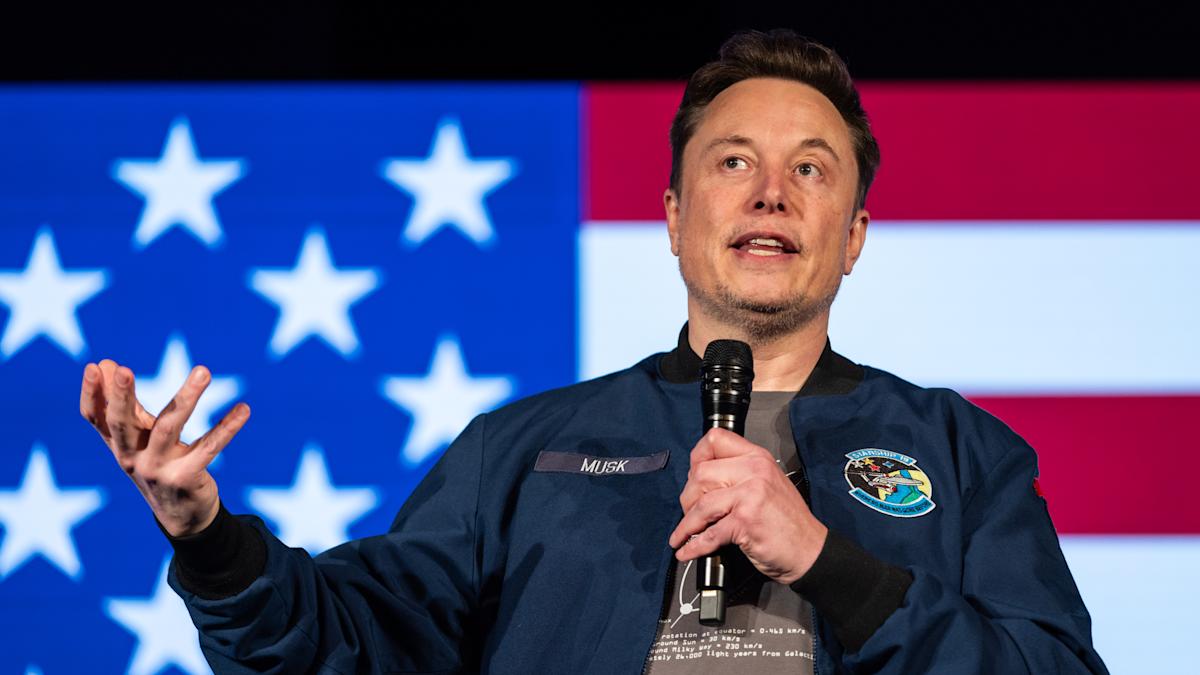
Tesla CEO Elon Musk had quite a ride heading the Department of Government Efficiency (DOGE) — an initiative designed to slash federal waste fraud, and abuse across the government.
Speaking at the All In Summit in September, Musk described his stint in Washington as “a hell of a side quest” and didn’t hold back when asked what he’d learned (1).
“The government is basically unfixable,” he declared, drawing laughter — and then applause — from the audience.
According to DOGE’s website, the initiative racked up an estimated $214 billion in savings, though critics have questioned the math (2). Musk says the big problem is America’s ballooning debt — which currently amounts to $38.99 trillion (3).
“It’s good to have talented people in the administration. But at the end of the day, if you look at our national debt, which is insanely high, the interest payments exceed the Defense Department — I guess, sorry, War Department budget — and they keep rising,” he said.
The numbers back him up. Treasury data show the U.S. paid $1.22 trillion in net interest in fiscal 2025 (4).
President Trump’s is pushing for a $1.5 trillion defense budget in FY2027 — a proposal that could swell the national debt by about $5.8 trillion, including interest, through 2035, according to estimates from The Committee for a Responsible Federal Budget (5).
That reality underpins Musk’s stark warning: “So if AI and robots don’t solve our national debt, we’re toast.”
But Musk isn’t just talking about AI — he’s investing heavily in it.
In February, the billionaire announced in a blog post that SpaceX had acquired xAI, ahead of a potential IPO later this year (6).
The combined business unites rockets, Starlink satellites, social platform X, and the Grok AI chatbot under one umbrella — with an estimated valuation of around $1.75 trillion (7).
Musk says the long-term plan revolves around a surprising idea: building AI data centers in space.
“Current advances in AI are dependent on large terrestrial data centers, which require immense amounts of power and cooling. Global electricity demand for AI simply cannot be met with terrestrial solutions, even in the near term,” Musk wrote in a statement.
“Space-based AI is obviously the only way to scale.”
Read More: I’m almost 50 years old and don’t have retirement savings. Is it too late?
Artificial intelligence might not just reshape the economy — it could be the only thing standing between America and bankruptcy, according to Musk.
Speaking with podcaster Dwarkesh Patel last month, Musk warned that without a massive productivity boom from AI and robotics, the U.S. could eventually collapse under its national debt (8).
“We are 1,000% going to go bankrupt as a country, and fail as a country, without AI and robots,” Musk said, adding, “Nothing else will solve the national debt. We just need enough time to build the AI and robots to not go bankrupt before then.”
Musk has made similar arguments before. In a conversation last November with entrepreneur Nikhil Kamath, he said AI could dramatically increase the output of goods and services — potentially pushing prices lower (9).
“If you have AI and robotics, and a dramatic increase in the output of goods and services, probably you will have deflation. That seems likely because you simply won’t be able to increase the money supply as fast as you increase the output of goods and services.”
But the same technology driving productivity could also threaten millions of jobs.
A recent analysis from Citrini Research explored how widespread automation could eliminate white-collar roles (10). If that happens at scale, fewer workers could mean lower tax revenue — and weaker consumer spending.
Early signs of that shift may already be showing up.
Fintech company Block, Inc. — founded by Jack Dorsey — recently slashed about 40% of its workforce, saying AI tools allow a smaller team to do more.
Musk isn’t the only billionaire sounding alarms. Ray Dalio, founder of the world’s largest hedge fund, Bridgewater Associates, has long cautioned that America is heading toward a “debt death spiral,” where the government must borrow simply to pay interest — a vicious cycle that accelerates over time.
Dalio doesn’t expect an outright default, but he sees another danger: currency erosion.
“There won’t be a default — the central bank will come in, and we’ll print the money and buy it,” he said in an interview with CNBC. “And that’s where there’s the depreciation of money.” (11)
The dollar’s shrinking buying power is familiar to Americans. According to the Federal Reserve Bank of Minneapolis’s inflation calculator, a $100 bill today has about the same purchasing power as $12 in 1970.
Dalio recommends a classic safeguard: gold.
“People don’t have, typically, an adequate amount of gold in their portfolio,” he told CNBC. “When bad times come, gold is a very effective diversifier.”
Unlike fiat currencies, gold can’t be printed at will by central banks or governments. It’s also widely regarded as the ultimate safe haven. Gold is not tied to any one country, currency or economy, and in times of economic turmoil or geopolitical uncertainty, investors often flock to it — driving prices higher.
Even though gold prices have pulled back recently, the metal remains a popular safe haven during periods of economic uncertainty. Over the past year, the price of gold has surged more than 57%, far outpacing the roughly 12.8% gain in the S&P 500 Index (12).
One way to invest in gold that can provide significant tax advantages is to open a gold IRA with the help of Priority Gold.
Gold IRAs allow investors to hold physical gold or gold-related assets within a retirement account, which combines the tax advantages of an IRA with the protective benefits of investing in gold, making it an attractive option for those looking to potentially hedge their retirement funds against economic uncertainties.
To learn more, you can get a free information guide that includes details on how to get up to $10,000 in free silver on qualifying purchases.
Just keep in mind that gold is often best used as one part of an otherwise well-diversified portfolio.
Like Dalio, Musk has also shared thoughts on how Americans can protect themselves if the dollar is losing value.
“It is generally better to own physical things like a home or stock in companies you think make good products, than dollars when inflation is high,” he wrote on X back in 2022 — shortly before U.S. inflation spiked to a 40-year high (13).
Musk may have a point about physical assets. Consider this: the S&P CoreLogic U.S. National Home Price Index tracks single-family home prices in the U.S., and has climbed nearly 50% over the past five years (14).
Real estate is widely considered a long-term hedge against inflation. As the cost of materials, labor and land rises, home values often increase in tandem. Rental income also tends to move higher, providing landlords with a cash flow that adjusts with inflation.
The good news is, these days you don’t even need to buy a house outright to benefit from real estate investing.
Mogul is a real estate investment platform offering fractional ownership in blue-chip rental properties, which gives investors monthly rental income, real-time appreciation and tax benefits — without the need for a hefty down payment or 3 a.m. tenant calls.
Their team hand-picks the top 1% of single-family rental homes nationwide for you. Each property undergoes a vetting process, requiring a minimum 12% return even in downside scenarios. Across the board, the platform features an average yearly return of 18.8%.
Their cash-on-cash yields, meanwhile, average between 10 to 12% annually. Offerings often sell out in under three hours, with investments typically ranging between $15,000 and $40,000 per property.
Getting started is a quick and easy process. You can sign up for an account and then browse available properties. Once you verify your information with their team, you can invest like a mogul in just a few clicks.
If diversifying into multifamily and industrial rentals appeals to you, you could consider investing with Lightstone DIRECT, a new investing platform from the Lightstone Group, one of the largest private real estate companies in the country with over 25,000 multifamily units in its portfolio.
Since they eliminate intermediaries — brokers and crowdfunding middlemen — accredited investors with a minimum investment of $100,000 can gain direct access to institutional-quality multifamily opportunities. This streamlined model can help reduce fees while enhancing transparency and control.
And with Lightstone DIRECT, you invest in single-asset multifamily deals alongside Lightstone — a true partner — as Lightstone puts at least 20% of its own capital into every offering. All of Lightstone’s investment opportunities undergo a rigorous, multi-stage review before being approved by Lightstone’s Principals, including Founder David Lichtenstein.
How it works is simple: Just sign up with your email, and you can schedule a call with a capital formation expert to assess your investment opportunities. From here, all you have to do is verify your details to begin investing.
Founded in 1986, Lightstone has a proven track record of delivering strong risk-adjusted returns across market cycles with a 27.6% historical net IRR and 2.54x historical net equity multiple on realized investments since 2004. All told, Lightstone has $12 billion in assets under management — including in industrial and commercial real estate.
As such, even if multifamily rentals don’t appeal to you, Lightstone could still serve you well as an investment vehicle for other real estate verticals.
Get started today with Lightstone DIRECT and invest alongside experienced professionals with skin in the game.
Musk also highlighted that stocks can be a smarter alternative to holding cash when inflation is high.
True as it may be, his statement naturally raises a question — how do you choose the right companies?
One of the world’s most respected investors, Warren Buffett, offers a straightforward answer: skip the stock picking and simply own the S&P 500.
“In my view, for most people, the best thing to do is own the S&P 500 index fund,” Buffett has famously stated (15).
This approach gives investors exposure to 500 of America’s largest companies across a variety of industries, providing better diversification than individual stocks.
The beauty of this approach is its accessibility — anyone, regardless of wealth, can invest in ETFs like the S&P 500. Even small amounts can grow over time, too, with tools like Acorns, a popular app that automatically invests your spare change.
Signing up for Acorns takes just minutes: link your cards, and Acorns will round up each purchase to the nearest dollar, investing the difference — your spare change — into a diversified portfolio.
With Acorns, you can invest in an S&P 500 ETF with as little as $5 — and, if you sign up today, Acorns will add a $20 bonus to help you begin your investment journey.
But passive investing isn’t for everyone.
Platforms like Robinhood are designed to make investing simpler and more approachable.
If you prefer a more hands-on approach, you can also buy and sell individual stocks, fractional shares and options (for qualified traders) — backed by 24/7 support. Stocks, ETFs and their options trades are commission-free.
With access to popular ETFs like the Vanguard S&P 500, you can build diversified exposure without needing to pick individual stocks.
The platform also offers both a traditional IRA and a Roth IRA, so you can choose the tax strategy that fits your retirement plan.
With its recurring investment feature, you can set up automatic investments of your preferred fractional shares, stocks and ETFs on your own schedule.
Over time, this helps make investing a habit and steadily grows your portfolio.
Join 250,000+ readers and get Moneywise’s best stories and exclusive interviews first — clear insights curated and delivered weekly. Subscribe now.
We rely only on vetted sources and credible third-party reporting. For details, see our editorial ethics and guidelines.
@All-In Podcast (1); DOGE (2); Treasury.gov (3), (4); The Committee for a Responsible Federal Budget (5); SpaceX (6); Bloomberg (7); @Dwarkesh Patel and Stripe (8); @Nikhil Kamath (9); Citrini Research (10); @CNBC International Live (11); APMEX (12); @Elon Musk (13); S&P Global (14); NASDAQ (15)
This article provides information only and should not be construed as advice. It is provided without warranty of any kind.