
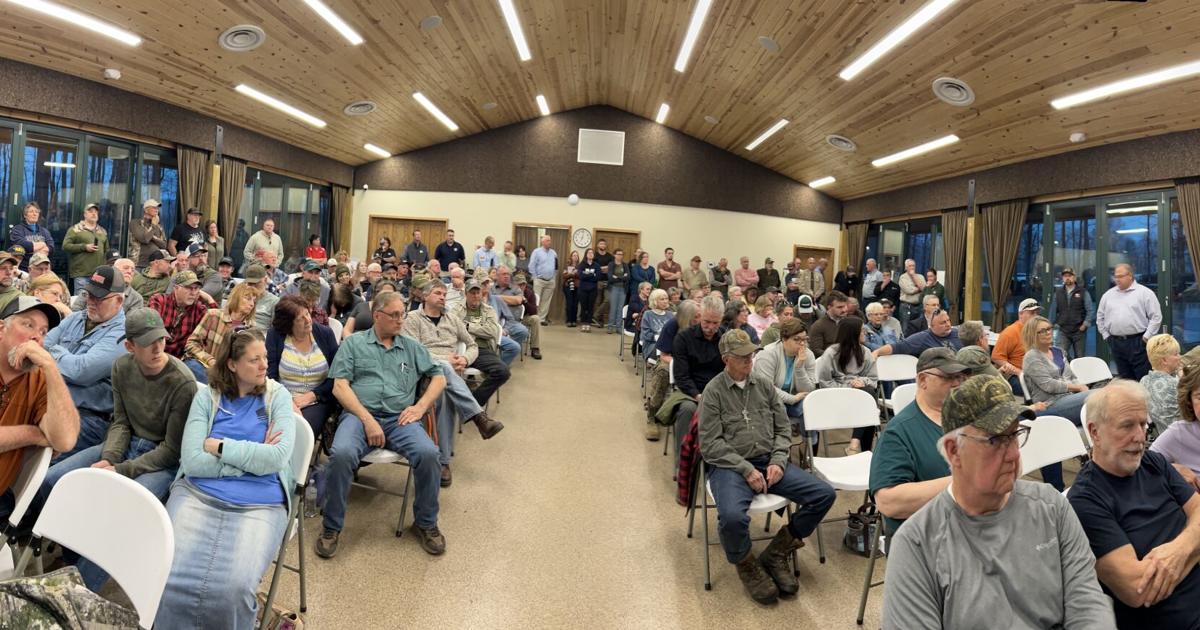
BENEZETTE — There was standing room only on March 26 at the Jack and Jean Parker Outdoor Classroom near the Elk Country Visitor Center to discuss Pennsylvania’s elk herd.
State Rep. Michael Armanini welcomed everyone and noted that taxpayer dollars paid for the beautiful facility they were in, and that Benezette has been officially known as the “elk capital of Pennsylvania,” which is a huge tourism draw. The problem is that elk are now scarce in an area where they were once very plentiful.
He also stated that he has been working with the Pennsylvania Game Commission, the Department of Conservation and Natural Resources (DCNR), and the Keystone Elk Country Alliance (KECA) to “find ways to revitalize the main elk viewing areas of Winslow Hill and Dents Run, and bring back the beauty of the elk so that a good majority of people can view them. It’s a delicate balance between how do we attract and keep wild animals in a viewing area so that people who are not true outdoorsmen or sportsmen can come and see their beauty.”
The first Benezette resident to speak was the owner of MacDarvey Castle and Elk View, Chuck Brotherton. He said, “I came here about 15 years ago from New Jersey, and I came here for one reason: because of the abundance of wildlife in Benezette. The group I used to come with called this area ‘The Little Yellowstone of the East’ because (the wildlife) was that bountiful.
“I bought all the property (that I could) and spent tens of thousands of dollars to live here based on that. And I feel that today, it doesn’t exist. When I first came here I used to go out with KECA and Rocky Mountain to capture elk and tag them. We’d get 10 or 15 on a weekend; now they struggle to find one each.
“KECA has done a fabulous job of bringing in students and families with their displays and their movie. They get everybody pumped up and they are all excited to understand the nature of the elk. They go home and tell all their friends. Now comes the problem. They come back, and they don’t find any elk. They sit at these viewing areas for hours and drive all over the roads and sit there for hours, but they don’t see any elk. Yes, some people do see some; it’s not like they don’t exist. When I first came here I drove my 80-year-old mother around and we would easily see 50 to 100 elk each night.”
Surrounding counties have begun to distribute pamphlets giving GPS locations where the elk can be found, and it’s no longer in Benezette. He opined that the visitor center has had 100,000 fewer visitors than it did pre-pandemic, and asked that some roads near the feeding plots be opened up to visitors so even the elderly can enjoy seeing the elk without getting out of their cars.
Another speaker questioned whether organizations like the Bennetts Valley Sportsmen Club, Pheasants Forever, and other conservation-minded organizations that have the equipment, the volunteers, and the skills to establish supplemental food plots for the elk on private property would be permitted to do that. It was suggested that organizations could band together to get bulk lime and seed to establish food plots that are more easily accessible than many of the already established food plots. The point was made that most of the food plots planted and managed by KECA or the Game Commission are in remote areas having limited access, which doesn’t solve the problem of small numbers of elk being easily visible from roads as was the case several years ago.
Peggy DeCarli has owned the Medix Hotel for 27 years, and she stated that, in the past, elk were often in the hotel parking lot and across the street at the little store. They were an attraction that brought people to the area, and they patronized her establishment and other area businesses. She asked whether the only place elk may be viewed presently are near the remote and mostly inaccessible food plots maintained by the Game Commission and KECA.
Another speaker was wildlife photographer Bruce Watkavich who isn’t from the area, but who has been visiting here monthly for about 20 years. He said, “When I came here 20 years ago, I had to come to Benezette to find the elk, because that was where the cows were. Bulls would come from 10 or 12 miles away because this is where the cows were. That was back when the herd numbered a couple of hundred, and if you wanted to see them, this is where you had to come. These animals move for a number of other reasons, namely to be near food and water sources, or to move away from excess human noise and contact. The animals are going to be where they want to be, but they are still around.” Watkavich noted that last year’s extended drought caused the bulls to migrate to better grazing areas. He concluded, “We know we want to keep a lot of (the elk) in the Benezette area, but we’ve also seen that the elk are spreading out. Did we push the tourism so much that we just expect they have to be here? They’re not going to be here all the time because the elk move around to find food and water, but they are still in the area.”
Another speaker was octogenarian Terry Moore, and he said he has lived in the Benezette area since 1959, and has seen many changes over the years. He gave credit to KECA and the Game Commission for their work in reclaiming strip mined land and turning it into grazing land.
He stated, “But the biggest change that’s happened here is that we aren’t allowed to feed the elk any more in our yard. I fed elk for 30 years, as did my neighbors, and when you drove around by the campground or down by the store, you could see elk. There were always a few of them running. They were here because people were feeding them. They were tame and not suitable for hunting. If you want a challenge, go out to Wyoming.”
Moore noted that the elk he fed were always healthy, and they didn’t get Chronic Wasting Disease (CWD) by being fed in a group. He noted that a $500 fine for feeding the elk on private property was instituted at some point because it made the elk tame and dependent on humans for food, and stated that’s the reason elk are not being seen as people drive around Benezette.
Another resident recalled meetings he went to 30 years ago where people were complaining because there were too many elk in their yards, and were rubbing their antlers on cars. Without available food plots, elk were eating grass, shrubs, and garden produce on private property. People demanded that elk be taken to another location because they had become a destructive nuisance. They wanted the elk gone and they wanted the tourists gone. The Game Commission responded by making more habitat areas over a much larger area, and the elk have moved on, away from the roads and houses.
PGC does not advocate transporting elk from one area to another because of the danger of spreading Chronic Wasting Disease, according to elk biologist Jeremy Banfield.