
We are now in the home stretch in the nearly four-month saga of Comet C/2026 A1 (MAPS). This is the make-or-break week for this object as it heads for its long-awaited rendezvous with the sun this weekend.
The comet was discovered on Jan. 13, 2026, by a team of four amateur astronomers. “MAPS” is an acronym using the first letters of the surnames of the discoverers: Alain Maury, Georges Attard, Daniel Parrott, and Florian Signoret. They found the comet using a remotely operated 11-inch telescope at the AMACS1 observatory in Chile’s Atacama Desert. What makes this discovery special is that Comet MAPS belongs to a special class of comets known as Kreutz sungrazers.
You may like
A date with destiny
Saturday, April 4, is the day of Comet MAPS perihelion — when it will make its closest approach to the sun. Based on updated orbital elements published on the Central Bureau for Astronomical Telegrams (CBAT) Circular#5675, Comet MAPS will pass within 101,100 miles (162,700 km) above the sun’s surface (the photosphere) at 10:24 a.m. EDT (1424 GMT, 7:24 a.m. PDT). The comet will then be in the midst of completing a hairpin-curved path around the sun, racing at a speed of 322 miles (518 km) per second.
Will it be visible?
It is also possible that the comet may become extremely bright around this time, possibly even bright enough to glimpse in the daytime, though the very close proximity to the sun in the sky makes this an extremely dangerous proposition. Indeed, the sun’s infrared rays can burn the retina of the eye and cause irreparable damage, all without causing any pain and neither sunglasses, telescopes, nor binoculars will protect against the type of eye damage that could ultimately result in blindness, when a person — however briefly — accidentally looks directly into the sun’s rays.
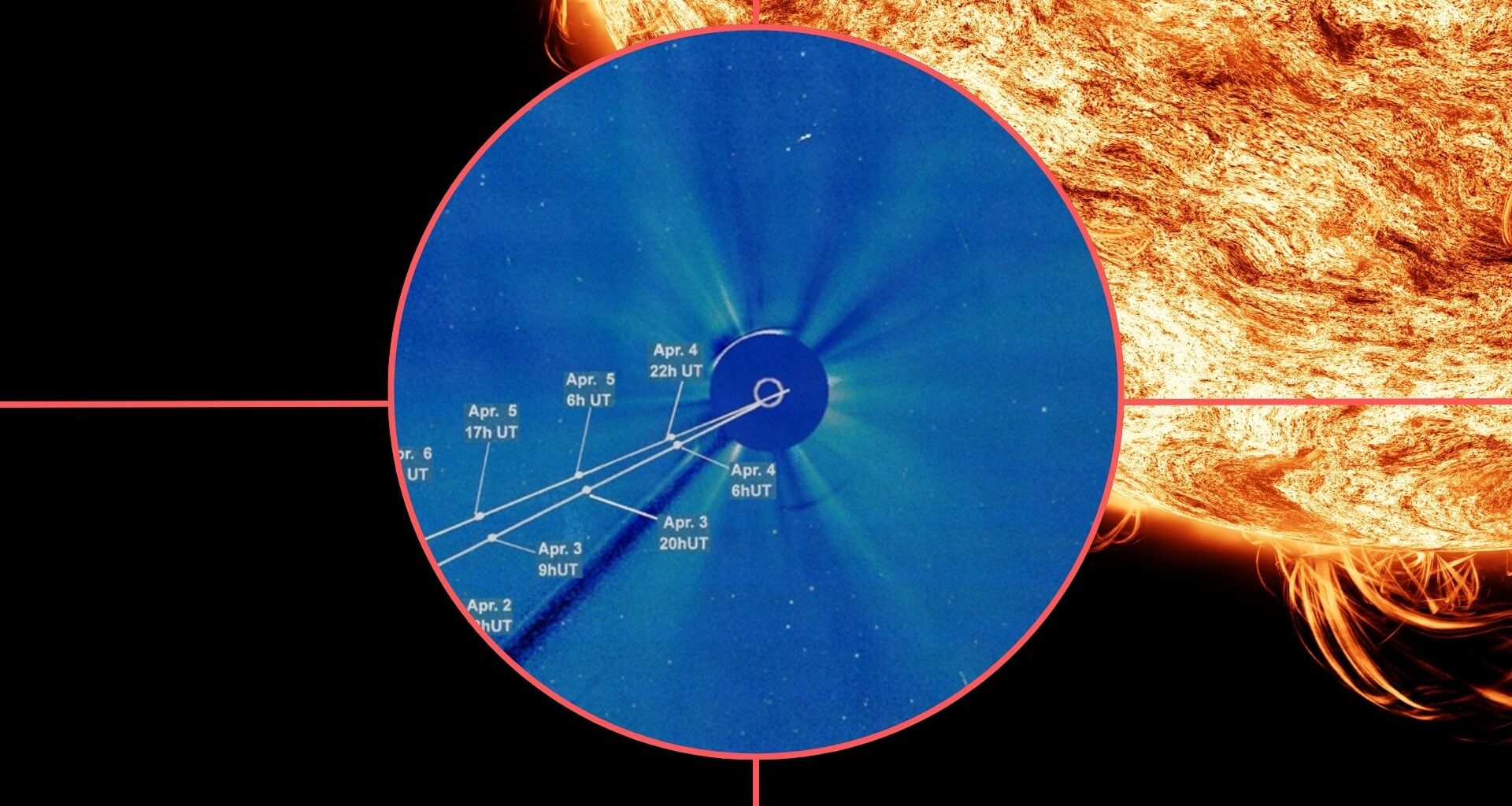
To get a good (and safe) view of Comet MAPS as it approaches and then sweeps rapidly around the sun, reserve a seat next to your computer and stay tuned to SOHO’s LASCO (Large Angle and Spectrometric Coronagraph Experiment) C3 camera, by accessing either its near-live images or videos that span the past 24 hours.
Comet MAPS will be within range of the LASCO C3 imagery from April 2 at 8:00 a.m. EDT (1200 GMT) through April 6 at 1:00 a.m. EDT (0500 GMT). During a roughly four-hour timespan centered on the time of perihelion on April 4, the comet will appear to pass behind the sun as seen from our earthly perspective, then rapidly swing around and cross in front of the sun.
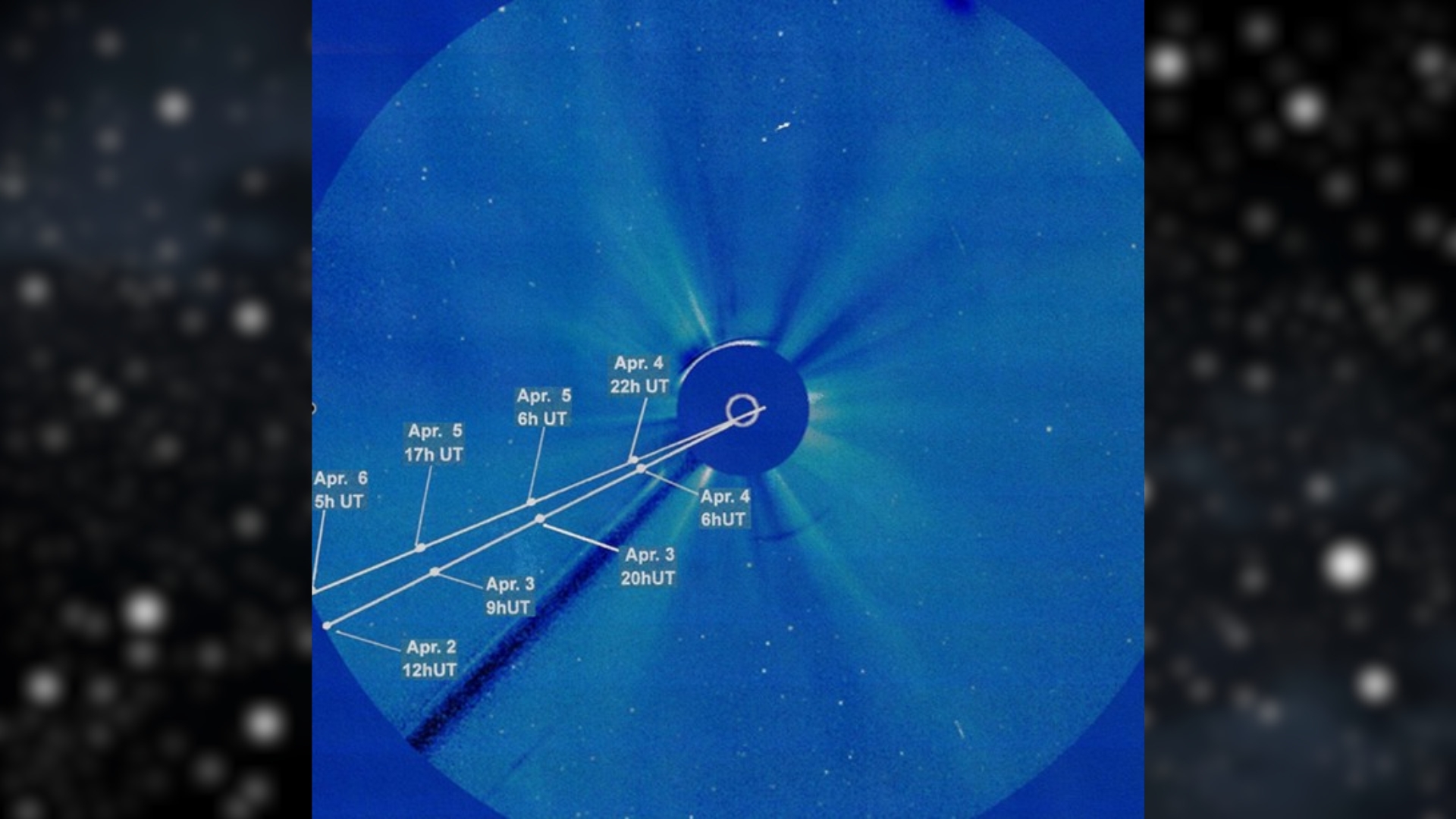
The comet will cross the field of view of the SOHO’s LASCO 3 coronagraph from April 2 to April 6. (Image credit: ESA / NASA / SOHO. Comet track by Joe Rao.)Sizzler or fizzler?
There has been much talk on social media of late, concerning whether Comet MAPS will put on a spectacular visual show for naked-eye observers after it sweeps around the sun. Since some of the brightest comets in history have belonged to the Kreutz sungrazing family, hopes have been running high that a celestial showpiece will soon adorn our western evening sky. Some have already christened Comet MAPS as “The Great Easter Comet of 2026.”
But will all this actually come to pass?
As it stands now, there appear to be three possible options for Comet MAPS:
What to read next
Option 1: It disintegrates at or just prior to perihelion
In this situation, as the comet is reaching its closest point to the sun, its nucleus, being subjected to intense solar heating and tidal stresses caused by the sun’s gravity, completely disintegrates. Upon swinging around the sun, nothing is left to be seen.
Just such a scenario took place in November 2013 with Comet ISON. Although not a member of the Kreutz sun grazing family, Comet ISON still passed to within 724,000 miles (1.16 million km) of the sun’s surface. It was highly touted to become a brilliant naked-eye object, but instead, suffered a significant disruption about a week prior to perihelion and almost completely broke up when it made its closest pass to the sun, save for a single small fragment, which had somehow survived and itself disintegrated several days later.
Option 2: It disintegrates after perihelion
Following along this script, the comet arrives at perihelion, then rapidly swings around the sun and back out into space seemingly intact. But shortly thereafter, its nucleus fragments and quickly disintegrates.
An excellent example of this was the so-called Great Southern Comet of 1887; a member of the Kreutz family. It apparently passed to within just 17,000 miles (27,000 km) of the sun’s surface. In the days immediately following its mid-January perihelion, its head was described as a diffused nebulous mass, but far more noteworthy was its tail, described as a pale narrow ribbon of light. In comet annals, the 1887 comet became known as “The Headless Wonder.” Another Kreutz comet was Comet Lovejoy in December 2011, which swept to within 87,000 miles (140,000 km) of the sun’s surface. It seemingly emerged intact and put on a fine showing in the pre-Christmas southern morning skies, but several days after perihelion, its nucleus subsequently underwent a cataclysmic fragmentation, and it faded very rapidly thereafter. One Australian observer commented that the most striking feature of Comet Lovejoy was the extreme straightness of its 30-degree tail, but the head was “virtually nonexistent.” Another headless wonder!
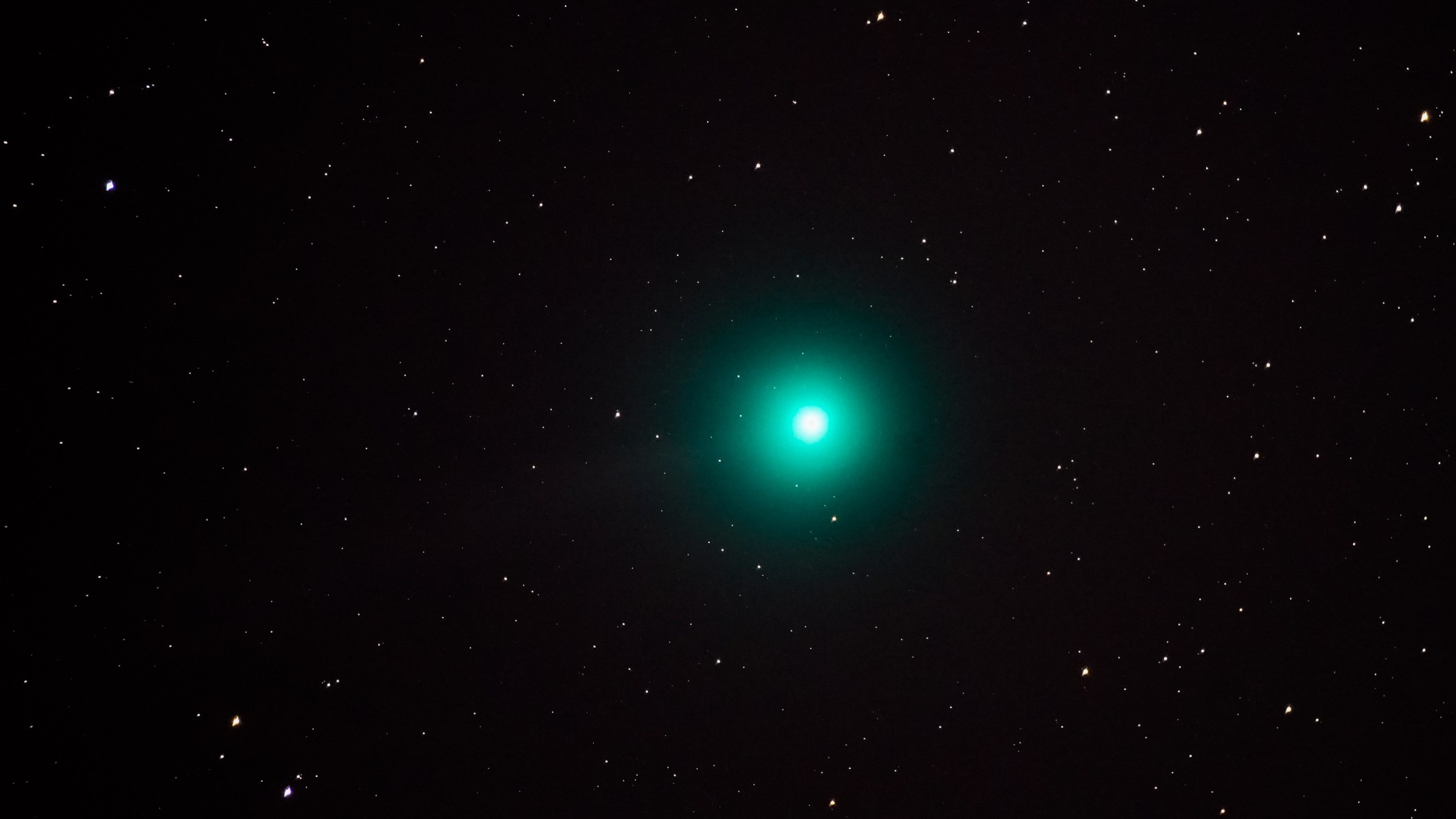
Comet Lovejoy C/2011 W3 captured on Jan. 10, 2011. (Image credit: Ryan Henke via Getty Images)Option 3. It survives perihelion
In this possible eventuality, the comet sweeps around the sun and puts on a spectacular show as it moves back out into space.
For this case, we can cite “The Great Comet of 1965,” Ikeya-Seki, which was the most brilliant comet of the 20th century. It attained a magnitude of at least -10 (as bright as a half-moon) and was readily visible next to the sun during the daytime. This comet was another member of the Kreutz sungrazers, passing within 280,000 miles (450,000 km) of the solar surface, with its nucleus seen breaking into three separate pieces. Nonetheless, in late October, it spawned a bright and slender curved tail, about the length of the handle of the Big Dipper, appearing above the southeast horizon a couple of hours before the sun.
Breaking up is not so hard to do
The important factor to note is that the one thing that ties all three options together is that in every case, the comet nucleus ended up breaking up, the obvious result of being exposed to the sun’s intense heat as well as its massive gravitational force, pulling on the nucleus and ripping it apart.
Ultimately, this will likely be the fate of Comet MAPS.
Size matters
But which of the three options will Comet MAPS fall into? A major component to consider is the size of the nucleus. In the case of Comet Ikeya-Seki, it is believed that its mean diameter was about 5.4 miles (8.7 km).
The other comets we spoke of, however, were likely much smaller.
The diameter of the Great Southern Comet of 1887’s shattered nucleus is believed to have been 1.5 miles (2.4 km). Comet ISON was estimated to be only 0.9 miles (1.4 km) wide, while Comet Lovejoy’s nucleus may have been no more than a mere 0.3 miles (0.5 km) across. In a recent technical paper published in March by the American Astronomical Society (AAS), an analysis of images taken with the James Webb Space Telescope suggests that the nucleus of Comet MAPS appears to be — relatively speaking — quite puny, on the order of no more than 0.2 miles (0.4 km) in diameter.
The AAS paper thus concludes that, like Comet ISON, from thirteen years ago, the nucleus of Comet MAPS could be spun apart by outgassing torques (twisting forces that tends to cause rotation), causing it to disrupt before perihelion, “. . . in which case,” note the authors, “its scattered debris would likely be thoroughly destroyed by the sungrazing encounter, leaving no observable remnant afterward.”
That certainly does not bode well for a bright sky show.
Tail wags the comet?
So right now, assuming that the nucleus of Comet MAPS totally disintegrates prior to, or shortly after its closest approach to the sun, suggests that either we will see nothing emerge into the western evening sky during the second week of April, or . . . as was the case with the Great Southern Comet of 1887 and Comet Lovejoy in 2011, only the dusty residual appendage of a tail protruding up from the western horizon will be seen, with no noticeable head or coma.
Indeed, in the end, the tail might be all that is left to be seen of Comet MAPS.
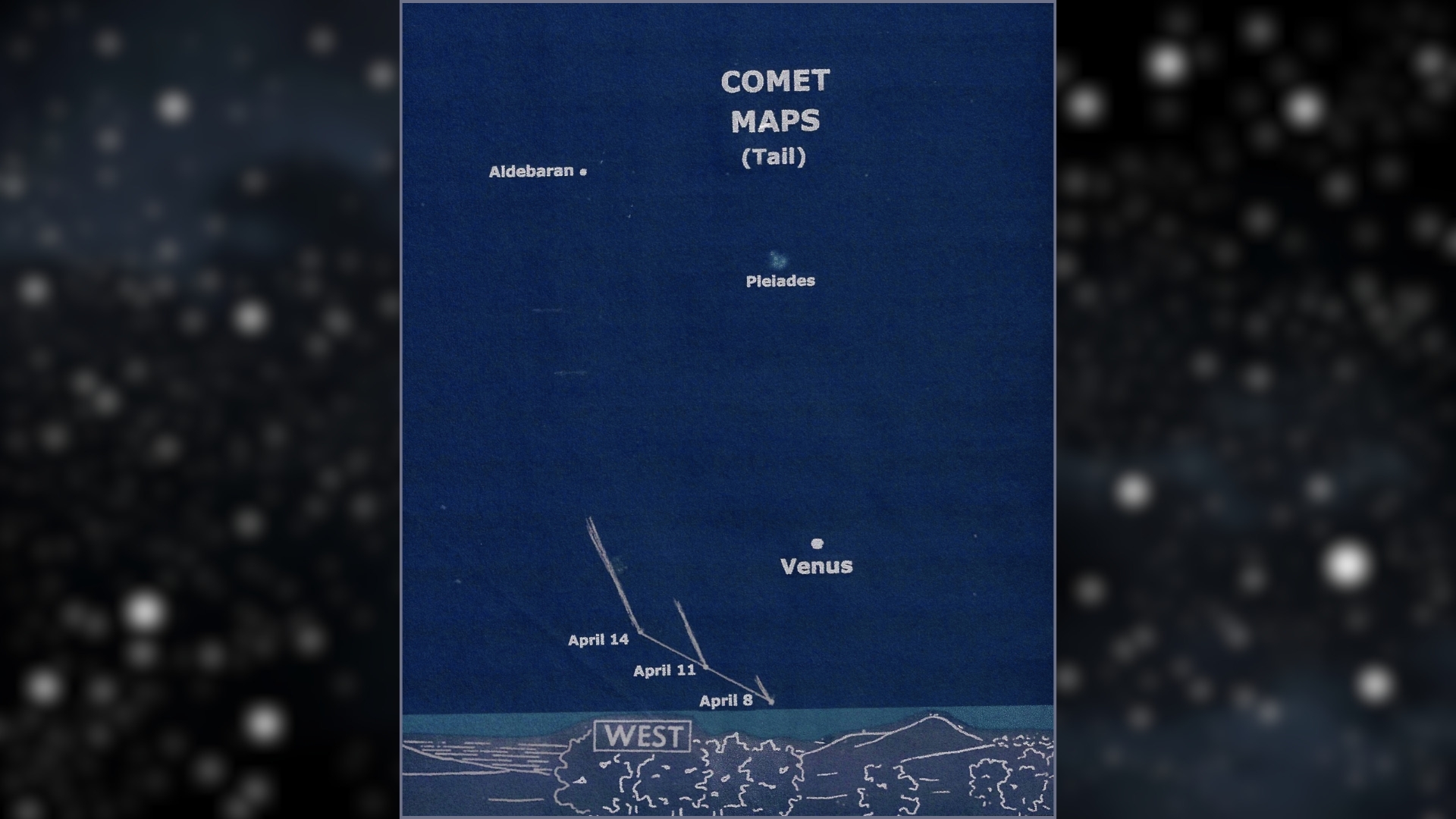
If Comet MAPS survives perihelion, it may be visible as a narrow dusty tail protruding from the western twilight sky during the second week of April. This map, drawn for an observer in latitude 40° north, about 45 minutes after sunset, shows the probable direction in the sky of the comet’s tail should one develop. Binoculars are recommended for locating it. (Image credit: Joe Rao)
Prospective comet watchers should keep watch of that part of the sky near the western horizon between 45 minutes and one hour after sunset during the April 8 to April 14 time frame. Sweeping the sky with binoculars could be beneficial in picking up the tail of Comet MAPS against the bright twilit sky glow. Of course, there is also a chance — albeit small — for a pleasant surprise, for comets tend to fickle and it seems that the only thing that is predictable about them is their unpredictability.
Or as renowned Canadian astronomer David Levy, himself a discoverer of 23 comets, has famously noted: “Comets are like cats: they have tails, and they do precisely what they want!”
We here at Space.com will continue to keep you posted on all the late-breaking developments regarding Comet MAPS, so stay tuned!
Joe Rao serves as an instructor and guest lecturer at New York’s Hayden Planetarium. He writes about astronomy for Natural History magazine, Sky and Telescope, The Old Farmer’s Almanac and other publications.